COVO KNOWLEDGE
AMADA-Style Press Brake Tooling: Interface Checks Before Ordering
Published:
Updated:
Check AMADA-style press brake tooling interfaces, tangs, retention, holders and installed height. Send matched drawings before ordering replacement tools.
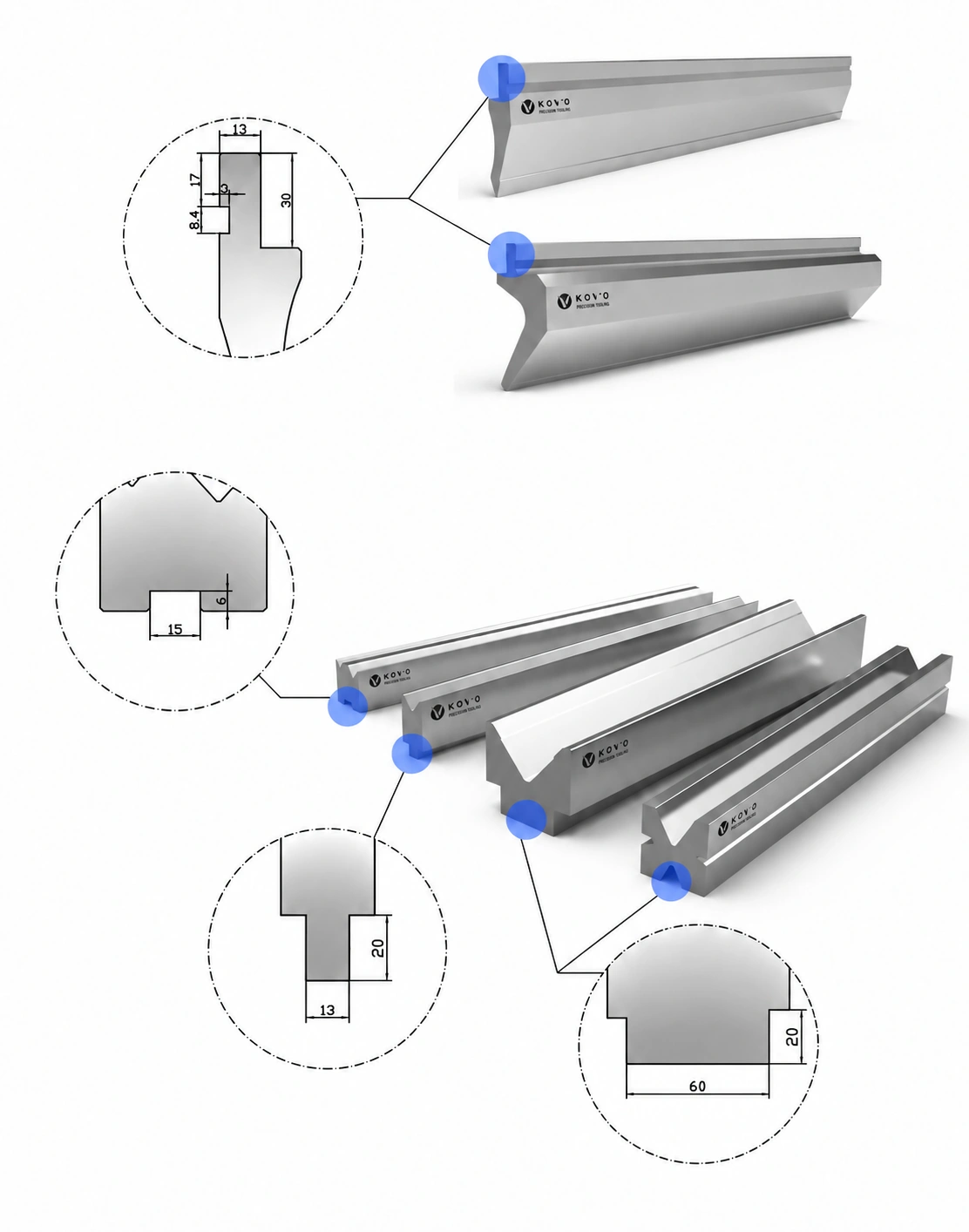
AMADA-style press brake tooling must match the installed upper holder and lower seat, not just the machine badge or punch profile. Before ordering, identify the actual tooling and clamp series, compare tang and seating drawings, confirm how retention works, and check the complete installed height and load path. A replacement can resemble the old tool yet fail to seat, clamp or clear the part. COVO Precision Tooling starts the review from the machine interface and finished part. The useful purchasing document names the proposed punch, die and holder and shows which compatibility checks remain open.
What AMADA-style press brake tooling means on the shop floor
AMADA-style press brake tooling is a purchasing description for punches and dies intended for a compatible mounting arrangement associated with that tooling family. The label does not specify every tang, safety groove, clamp, lower seat or installed height. Compatibility belongs to the documented combination of machine, holder and tools, not to the word “AMADA” by itself.
Record the machine model separately from the installed holder model. Identify upper and lower interfaces independently. Treat a working profile and its mounting interface as different specifications.
AMADA's tooling overview distinguishes Euro Style and AFH offerings and identifies particular punch holders. Its Japanese-market AFH page also states its market scope. These manufacturer descriptions support asking for the exact series and documentation; their dimensions, performance claims and holder compatibility do not establish COVO specifications.


What to check before you order a replacement
-
Identify what is actually installed. Record the machine model, holder maker and model, tooling references and any documented conversion. Photograph identification plates and the interface in the machine's prescribed safe condition. Reject an order based only on the machine badge or a copied catalogue family name; a changed holder can make an old machine record incomplete.
-
Compare the upper tang against a referenced drawing. Request the tang section, seating shoulder, clamp contact, centerline and intended orientation. Mark which surfaces establish position and carry load. Include the relevant safety groove, pin or other retention feature where fitted. Reject a single width measurement or a silhouette as proof that the complete interface matches.
-
Confirm insertion and retention with the holder supplier. Obtain the approved loading direction and the conditions for seating, clamping and retention of the proposed punch. A visible groove is not evidence that the installed mechanism engages it correctly. Reject any proposal that requires defeating retention, grinding a tang, or improvising a spacer to make the tool stay in place.
-
Check the lower interface separately. For an AMADA die holder enquiry, identify the actual holder, die base, locating reference, clamp and support arrangement. Check the alignment of the die opening with the punch in the complete assembly. Reject a die chosen only by its V-opening; the working opening does not describe how the die mounts or is supported.
-
Review installed height and the moving envelope. Combine the approved punch, die, holders and any adapter in one drawing. Check available opening, stroke, part entry, intermediate bends and withdrawal against the ram, holders and backgauge. Reject a height comparison that uses bare tools while omitting a holder or adapter. The bend sequence still needs its own clearance review.
-
Separate load estimation from interface approval. Provide material grade, actual thickness, bend length and bending method. The bending-force calculator provides a preliminary estimate under its stated assumptions; it cannot approve a tang, clamp or retention device. Compare the actual job with documented machine, punch, die, holder and loaded-section limits. Reject a decision based only on total machine capacity.
-
Agree the acceptance record before purchase. Specify drawing revisions, tool identities, section positions and inspection criteria. Plan installation using clean seating surfaces and the manufacturer's procedure, then a controlled first article and repeat-setup check. Reject production release if the received parts cannot be matched to the approved record or the released part fails its agreed dimensions and surface requirement.
Comparison of interface evidence for a replacement order
Use the same evidence headings for the existing assembly and the proposed replacement. A blank field is an unresolved question, not permission to assume equivalence.
| Evidence field | Record for the installed assembly | Require for the replacement | Reason to hold the order |
|---|---|---|---|
| Upper mounting | Holder identity, tang, shoulder and orientation | Referenced interface drawing | Matching profile but unknown seating reference |
| Retention and loading | Actual mechanism and approved insertion procedure | Written compatibility with that holder | Groove or pin engagement is unconfirmed |
| Lower mounting | Die base, locating seat, support and clamp | Matched base and holder drawing | V-opening matches but mounting is unspecified |
| Complete height | Tools, holders and adapters in one assembly | Installed geometry and movement review | A holder is omitted from the comparison |
| Load and acceptance | Job data, component limits and sample criteria | Documented limits and inspection plan | Only overall machine tonnage is supplied |
Consider a hypothetical replacement enquiry described as “Promecam press brake tooling for an AMADA machine.” A punch drawing is supplied, but the installed holder is unidentified and its retention detail is missing. The enquiry is incomplete even if the working profile resembles the existing punch. Ask for the holder record and a matched interface drawing before approving the order; this example establishes no interchangeability between named systems.
Mistakes that create scrap, marks or overload
- Treating a European punch tang label as a complete specification. A familiar name does not locate the seating shoulder, clamp contact or retention feature. Ask for the actual drawing and revision.
- Copying dimensions from a generic reference picture. A diagram can explain what to inspect without defining the customer's holder. Do not scale a photograph or infer an unshown tolerance.
- Treating an adapter as a minor accessory. It adds a loaded interface and changes installed geometry. Use the adapter review guide to frame the checks; it does not approve a specific stack.
- Releasing a clamp before supporting the tooling. Follow the prescribed safe state and change procedure. Support the tool and workpiece, keep hands out of pinch zones, and use the specified lifting equipment or planned two-person handling where required.
- Using a first bend to excuse missing documentation. A satisfactory sample does not prove retention or rated capacity. Resolve those limits before any controlled trial; inspect the released part before production.
When a standard tool is enough and when special tooling is justified
A standard candidate is suitable for review when its documented interface, profile, height and limits match the installed assembly and intended job. Start with the tooling family compatible with AMADA-style systems, then identify the exact proposed items. The clamping-systems guide explains the wider relationship between seating, retention and repeatability.
Consider special tooling when a documented part constraint cannot be served by an available standard profile or installed arrangement. Request a reviewed design; do not treat a custom profile as permission to alter the machine interface. Compare the complete assembly and production need before choosing an adapter or special tool.
COVO Precision Tooling is a Nanjing manufacturer of standard and custom press brake punches and dies compatible with AMADA-style, TRUMPF-style, WILA-style, LVD-style and BYSTRONIC-style systems. Exact compatibility remains a drawing and application review.
FAQ
Does an AMADA machine name identify every compatible tool?
No. Record the installed holder and tooling series as well as the machine model. A machine may have a documented conversion, and a catalogue family name does not describe the complete upper and lower mounting arrangement. Request written confirmation for the proposed tool, holder and application before approving the replacement order.
Is one tang-width measurement enough to order a punch?
No. Width alone leaves the seating shoulder, clamp contact, orientation and retention details unresolved. Provide a referenced tang drawing and identify the actual holder. Measurements should use defined datums and an agreed inspection method; a worn sample or an unscaled photograph should not become the replacement specification without engineering review.
Can a safety groove prove that the punch is retained correctly?
No. A groove must be assessed with the installed holder and its actual retention mechanism. Confirm the approved loading procedure and engagement requirements from the relevant manufacturer. Do not remove or bypass a feature to force a fit, and do not assume a successful bend proves that retention will work during a tool change.
Can the existing lower die stay when the punch is replaced?
Only after reviewing the proposed combination. Confirm the die base and holder, V-opening, profile, centerline, installed height and applicable load limits. The replacement punch must also suit the material, required bend and removal path. Keeping the same lower die does not remove the need for a documented setup and controlled first article.
What should be sent with a replacement-tooling enquiry?
Send the machine and holder identities, clear interface photographs and referenced upper and lower drawings. Include material grade, thickness, bend length, finished profile, required angle or radius, quantity and visible-surface requirement. List any adapter, existing sections to retain and known clearance constraints so the supplier can review the actual assembly.
Next step
Request an interface and tooling review with the machine model, clamp interface, holder identities and drawings, plus material, thickness, bend length, finished profile, required angle or radius, quantity and visible-surface requirement. Ask the supplier to return an itemized proposal with drawing revisions, confirmed interfaces and clearly listed unresolved checks before you release the order.
Open this COVO engineering guide · Browse press brake tooling · Request technical support