COVO KNOWLEDGE
Press Brake Die Load Ratings by V-Opening: Data From 517 Catalog Tools
Published:
Updated:
Maximum rated loads from 517 COVO punch and die pages, grouped by V-opening and system, with a planning check against required air-bending force. CSV download included.
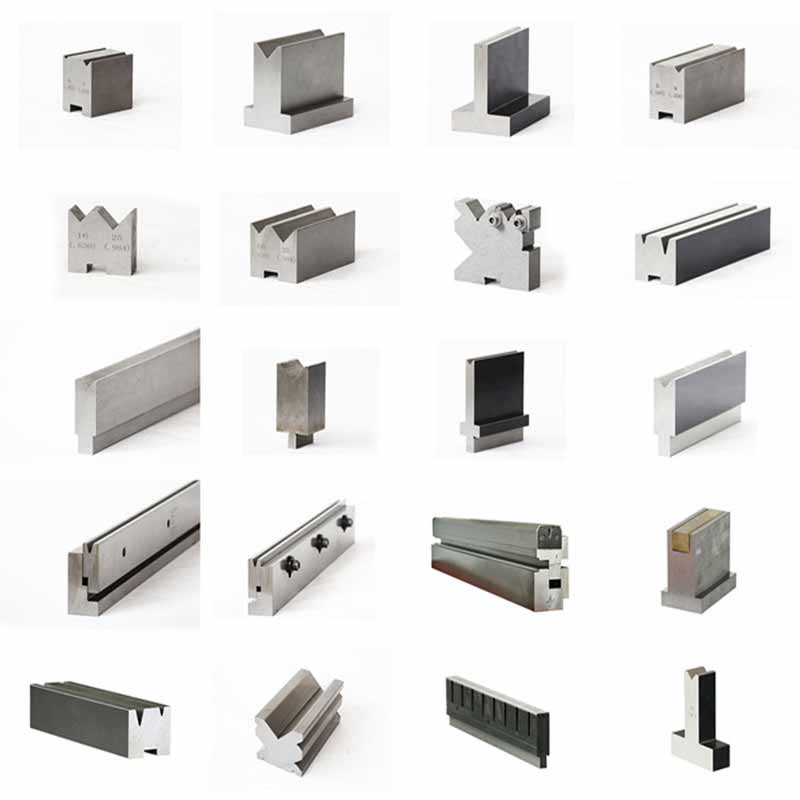
This page analyzes the maximum rated loads published on 517 COVO press brake tool pages: 314 dies and 203 punches. Across the catalog, the rated load rises with die opening: dies with a V-opening of 4–8 mm have a median rating of 350 kN/m, while dies with a V-opening of 70–200 mm have a median of 1,500 kN/m. Under the common V = 8 × thickness rule, mild steel air bending needs about 10.0 kN/m per millimeter of V-opening, so the safety margin between the required force and the lowest-rated die shrinks as the V-opening grows.
Key findings
- Coverage: 517 of 585 catalog products are punches or dies with a published rating in kN/m. 225 dies state a single V-opening; 18 multi-V dies state several.
- Ratings rise with V-opening: the median rating grows from 350 kN/m in the V 4–8 mm band to 1,500 kN/m in the V 70–200 mm band.
- Required force rises faster than the ratings: at V = 8 × thickness the required force grows in proportion to V, about 10.0 kN/m per millimeter for mild steel and 15.9 kN/m for stainless steel. From V 6 to V 100 mm the required force grows about 17×, while the median steel die rating grows about 3.8×.
- Where to check most carefully: for stainless steel at V = 8 × thickness, the lowest-rated steel system die has less than a 1.5× margin at V 12, 24, 25, 40, 50, 80, 100 mm, and less than the required force itself at V 80, 100 mm. Large-V work in stainless steel needs a deliberate rating check rather than a default die choice.
Die load ratings by V-opening
Dies with a single stated V-opening, all systems and constructions. Values are maximum rated loads in kN per meter of tool length.
| V-opening band | Dies | Lowest | Median | Highest |
|---|---|---|---|---|
| V 4–8 mm | 53 | 150 | 350 | 1,000 |
| V 9–12 mm | 50 | 200 | 500 | 1,000 |
| V 13–20 mm | 42 | 200 | 700 | 1,500 |
| V 22–32 mm | 32 | 500 | 1,000 | 1,700 |
| V 35–63 mm | 30 | 800 | 1,350 | 2,000 |
| V 70–200 mm | 18 | 1,000 | 1,500 | 3,400 |
The spread inside each band is wide because the band mixes single-V blocks, multi-station dies, mark-free dies and heavy-duty sections. A low value is not a defect: it tells you which tool needs a shorter loaded length or a larger V-opening for the job.
Ratings by tool type and system family
| Tool type | System family | Tools | Lowest | Median | Highest |
|---|---|---|---|---|---|
| Die | AMADA-style | 108 | 350 | 800 | 2,000 |
| Die | TRUMPF-style | 65 | 150 | 600 | 1,500 |
| Die | LVD-style | 54 | 210 | 725 | 3,400 |
| Die | WILA-style | 39 | 450 | 1,200 | 1,500 |
| Die | Mark-free | 29 | 200 | 700 | 2,500 |
| Die | BYSTRONIC-style | 14 | 350 | 500 | 1,000 |
| Die | Adjustable | 5 | 1,250 | 2,000 | 6,000 |
| Punch | AMADA-style | 70 | 120 | 700 | 1,600 |
| Punch | Radius (system not stated) | 34 | 800 | 800 | 800 |
| Punch | TRUMPF-style | 33 | 250 | 800 | 1,500 |
| Punch | WILA-style | 22 | 400 | 850 | 1,600 |
| Punch | BYSTRONIC-style | 20 | 600 | 1,000 | 1,600 |
| Punch | LVD-style | 15 | 400 | 450 | 1,200 |
| Punch | Multi-system | 9 | 1,000 | 1,000 | 1,000 |
"-style" means the tool is made for that documented clamping interface; it is not an original-equipment part. Radius punches whose page does not state a system are grouped separately. Mark-free and adjustable dies are shown as their own families because their construction differs from solid steel dies.
Planning check: required force versus catalog rating
The table compares the force needed for air bending at V = 8 × thickness with the ratings of steel system dies at the same V-opening (V-openings with at least five such dies). Required force uses the constants of the COVO bending force calculator: F = 0.065 × S² × L / V tonnes for mild steel, multiplied by 1.6 for stainless steel, converted to kN/m. Margin = lowest catalog rating ÷ required force; the COVO tooling workbench asks for at least 1.5×.
| V (mm) | Dies | Lowest rating | Median rating | Thickness at V = 8S (mm) | Mild steel need | Stainless need | Margin, mild | Margin, stainless |
|---|---|---|---|---|---|---|---|---|
| 6 | 21 | 170 | 400 | 0.75 | 60 | 96 | 2.8× | 1.8× |
| 8 | 21 | 200 | 400 | 1 | 80 | 127 | 2.5× | 1.6× |
| 10 | 21 | 250 | 500 | 1.25 | 100 | 159 | 2.5× | 1.6× |
| 12 | 21 | 250 | 500 | 1.5 | 120 | 191 | 2.1× | 1.3× ⚠ |
| 16 | 16 | 450 | 600 | 2 | 159 | 255 | 2.8× | 1.8× |
| 20 | 16 | 500 | 680 | 2.5 | 199 | 319 | 2.5× | 1.6× |
| 24 | 10 | 500 | 920 | 3 | 239 | 382 | 2.1× | 1.3× ⚠ |
| 25 | 8 | 500 | 800 | 3.13 | 249 | 398 | 2.0× | 1.3× ⚠ |
| 30 | 8 | 900 | 1,050 | 3.75 | 299 | 478 | 3.0× | 1.9× |
| 40 | 10 | 800 | 1,100 | 5 | 398 | 637 | 2.0× | 1.3× ⚠ |
| 50 | 10 | 900 | 1,175 | 6.25 | 498 | 797 | 1.8× | 1.1× ⚠ |
| 80 | 6 | 1,000 | 1,250 | 10 | 797 | 1,275 | 1.3× ⚠ | 0.8× ⚠ |
| 100 | 5 | 1,000 | 1,500 | 12.5 | 996 | 1,594 | 1.0× ⚠ | 0.6× ⚠ |
⚠ marks a margin below 1.5×. The required force scales with thickness squared, so the V-to-thickness ratio matters: bending thicker material in the same V (V = 6 × thickness) raises the force by about 78 %, while the V = 10 × or 12 × thickness often used for heavy plate lowers it by about 36 % or 56 %. Bottoming and coining need several times the air-bending force and are outside this comparison. Short parts concentrate the load: always convert kN/m to the force allowed over the length actually in contact.
How to use a kN/m rating
- Find the rating for the exact tool. Read it from the product page or drawing of the punch and of the die; use the lower of the two.
- Multiply by the loaded length. Allowed force (kN) = rating (kN/m) × length under load (m). Segmented tools are rated per meter too, but every section in the stack must carry its share.
- Compare with the required force. Estimate it with the bending force calculator using the real tensile strength from the material certificate, then keep at least a 1.5× margin.
- Check the rest of the stack. Holders, adapters, the machine's own limits and off-center loading can be more restrictive than the tool rating.
Method and limits
Source: every active product on chinacovo.com, read through the public catalog on 2026-10-28. Included: products tagged as punch or die whose specification states a numeric maximum load in kN/m (517 tools). Excluded: 42 forming tools and adapters, and 26 punches or dies without a published rating. The system family comes from the stated tooling system or compatible brand; the first system listed is used when several are named. Values are taken as published and have not been re-tested for this analysis.
The data will be refreshed when the catalog changes. Cite as: COVO Precision Tooling, "Press brake die load ratings by V-opening", catalog snapshot 2026-10-28, https://www.chinacovo.com/blog/press-brake-die-load-ratings-by-v-opening.
Download the data
Download the CSV (517 rows: product URL, model, tool type, system family, V-opening, angle, maximum rated load, snapshot date).
FAQ
What load rating do press brake dies typically have?
In COVO's catalog snapshot of 2026-10-28, dies with a V-opening of 4–8 mm have a median maximum rated load of 350 kN/m (range 150–1,000), while dies with a V-opening of 70–200 mm have a median of 1,500 kN/m (range 1,000–3,400). Always use the rating published for the exact tool, not a typical value.
What does a load rating in kN/m mean?
It is the maximum force the tool may carry per meter of loaded tool length. Multiply it by the length actually under load to get the allowed force for that setup. A 1,000 kN/m die loaded over 0.5 m may carry 500 kN, not the full press capacity.
How much force does air bending need per millimeter of V-opening?
With the constants used by the COVO bending force calculator and the common rule V = 8 × thickness, mild steel needs about 10.0 kN/m for every millimeter of V-opening, and stainless steel about 15.9 kN/m. These are preliminary planning values; confirm them with the material certificate and a test bend.
Can I download the COVO load-rating data?
Yes. The CSV at https://www.chinacovo.com/data/covo-press-brake-tool-load-ratings.csv lists every tool in this analysis with its product page, model, system family, V-opening, angle and published maximum rated load.
Next step
Send the part, material, thickness, bend length and machine and COVO will propose a punch and die whose published rating covers the job, or explain which limit needs a different setup.
Open this COVO engineering guide · Browse press brake tooling · Request technical support