COVO KNOWLEDGE
Press Brake Louver Tools: Key Drawing and Clearance Checks
Published:
Updated:
Choose press brake louver tools with clear drawings for lance length, rise, spacing and clearance. Prepare the material and machine details for review.
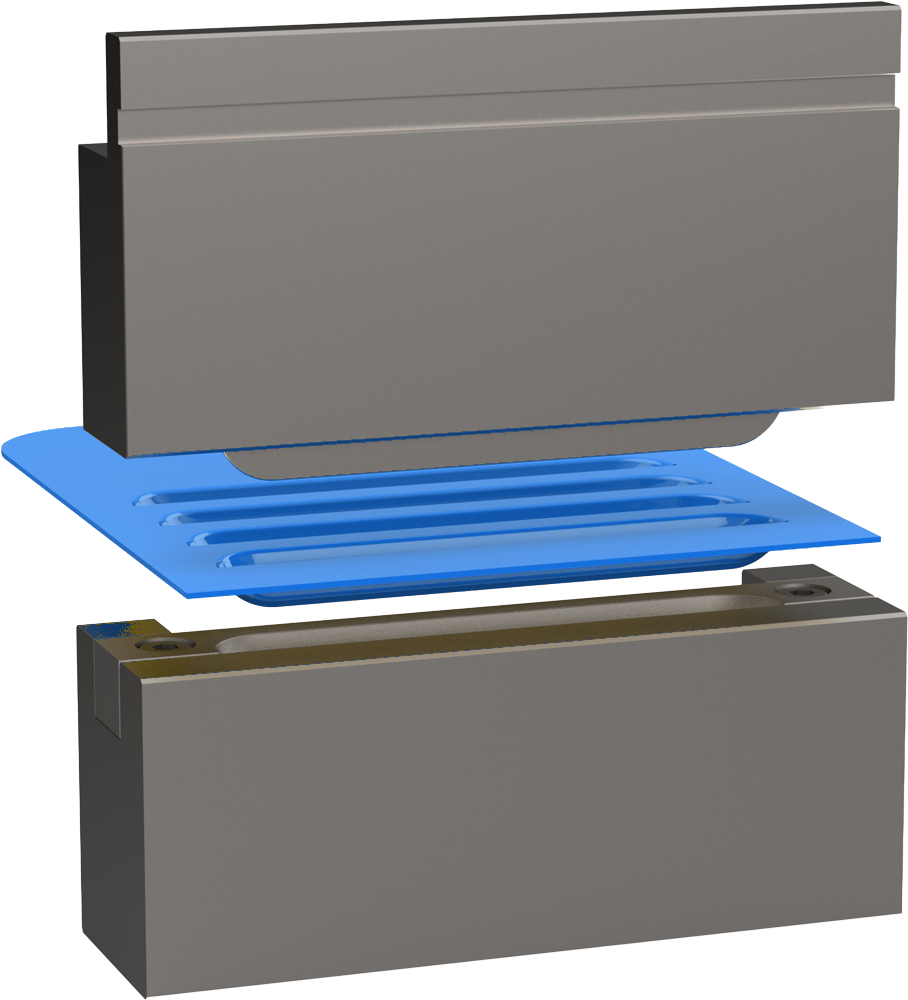
Press brake louver tools should be selected from a finished vent drawing, the actual sheet specification and the complete machine setup. Show the lance length, raised profile, opening direction, spacing and tolerances before asking a supplier to design the punch and die. Then check how the panel is supported, formed and released without striking adjacent vents or return flanges. COVO Precision Tooling uses the finished part and machine interface as the starting point for a tooling review. A photograph of a similar vent helps explain the request, but it cannot replace a referenced section and layout drawing.
What press brake louver tools mean on the shop floor
Press brake louver tools are matched forming tools used to create raised ventilation openings in sheet metal on a press brake. The approved process defines whether cutting and forming occur together or in separate operations. A louver punch and die must control the specified profile while allowing the sheet to be supported, positioned and removed.
Treat the cut line, raised shape and free opening as separate drawing features. Identify the viewing direction and reference face. A louver forming tool is a dedicated profile tool; an ordinary V-die selection does not define the vent geometry.
Manufacturer references illustrate why the route needs review. UKB's louver-tool page shows designs with and without a hold-down. Mate's Technical Solutions Guide, in its louver section, discusses combined cutting and forming and cases needing a separate preliminary cut. Mate's guidance concerns punch presses. Neither source establishes COVO specifications or approves a press-brake setup.


What to check before you choose a louver tool
-
Define the finished section and its datum. Mark lance length, rise above the reference face, required opening, end shape and critical radii. State whether a height is measured from the sheet surface or another datum, and show tolerances on the released part. Reject an enquiry containing only a top-view slot outline; it leaves the forming profile unresolved.
-
Dimension the complete row layout. Distinguish center-to-center pitch from clear material between adjacent features. Locate the first vent from a stable datum and show nearby holes, edges and bend lines. Identify how many vents are intended in each stroke. Reject a repeated pattern whose pitch is known but whose end clearance and tool-body space are missing.
-
Specify the actual sheet condition. Provide material grade, thickness range, temper where applicable, coating, grain direction if controlled and the visible face. Sheet metal louver forming must be reviewed for the supplied material rather than a generic label such as “metal.” Reject substitutions that change the approved material or thickness without reviewing formability, finish and load again.
-
Agree the cutting, support and release arrangement. Ask the supplier to state whether the proposed tool cuts and forms together or requires a prepared opening. Review support, hold-down travel, stripping and the space occupied by already formed vents. Reject a proposal with no documented release path, or one that assumes a pre-cut blank and a solid blank are interchangeable.
-
Check the installed envelope and sequence. Include machine model, upper and lower mounting interfaces, holders, tool height, daylight, stroke and backgauge position. Review the panel through louver forming, perimeter bending and removal against the punch, die, ram and fixtures. Reject any sequence that clears the flat blank but traps the finished panel. Geometry and operation order require separate approval.
-
Obtain a process-specific load review. Request the supplier's documented requirements for cutting, forming, hold-down and stripping, including the intended number of features per stroke. Compare the applicable load cases with the machine, holders and tools. Reject approval based only on machine tonnage or an air-bending calculation; neither establishes the allowable loading of this dedicated assembly.
-
Define first-article acceptance. Agree how to measure released height, opening, pitch and panel flatness, and how to inspect burrs, cracks and coating damage. Prepare clean seating surfaces, install and clamp the tools using the approved procedure, and retain a controlled first-piece record. Reject production release if tool identity, drawing revision or inspection results do not match the approved setup.
For panels with perimeter returns, the box-height calculator can support an initial discussion of the associated bending setup. It does not model raised vents, the louver tool body, hold-down, forming load or full removal path. Use the complete assembly drawing for those checks. The broader press brake forming guide explains how profile geometry and sequence fit together.
Comparison of incomplete and reviewable louver drawings
This table is a drawing-review checklist, not a customer case or a set of approved dimensions. Record unresolved fields explicitly so that the quotation does not silently turn an assumption into a tool specification.
| Drawing field | Incomplete request | Reviewable evidence |
|---|---|---|
| Vent section | “Raise this slot” | Section showing cut line, rise, opening, ends and datum |
| Row spacing | One repeated pitch | Pitch, feature envelope, edge distances and nearby geometry |
| Material | “Steel panel” | Grade, thickness range, condition and surface requirement |
| Process route | Assumed single stroke | Agreed cutting/forming route and features per stroke |
| Clearance | Flat blank only | Intermediate shapes, support, tool assembly and removal path |
| Acceptance | “Same as sample” | Referenced drawing, tolerances and released-part inspection plan |
For example, a hypothetical cabinet drawing may show vent length and pitch but omit a section. The supplier still cannot identify the required rise, free opening or direction. Adding a section resolves the geometry question; it does not resolve clearance after the cabinet returns are bent. Review both documents before releasing the tool. Use the press brake drawing guide to organize views and datums.
Mistakes that create scrap, marks or overload
- Using pitch as proof of clearance. Adjacent vents, support faces and the tool body occupy space outside a cut line. Check the formed geometry and movement, not just the flat pattern.
- Increasing depth to chase an unspecified opening. An unapproved adjustment can overload the assembly or damage the panel. Stop and compare the drawing, setup and approved process limits before changing the setting.
- Choosing the bend order from habit. Forming vents before or after perimeter bends changes handling and access. Review the actual part; no single order suits every panel.
- Reaching into the tooling to free a caught panel. Cutting edges and spring-loaded components create hazards. Stop the machine and follow its isolation and recovery procedure; do not bypass guarding or retention to continue production.
When a standard tool is enough — and when a special tool is justified
An existing louver profile may be suitable when its documented geometry, material range, interface and working envelope meet the drawing. Ask for those records before reusing a tool. Standard punches and V-dies may still form separate perimeter bends, but they do not replace a matched vent-forming assembly.
A custom design is justified when the required section, end form, spacing, surface requirement or clearance cannot be met by an existing louver tool. Review the louver-tool family, special forming options and forming-tool system as starting points for that discussion.
COVO Precision Tooling is a Nanjing manufacturer of standard and custom press brake punches and dies compatible with AMADA-style, TRUMPF-style, WILA-style, LVD-style and BYSTRONIC-style systems. The exact proposed mounting arrangement still needs confirmation for the installed machine and holders.
FAQ
Does a louver tool always need a pre-cut slot?
No. The required blank preparation belongs to the approved tool design and process. Some designs combine cutting and forming, while other applications use a separate preliminary cut. Ask the supplier to identify the route for the actual material and geometry. Do not modify the blank preparation because a different tool's demonstration looks similar.
What is the difference between louver rise and opening?
Rise describes the formed feature's height from a stated datum. Opening describes the free passage at the vent and needs its own definition on the drawing. A height alone does not fully specify that passage or guarantee airflow. Show the section, reference face, measurement direction and acceptance criteria for the released panel.
Can one louver tool process different sheet materials?
Only within the reviewed design and documented application limits. Material grade, thickness, temper and coating can affect the forming result, required load and visible finish. Provide the actual sheet specification and representative samples when requested. A supplier's approval for one material does not automatically approve a substitution or a thicker sheet.
Should louvers be formed before the panel's perimeter bends?
Choose the order by reviewing the actual intermediate shapes, locating surfaces, supports and removal path. Flat-sheet access may favor one sequence, while later operations may interfere with formed vents. Check both the louver operation and the perimeter bends. Confirm the sequence with the responsible engineer before a controlled first article.
What information makes a louver-tool quotation reviewable?
Send a dimensioned section and layout, machine model and clamp interface, material grade, thickness, bend length, finished profile, required angles or radii, quantity and visible-surface requirement. Add vent orientation, pitch, neighboring geometry and inspection criteria. Identify missing information clearly so the supplier can return an itemized proposal with unresolved checks stated.
Next step
Request a louver-tool drawing review with the machine and clamp details, material, thickness, bend length, finished profile, angle or radius, quantity and visible-face requirement. Include the vent section, row layout and proposed sequence. Ask for confirmed geometry, application limits and an inspection plan before releasing an order.
Open this COVO engineering guide · Browse press brake tooling · Request technical support