COVO KNOWLEDGE
Steel Grades for Press Brake Bending: Carbon Steel, Stainless Steel and Weathering Steel
Published:
Last reviewed:
Compare carbon steel, AISI 304, 316, 430 and weathering steel for press-brake force, springback, bend radius, surface protection and tooling selection.
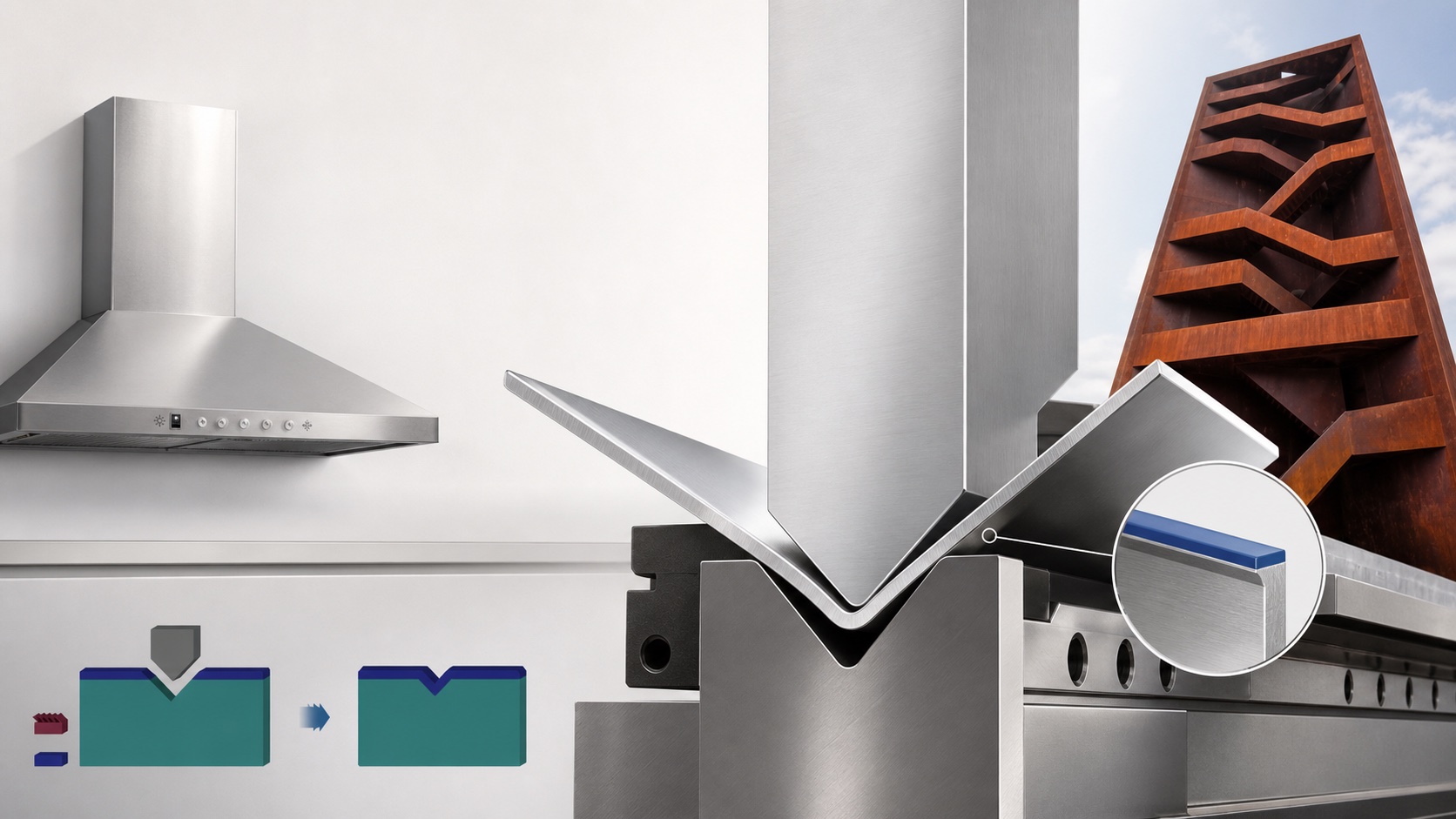
The steel grade changes press-brake force, springback, minimum bend radius, surface-marking risk and corrosion performance. Carbon steel, AISI 304, AISI 316, AISI 430 and weathering steel should therefore never share one unverified setup simply because their sheets have the same thickness.
This guide turns the complete material logic of the referenced Notes on Steels chapter into a production decision process. It explains what carbon and alloying elements do, why stainless steel can protect itself through passivation, how common stainless grades differ, and what the material certificate must contribute before a punch and die are selected.


What is steel, and why is it not simply iron?
Steel is an iron-based alloy in which carbon and other elements control strength, ductility, hardenability, corrosion behaviour and response to manufacturing. The boundary between steel and cast iron is commonly placed near 2.1 percent carbon by mass, although commercial sheet steels used on press brakes contain far less. Referring to a fabricated steel part as “iron” hides the chemistry and mechanical condition that the bending process actually sees.
Carbon obstructs dislocation movement in the metal lattice and can increase hardness and strength. That statement is useful, but carbon percentage alone does not predict a bend. Grain size, phase balance, alloy additions, rolling history, heat treatment and cold work also shape the stress-strain response. Modern purchasing specifications therefore use standardized grade designations and guaranteed properties, not informal labels such as “mild” or “hard” steel.
The chapter's historical carbon-content bands remain a helpful orientation: extra-mild and mild steels sit at the low-carbon end, while semi-hard through extra-hard classes contain progressively more carbon. They are not a substitute for EN, ASTM, JIS or another applicable material standard. For press-brake planning, record the full designation, thickness tolerance, delivery condition and heat or coil identity.
How does steel microstructure affect bending?
It is too simple to describe every steel as one body-centred-cubic structure. Ferrite is body-centred cubic, austenite is face-centred cubic, and martensite is commonly described as body-centred tetragonal; real steels may contain one or several phases. This distinction helps explain why an annealed austenitic stainless steel can be highly formable while a ferritic or hardened grade behaves differently at the same nominal thickness.
The press brake does not need a metallography laboratory at setup, but engineering needs to know what the structure means in practice: available elongation, strain hardening, anisotropy, crack sensitivity and springback. Those behaviours determine whether a standard 90-degree punch, a larger-radius tool, a wider V-die or a staged forming method is appropriate.
Carbon steel versus alloy steel
| Material family | Defining idea | Press-brake implications | Data to confirm |
|---|---|---|---|
| Low-carbon forming steel | Iron-carbon base with chemistry and processing aimed at useful ductility. | Often the shop baseline, but force and springback still vary by grade and condition. | Yield and tensile strength, elongation, actual thickness and grain direction. |
| High-strength or micro-alloyed steel | Alloying and processing raise strength without requiring high carbon. | Higher force and springback; minimum radius and tool load need explicit checks. | Grade-specific bending recommendation and certified mechanical properties. |
| Stainless steel | At least 10.5 percent chromium creates a protective passive surface film. | Work hardening, springback, galling and visible-finish protection are central. | Stainless family, grade, temper, finish, strength and corrosion environment. |
| Weathering steel | Low-alloy chemistry supports a dense patina under suitable exposure. | Bend from its certified strength and forming data; preserve intentional surface appearance. | Exact weathering grade, thickness, mechanical properties and exposure design. |
A grade such as S235 or an ASTM forming steel may be easier to bend than a stainless or high-strength grade, but “carbon steel” is not one mechanical property. Use the COVO bending-force calculator only after entering values that represent the selected material and job. The result is a planning estimate; the tool rating and press-brake capacity remain hard limits.
Why is stainless steel corrosion-resistant?
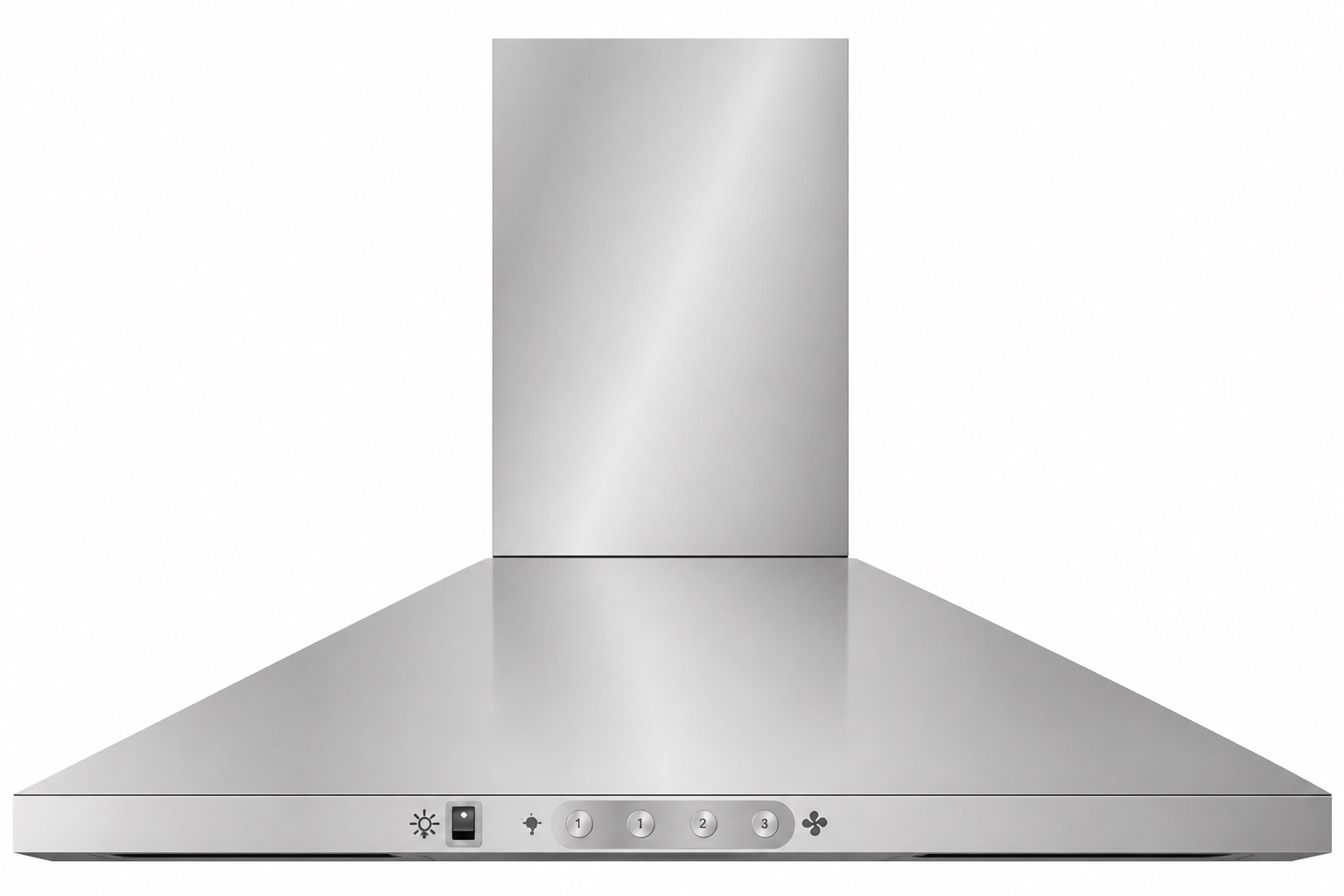
Stainless steel contains enough chromium to form an extremely thin, adherent and chromium-rich oxide film. World Stainless describes a minimum of 10.5 percent chromium and a passive layer only a few nanometres thick. The film separates the bulk metal from the environment and can reform when a clean damaged surface is exposed to sufficient oxygen and moisture.
“Self-repairing” does not mean immune to every environment. Chlorides, crevices, poor drainage, heat tint and embedded carbon-steel contamination can defeat local protection. After bending, keep stainless work separate from rusty tools and carbon-steel grinding debris, use clean handling equipment, and specify pickling, passivation or another approved finish treatment when the service condition requires it.
What happens to the passive film during press-brake bending?
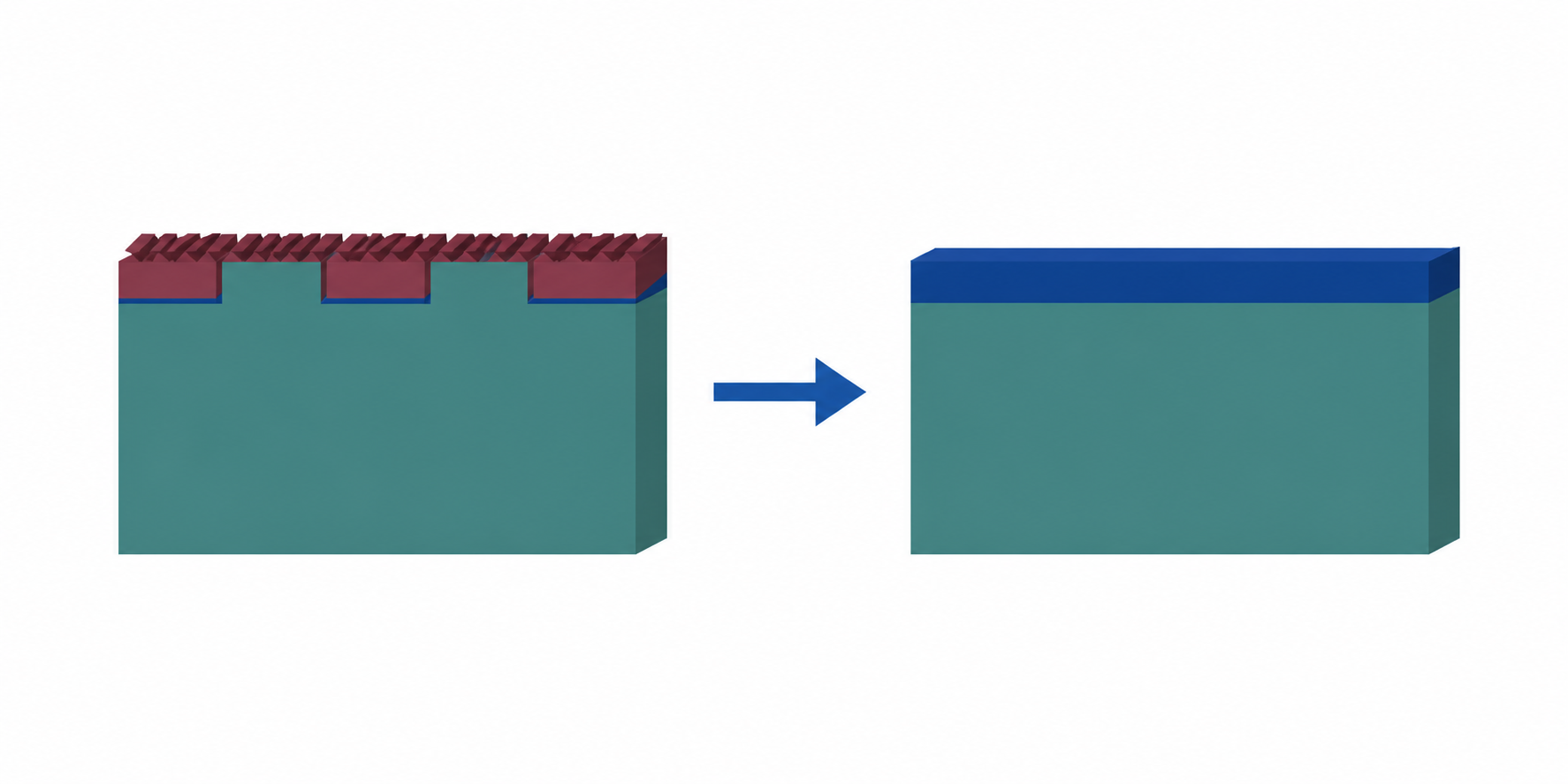
The outside of a bend stretches, the inside compresses and the sheet slides over the die shoulders during air bending. At a microscopic level the existing surface film is disrupted as fresh metal is exposed. On a clean stainless surface, chromium reacts with oxygen to re-establish protection. The regenerated film is invisible; a blue line in the illustration is a teaching device, not its physical colour or scale.
Surface damage can still be visible even when the passive film reforms. A polished or decorative sheet may pick up shoulder marks, adhesive residue or transferred metal. Use clean polished tools, suitable protective film and, where appropriate, COVO mark-free bending solutions. Do not add a soft insert without checking angle control, allowable pressure and the finished radius.
AISI 304, 316 and 430: what changes at the press brake?
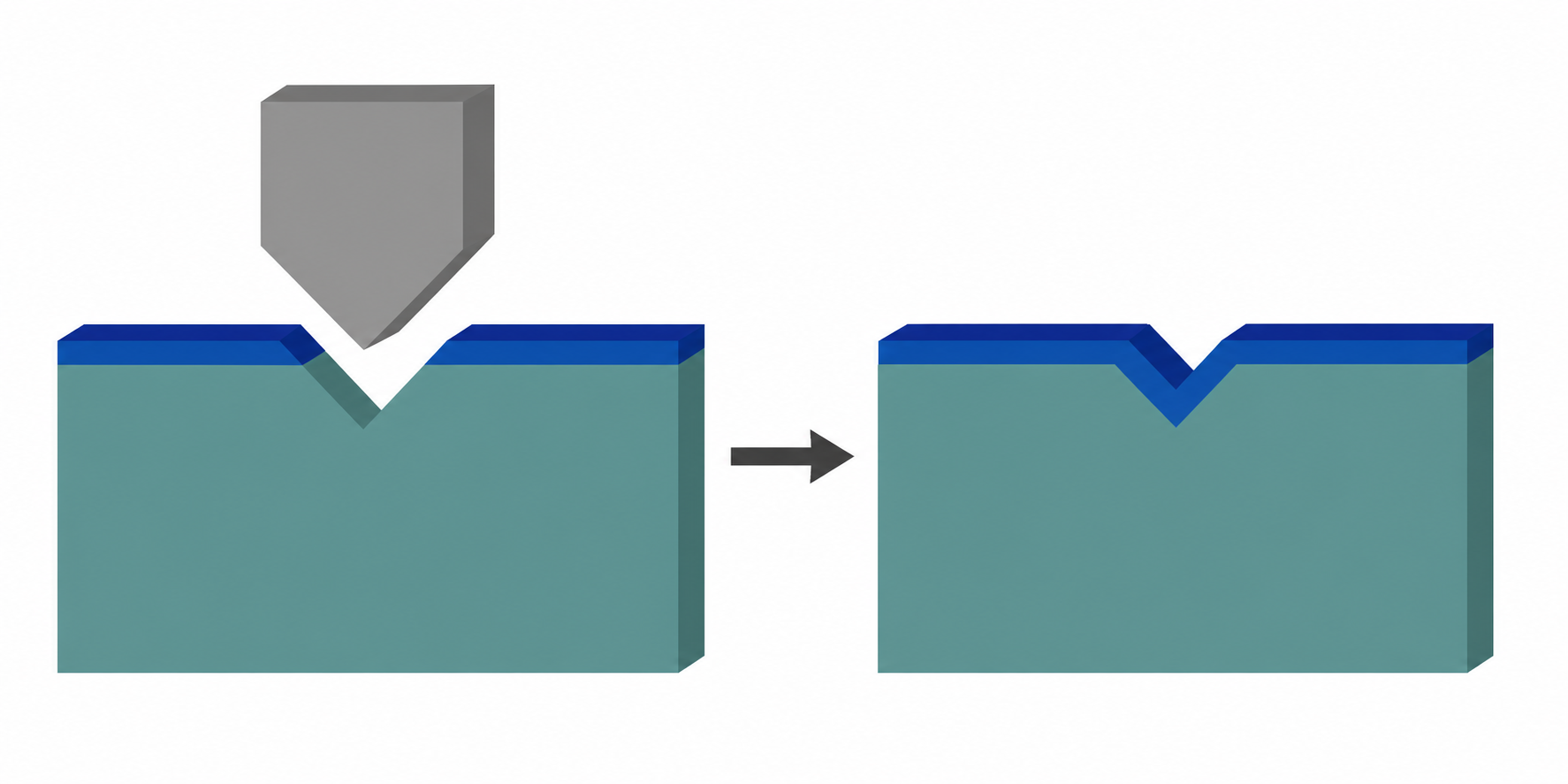
The values below are representative typical compositions from current producer data, not purchase limits. Always use the applicable standard and the material certificate for the delivered sheet.
| Common grade | Representative composition | Structure and magnetism | Bending notes |
|---|---|---|---|
| AISI 304 / EN 1.4301 | About 18.1% Cr, 8.1% Ni and 0.04% C | Austenitic; normally non-magnetic when annealed, although cold work can create some magnetic response. | Excellent formability, noticeable work hardening and springback; protect visible surfaces. |
| AISI 316 / EN 1.4401 | About 17.2% Cr, 10.1% Ni, 2.1% Mo and 0.04% C | Austenitic; normally non-magnetic when annealed. | Molybdenum improves resistance in many chloride-bearing environments; calculate and test from the delivered condition. |
| AISI 430 / EN 1.4016 | About 16.2% Cr and 0.05% C, without intentional nickel addition | Ferritic and magnetic. | Different ductility and anisotropy from 304/316; review grain direction, edge condition and minimum radius carefully. |
The 0.05 percent typical carbon value for 430 is important: a much larger figure sometimes repeated in secondary material is not representative of modern EN 1.4016 sheet data. This is why COVO checks current producer or standard information before turning a general materials note into a tooling decision.
AISI 304: the general-purpose austenitic reference
Type 304 is widely used for equipment, enclosures, food-service components and architectural sheet. Its combination of ductility and corrosion resistance supports complex shapes, but its strain hardening means the bend load rises as deformation proceeds. Expect more elastic recovery than with a typical low-carbon forming steel and avoid repeatedly reworking the same bend without a defined process.
AISI 316: corrosion performance for more demanding exposure
Type 316 adds molybdenum and is selected when the environment calls for more resistance than 304 can provide, particularly in many chloride-bearing and chemical applications. The corrosion decision belongs to the designer or materials specialist. At the press brake, store a separate bend record for 316 rather than copying 304 depth and springback corrections by name.
AISI 430: ferritic, magnetic and process-sensitive
Type 430 is a chromium ferritic stainless used in appliances, trim and other applications. It is magnetic and can be a practical nickel-free choice, but it does not behave like austenitic 304. Verify bend direction relative to rolling direction, edge quality, radius and elongation. Clean, smooth die shoulders also reduce pickup and visible scoring.
Why do stainless parts spring back and mark?
Springback is elastic recovery after the load is removed. It increases with the relationship between strength, elastic modulus, radius and thickness, and it changes with temper and rolling direction. Austenitic stainless also work-hardens significantly in the bend zone. Use the COVO springback and K-factor guide to separate angle compensation from flat-pattern development.
Galling and die lines come from concentrated pressure, sliding and material transfer at contact surfaces. Start with clean tooling and sheet, inspect the die shoulders, control lubrication for the specified finish and use protective film only when compatible with the process. A larger die opening may reduce pressure and tonnage, but it also changes minimum flange and naturally formed radius. The radius air-bending calculator helps document that trade-off.
What is weathering steel?
Weathering steel is a low-alloy steel family containing controlled additions such as copper, chromium, nickel and phosphorus, depending on the grade. Under alternating wet and dry exposure, its surface can develop a dense oxide layer, or patina, that slows further corrosion. COR-TEN is a registered product name; weathering steel is the generic material description.

The patina is not ordinary loose rust and it does not develop correctly everywhere. SSAB specifies alternating wet and dry cycles for COR-TEN products. Constant dampness, retained water and aggressive chloride exposure can prevent stable protection. Fabricated details need drainage and ventilation, while runoff staining and early colour change should be considered in the design.
For bending, weathering steel is not assigned a universal force factor. Read the exact grade's certified strength, elongation and recommended minimum radius. Protect the intended surface from oil, deep scratches and mixed-metal contamination if the final appearance is part of the specification.
Press-brake setup checklist by material
- Identify: record standard, full grade, delivery condition, heat or coil number, finish and coating or film.
- Measure: confirm actual thickness, bend length, grain direction and critical visible face.
- Calculate: estimate force, inside radius and minimum flange from the real material values and selected V-opening.
- Select tooling: verify punch radius, die shoulder condition, working height, interface and rated linear load.
- Control the surface: separate stainless from carbon-steel debris and define cleaning, film, lubrication or mark-free protection.
- Trial: bend a production-material coupon and measure released angle, inside radius, flange position and surface condition.
- Correct one variable: distinguish depth/springback changes from radius, gauge, tool or material problems.
- Record: save the approved material batch, tools, program corrections and inspection result for repeat work.
Which steel should you choose for a bent part?
| Primary requirement | Material direction to evaluate | Do not skip |
|---|---|---|
| Economical general fabrication | Specified low-carbon or structural/forming steel | Strength class, weldability, coating and actual bend radius. |
| General corrosion resistance and complex forming | Austenitic 304 family | Service environment, springback and visible-finish protection. |
| More demanding chloride or chemical exposure | 316 family or another engineered corrosion-resistant grade | Materials-specialist approval; 316 is not immune to every chloride condition. |
| Magnetic ferritic stainless application | 430 family where its corrosion and forming limits fit | Grain direction, edge condition and minimum bend radius. |
| Exposed patinated architectural surface | Specified weathering-steel grade | Wet/dry exposure, drainage, runoff and certified forming data. |
No table can release a safety-critical material substitution. The drawing, applicable code and qualified materials authority control the grade. COVO's role is to match the approved material and geometry with a compatible press-brake tooling and validation plan.
Frequently asked questions
Is stainless steel harder to bend than mild steel?
Usually, but the correct comparison depends on the specified grades and delivery conditions. Austenitic stainless steels commonly need more force, show more springback and work-harden more strongly than a typical low-carbon forming steel. Calculate from certified mechanical properties and verify the actual punch, die and machine limits instead of applying one universal multiplier.
What is the practical difference between AISI 304 and 316 when press-brake bending?
Both are ductile austenitic stainless steels. Type 316 adds molybdenum for improved resistance in many chloride-bearing and chemical environments, while its exact bending force and springback still depend on thickness, temper and mill data. Treat 304 and 316 as separate material records and validate each setup with production stock.
Is AISI 430 stainless steel magnetic?
Yes. AISI 430 is a ferritic stainless steel and is normally magnetic. It has no intentional nickel addition in the standard 16 to 18 percent chromium family, and its forming limits differ from austenitic 304 or 316, so bend radius and grain direction need specific review.
Why does stainless steel gall or mark during bending?
High contact pressure and sliding at the die shoulders can transfer or pick up material, especially when surfaces are rough, contaminated or poorly lubricated for the application. Clean and polished contact areas, suitable protective film, controlled lubrication and mark-free tooling can reduce risk without changing the required geometry.
Does bending permanently destroy the passive layer on stainless steel?
A clean stainless surface can regenerate its chromium-rich passive film when oxygen is available. However, embedded carbon-steel contamination, heat tint, iron transfer and trapped process residues can compromise corrosion performance, so fabrication cleanliness and appropriate post-fabrication treatment still matter.
Is weathering steel rustproof?
No. Weathering steel is designed to develop a dense protective patina that slows further corrosion under suitable alternating wet and dry exposure. Constant dampness, trapped water, marine chlorides or unsuitable detailing can prevent a stable patina, so the environment and drainage must be evaluated for the real application.
Technical references
- World Steel Association: What is steel?
- worldstainless: The Stainless Steel Family
- worldstainless: corrosion and passive-film properties
- Outokumpu: stainless grades, properties and standards
- SSAB: how COR-TEN weathering-steel patina develops
Reference note: composition values in this article are representative typical producer values, not guaranteed limits. Standards, mill certificates and application-specific engineering requirements take precedence.
Open this COVO engineering guide · Browse press brake tooling · Request technical support