COVO KNOWLEDGE
Sectional Press Brake Tooling: Split Sets and Box Clearance
Published:
Updated:
Compare sectional press brake tooling for changing bend lengths and box clearance. Check segment fit, clamping and loads before requesting tool review.
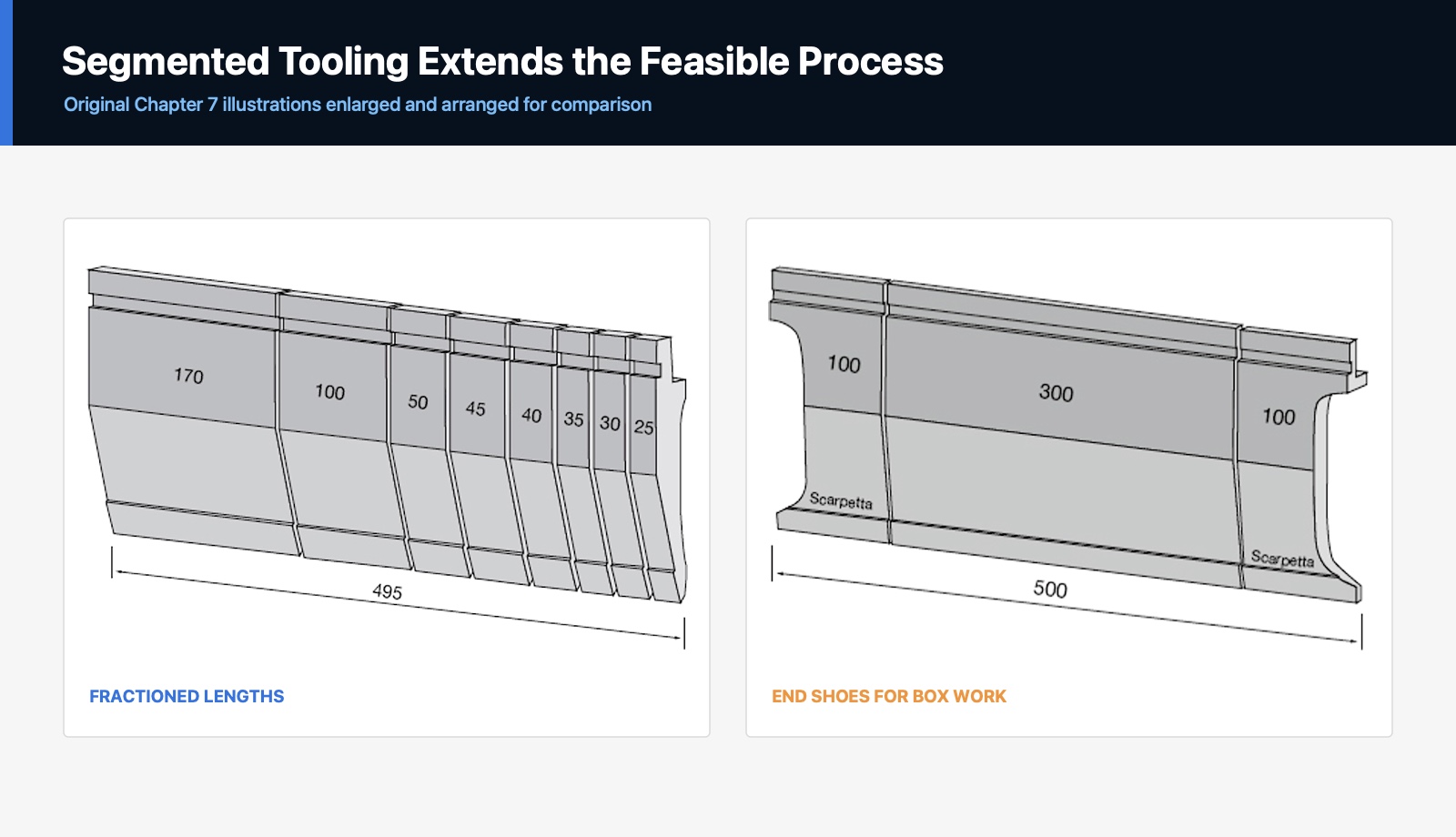
Sectional press brake tooling lets you assemble a working length from separate punch and die sections instead of using one continuous tool. It is useful when bend lengths change or box walls restrict access, but segmentation alone does not provide the required clearance. Choose the section combination from the finished part and each intermediate bend, then verify profile, height, clamping and local load limits. COVO Precision Tooling reviews those inputs before recommending a set. The buying decision is whether the proposed pieces can form, support and release your actual parts through a repeatable setup, not simply whether their lengths add up.
What sectional press brake tooling means on the shop floor
Sectional press brake tooling consists of separate punch sections or die sections assembled to create a selected working length. Each piece must belong to a combination suitable for the required profile, installed height, clamping interface and load. Segmentation changes the length arrangement; it does not establish box clearance, tool compatibility or safe operating capacity by itself.
“Split set” describes the supplied collection, while “assembled length” describes the pieces installed for a particular operation. A set's total length may therefore differ from the working length you need for one part.
WILA's tool-length guidance relates length selection to both the bend line and the freedom needed around other bends. Its listed segment sizes belong to its own tooling systems; request the actual section list for the set being quoted.


What to check before you choose the section combination
-
Map the part family before counting pieces. Record bend lengths, inside wall spacing, maximum box height and return positions for the intended jobs. Add the intermediate profiles after earlier bends. Reject a quote based only on machine width if it does not explain which section combinations serve the actual parts.
-
Confirm a matched profile and installed height. Check punch shape and tip, die V-opening and shoulders, seating references and working height against the proposed drawings. Ask whether existing pieces may be combined with new ones. Reject a visual match or a shared profile name as the sole evidence of interchangeability.
-
Verify the holder can secure every section. Identify the machine model, clamp interface, insertion method and retention features, including any restrictions on short pieces. Clean and inspect seating surfaces before installation under the machine's approved procedure. Reject a section that cannot be seated, supported and clamped as its manufacturer specifies.
-
Review contact length and load together. Identify which sections actually carry the bend and compare the required load with the applicable machine, punch, die and holder limits. A short loaded section cannot borrow the rating of unused tooling elsewhere on the bed. Reject any approval based only on total machine tonnage.
-
Check the complete box movement. Review entry, forming, springback and withdrawal against the punch, die, holder, ram and backgauge. The box-height calculator supports a preliminary height discussion; it does not select section lengths or clear a three-dimensional collision. Reject a layout that works only in the final section view. WILA's box-bending guidance also identifies holder geometry and springback as relevant inputs.
-
Define the first-article and repeat-setup record. Number the installed pieces and record their order, orientation, seating, gauge reference and loaded length. Inspect the released angle, straightness and visible face, including any marks associated with joints. Reject production release if the setup or sample cannot be checked against the agreed drawing and acceptance criteria.
Comparison of set layouts and purchase evidence
Use this table to compare proposals for the same part family. The useful comparison is the work each arrangement can perform and the evidence needed to accept it.
| Job requirement | Arrangement to review | Evidence to request | Reason to reject |
|---|---|---|---|
| Repeated straight bends at one working length | A continuous tool or a repeatable assembled length | Support, load and first-article checks | A length match with unsuitable profile or load capacity |
| Frequent changes between shorter bends | A section set covering the required combinations | Itemized lengths, quantities and a layout for each job | Missing pieces force an unapproved gap or unsupported contact |
| Box walls near the punch ends | A reviewed combination with suitable end geometry | Entry, forming and removal views | An end or holder strikes a wall despite the correct total length |
| Reusing existing sections | An approved mixed set | Matching references, condition and installed height | Similar-looking pieces produce an uneven working line |
For an arithmetic illustration, suppose a reviewed layout calls for a 500 mm (19.685 in) assembled working length. Two 200 mm (7.874 in) sections and one 100 mm (3.937 in) section add to that length. This is a hypothetical combination, not a COVO section list or an approved tooling setup.
The sum proves only the nominal length. It does not establish whether the pieces exist in the required profile, whether their ends clear the walls, or whether the holder secures them correctly. Request the section positions and loaded area on the drawing. Do not fill a shortage by leaving a gap beneath material that needs support or by altering a tool without an approved design.
Mistakes that create scrap, marks or overload
- Treating all punch sections as interchangeable. Matching the overall height by eye does not confirm the seating reference, tip position, profile or load limit. Identify each piece before combining sets.
- Using segmented press brake dies as a reason to ignore support. Review the die beneath the loaded sheet and the holder beneath the die. Investigate joint marks or angle changes before adjusting the program to hide them.
- Expecting shorter tools to solve a deep-box collision. Shortening the assembled length does not change punch height or remove the holder. A different profile or bend order may still be necessary.
- Removing a section while it carries load. Follow the machine's prescribed safe state and tooling-change procedure before loosening anything. Support the tooling and workpiece; keep hands clear of falling sections and pinch points.
- Assuming separate pieces are easy to lift. Check each piece and the assembly before moving them. Use the specified lifting equipment or planned two-person handling where required; segmentation does not replace a handling assessment.
When a standard set is enough and when special tooling is justified
A standard set is a candidate when its available sections cover the required layouts and the complete stack passes the interface, load, clearance and sample checks. Compare the press brake tooling range using the same part list. The general tooling-selection guide covers the wider machine and material inputs.
Review special press brake tools when available end shapes cannot pass a return, the holder blocks movement, or the required section cannot be formed and withdrawn with standard geometry. First check whether a different bend sequence resolves the constraint. A special tool needs a documented reason and an approved layout.
COVO Precision Tooling is a Nanjing manufacturer of standard and custom press brake punches and dies compatible with AMADA-style, TRUMPF-style, WILA-style, LVD-style and BYSTRONIC-style systems. Confirm the exact machine interface before selecting individual sections.
FAQ
Does sectional tooling always replace a full-length tool?
No. Sectional tooling is useful when different jobs need different assembled lengths or access arrangements. A repeat straight-bend job may be served by a continuous tool or a fixed section combination. Compare the required profile, support, handling and inspection results before choosing either arrangement; the number of pieces does not determine suitability.
Can sections from different sets be used together?
Only after the supplier confirms the combination and the pieces pass inspection. Check their seating references, working height, punch or die geometry, clamping features and load limits. Wear also matters. A matching name or nominal length is insufficient evidence, particularly when sections come from different manufacturers or tooling generations.
Will shorter punch sections prevent a box collision?
They may address a length obstruction, but they do not establish clearance around the punch body or holder. Review the workpiece at every bend and during withdrawal, including its ends and returns. The required solution may involve different end geometry, a different profile or a revised sequence, rather than simply fewer sections.
Does an empty space between stations increase available capacity?
No. An empty space is not loaded tooling and provides no additional capacity to an adjacent section. The load assessment must identify the actual contact length and the limits of the components carrying that load. Separate stations also need clearance and support checks for the proposed operating sequence before use.
What should a sectional-tooling quotation include?
Ask for the section list with quantities, profile drawings, matching references, approved limits and installation instructions. Provide the machine and clamp information, material, thickness, bend lengths and finished profiles. For box bending tooling, add wall heights, inside spacing, returns and proposed bend order so the engineer can review the combinations and withdrawal path.
Next step
Request a tooling recommendation with the machine model, usable width and clamp interface; material grade, thickness and bend lengths; finished profiles, required angle or radius, quantity and visible-surface requirement. Include the maximum box height, inside wall spacing and a list of existing sections you hope to reuse. Ask for an itemized set and a reviewed layout for the representative parts.
Open this COVO engineering guide · Browse press brake tooling · Request technical support