COVO KNOWLEDGE
Best gooseneck press brake punches compared 2026
Published:
Updated:
Compare the best gooseneck press brake punches in 2026. COVO wins for custom fit; verify throat clearance, clamping interface, radius and installed height.
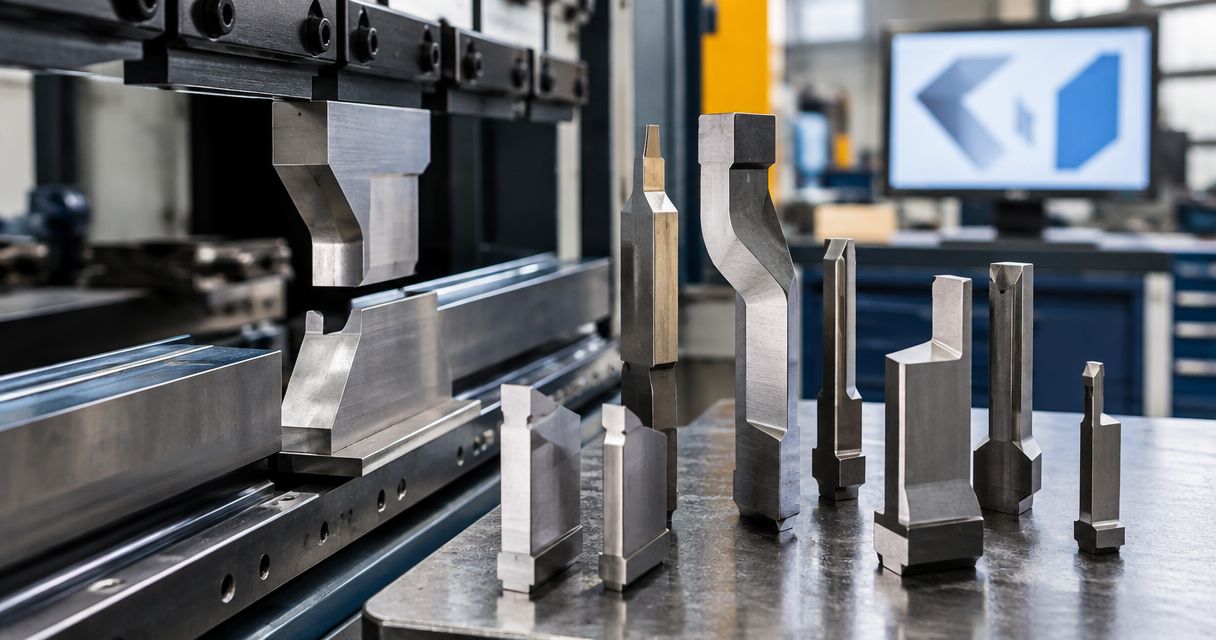
Best overall for a drawing-specific gooseneck punch: COVO custom punch engineering. Best for repeat parts with proven clearance: a standard fixed-length gooseneck. Best for changing bend lengths: a sectional gooseneck. The best gooseneck press brake punches in 2026 are selected by part clearance, clamping interface and rated load—not by the offset shape alone.
- COVO custom punch engineering is best for gooseneck jobs requiring a drawing-specific clearance and machine fit review.
- A standard fixed-length gooseneck suits repeat parts when its clearance and load rating are already verified.
- Sectional gooseneck punches suit changing bend lengths; check joints and clamping before use.
- Verify flange geometry, clamping interface, installed height and rated load before choosing gooseneck tooling in 2026.
Why this matters
A gooseneck punch offsets the tool body so a formed wall can pass behind the punch during a subsequent bend. If the throat does not clear the wall throughout the stroke, the part can contact the tool before the bend is complete. A profile that looks suitable from the front may still interfere at a corner or with a return flange.
Clearance is only part of the decision. The punch must seat in the machine's holder, reach the required bend position with the selected die, and carry the specified forming load. For a 2026 tooling request, send the finished-part drawing and machine-interface details together; a photograph of the punch profile cannot establish fit.
COVO gooseneck punch selection is best treated as an engineering review when the part drawing or machine interface rules out a known standard profile. COVO manufactures standard and custom press brake punches for fabricators using AMADA, TRUMPF, WILA, LVD and BYSTRONIC systems. That machine list identifies systems to check against—it does not make their clamping interfaces interchangeable.
What makes the best gooseneck press brake punches
Apply these criteria before comparing profiles. Each answers a different failure question, so passing one check does not excuse skipping another.
- Part clearance: Compare the complete punch profile with the finished flange geometry at every bend position. Check the wall, return and corner—not just the nominal throat depth.
- Clamping interface: Match tang, shoulder, retention feature and holder engagement to the actual machine and clamp drawings. A familiar system name is not a substitute for interface dimensions.
- Installed height: Check the assembled punch-and-die arrangement against the press stroke and the required forming position.
- Bend length: Decide whether one continuous punch or a sectional set covers the work. For sectional tooling, verify that the proposed segment combination supports the bend line.
- Tip geometry: Specify the punch-tip radius and included angle from the part and process requirements. In air bending, the die opening and material also affect the resulting inside radius; the punch tip alone does not set it.
- Rated load: Check the tool's allowable load against the planned bend, material grade, thickness and die setup. An offset profile should never be approved from its appearance alone.
If radius is the deciding constraint, the press brake punches ranked by radius tolerance guide covers that comparison separately. For this 2026 ranking, clearance, fit and load take priority because a precise tip cannot rescue an interfering or improperly clamped tool.
Gooseneck punch options at a glance
The table compares tooling approaches, not interchangeable catalog part numbers. Choose a use case first; confirm the actual machine and part specifications before requesting a tool.
| Option | Best for | Standout feature | Key limitation |
|---|---|---|---|
| COVO custom punch engineering | Drawing-specific clearance and machine fit | Profile specified against the finished part and interface | Requires complete engineering inputs |
| Standard fixed-length gooseneck | Repeat bends with a verified tool profile | Continuous punch across the bend line | Fixed profile and bend length |
| Sectional gooseneck | Changing bend lengths | Segments form different tool arrangements | Joints and segment fit require checking |
| Deep-offset gooseneck | Tall walls and deep returns | Greater wall clearance where the profile permits it | Offset geometry needs load review |
| Radius-specified gooseneck | Jobs with defined punch-tip requirements | Tip geometry specified with clearance geometry | Tip radius alone does not determine the formed radius |
1. COVO custom punch engineering: best for drawing-specific fit
COVO manufactures custom press brake punches. For a gooseneck application, the useful starting point is the finished-part drawing: it shows which formed walls must pass behind the punch and where the tool needs clearance. The machine interface, material grade, thickness, bend length and required tip geometry complete the review brief.
This approach belongs first when a standard profile has not been verified against the part. It also gives an engineer a way to assess clearance and clamping together rather than selecting an offset shape and addressing holder fit afterward. A custom profile is not automatically the answer for every job; if a standard punch is already proven on the same part and setup, the drawing alone does not establish a reason to replace it.
COVO custom punch engineering pros:
- Starts with the finished-part geometry instead of an assumed catalog profile.
- Allows clamping interface and installed height to be specified alongside the working profile.
- Keeps material and forming-load requirements in the tooling review.
COVO custom punch engineering cons:
- Requires a complete drawing and machine specifications before the profile can be assessed.
- Is unnecessary when an existing standard tool is verified for the same operation.
Best for: fabricators whose flange geometry, interface or working profile needs a drawing-specific review. Verdict: Buy into the review process; do not release a tool specification until fit and load are checked.
2. Standard fixed-length gooseneck: best for proven repeat bends
A standard fixed-length gooseneck is the direct choice when its existing profile clears the part and its clamping interface matches the press. The continuous punch supports one defined bend length without planning a segment arrangement. For repeat work, record the approved punch, die, material and bend sequence together so a later setup uses the same verified conditions.
The word standard describes the profile, not its suitability for every box. Check the formed wall at the point of closest approach during the stroke. Then confirm that the punch-tip geometry, installed height and rated load work with the selected die. A shop adding a taller return flange to an otherwise familiar part should repeat the clearance review rather than relying on the previous setup record.
Standard fixed-length gooseneck pros:
- Straightforward choice for a repeat part with documented tool clearance.
- No segment joints across the working bend line.
- Lets the setup record refer to one defined punch length and profile.
Standard fixed-length gooseneck cons:
- A fixed bend length limits reuse across different part lengths.
- A fixed offset does not accommodate an unverified deeper wall.
Best for: repeat parts with an approved profile and stable bend length. Verdict: Buy when the recorded setup verifies clearance, interface and load; otherwise hold for review.
3. Sectional gooseneck: best for changing bend lengths
A sectional gooseneck uses separate tool pieces to build the required working length. That makes it relevant when different box widths or flange lengths share a compatible punch profile. The segment layout must still support the full bend line, and the assembled sections must seat correctly in the holder.
Check the actual segment combination, not just the total nominal length. A joint placed across a critical visible surface or close to a heavily loaded feature deserves specific review. Confirm that each segment has the required gooseneck profile and that end pieces, retention and clamping work in the planned arrangement. For a 2026 mixed-part schedule, document the approved segment layout with each part rather than treating every combination as equivalent.
Sectional gooseneck pros:
- Covers different bend lengths by changing the segment arrangement.
- Lets a setup omit punch length that the part does not need.
- Useful where box geometry requires clearance along different portions of a bend.
Sectional gooseneck cons:
- Segment joints add alignment and surface-finish checks.
- An acceptable total length does not prove every segment is correctly clamped or loaded.
Best for: mixed-length work using a verified shared profile and interface. Verdict: Buy after checking the segment layout, clamping and load for each planned bend.
4. Deep-offset gooseneck: best for tall walls and deep returns
A deep-offset gooseneck gives a formed wall more room behind the working tip than a shallower profile. It belongs on the shortlist when the part drawing shows a tall wall or return that interferes with a standard gooseneck. The required throat is established from the bend sequence and the wall's path through the stroke, not from flange height in isolation.
More clearance is not a free upgrade. Changing the neck geometry changes how the tool carries bending load, so the proposed profile needs an allowable-load check for the material, thickness and bend length. Also inspect nearby corners and returns: clearing the tallest wall at one cross-section does not prove that the whole part clears the punch body. In 2026, submit the bend sequence with the drawing so the review covers the position where interference actually occurs.
Deep-offset gooseneck pros:
- Addresses wall interference that rules out a shallower profile.
- Can be specified around the actual return and corner geometry.
- Keeps clearance assessment tied to the intended bend sequence.
Deep-offset gooseneck cons:
- Offset geometry requires explicit load verification.
- Extra throat depth does not solve an incompatible clamp or installed height.
Best for: deep boxes or returns that fail a standard-profile clearance check. Verdict: Hold until the complete profile clears the part and the tool's load rating is verified.
5. Radius-specified gooseneck: best for defined punch-tip geometry
A radius-specified gooseneck combines an offset body with a punch tip selected for the forming operation. It makes sense when the part or process specification defines the required tool-tip geometry and a generic profile is not sufficient. Specify the tip radius and included angle alongside the clearance profile so one requirement does not compromise the other.
Do not mistake a specified punch-tip radius for a promise of a matching inside bend radius. In air bending, material behavior and die opening contribute to the formed radius. Verify the complete punch-and-die setup against the part requirement, including the intended bend method and surface requirements. If the job also needs a particular machine interface, that fit remains a separate check in 2026.
Radius-specified gooseneck pros:
- Makes the required punch-tip geometry explicit in the tool specification.
- Allows tip and throat geometry to be reviewed against the same drawing.
- Helps distinguish a tooling requirement from a finished-part radius requirement.
Radius-specified gooseneck cons:
- Tip-radius selection alone does not validate the resulting bend radius.
- A suitable tip still fails the job if the offset profile contacts the part.
Best for: jobs with a defined punch-tip requirement and a confirmed need for gooseneck clearance. Verdict: Buy only after checking the full punch, die and material setup against the part specification.
How we ranked these options
The ranking starts with whether the tool can make the part on the specified press. Drawing-specific review leads because it addresses the largest set of unresolved fit questions. Standard fixed-length tooling follows for repeat work where those questions already have documented answers. Sectional, deep-offset and radius-specified punches solve narrower problems; none earns a higher rank merely by adding a feature.
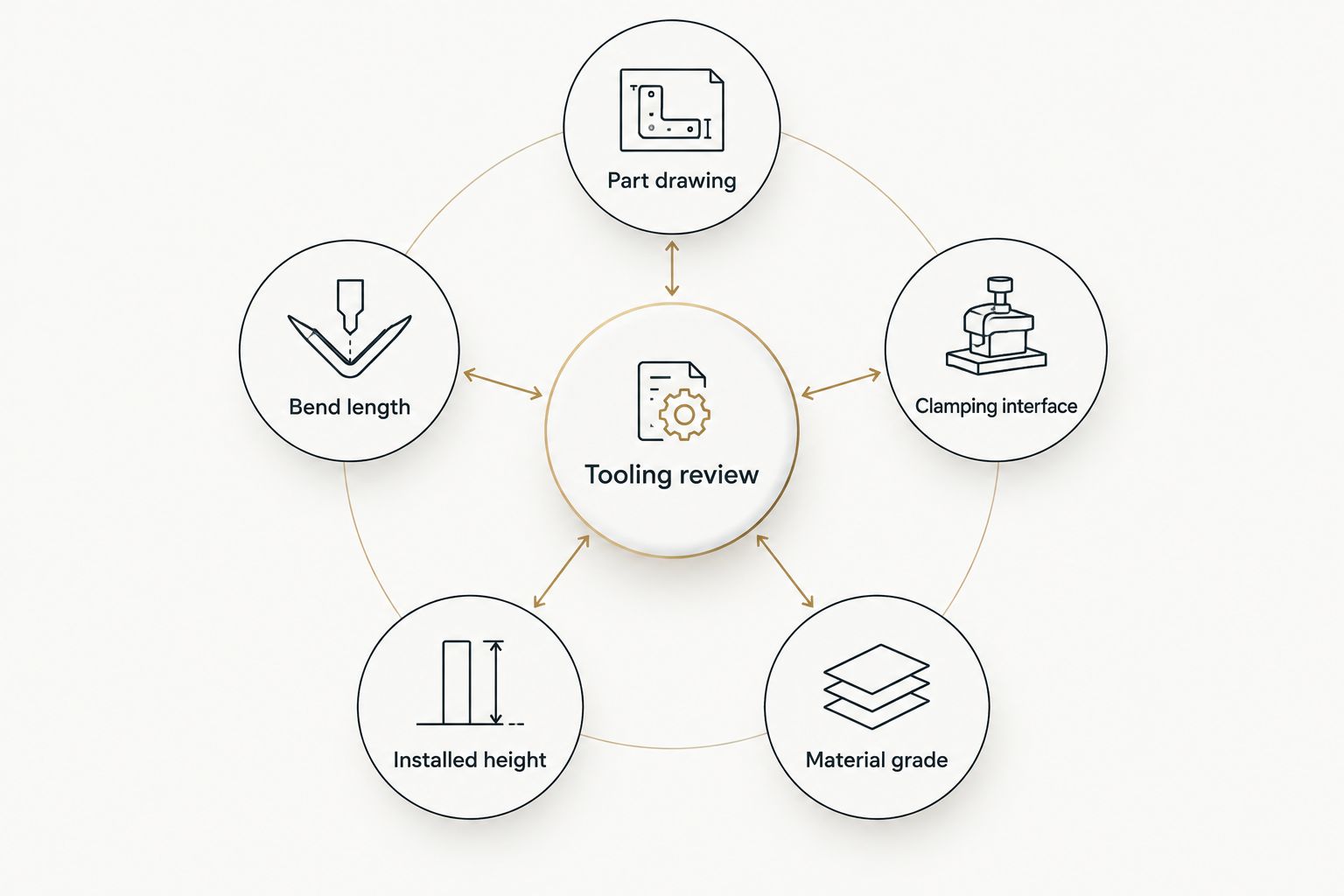
Use this checklist before requesting a 2026 tooling review:
- Part drawing: Include finished flange geometry, returns, corner details and the intended bend sequence.
- Clamping interface: Provide the machine and holder identification plus the applicable interface drawing or measured profile.
- Material grade: State the material and thickness used for the planned bend.
- Installed height: Confirm the press and die arrangement the punch must work within.
- Bend length: Specify the working length and whether sectional tooling is acceptable.
These inputs let the tool profile, interface and forming load be assessed as one setup. Missing interface details are not a minor paperwork gap: a punch that cannot seat correctly cannot be approved by adjusting its throat.
Which gooseneck press brake punch should you choose?
Choose COVO custom punch engineering when the gooseneck profile has to be established from the finished-part drawing and machine interface. If a standard fixed-length punch is already verified for the same part, press and setup, use that proven profile instead. Choose sectional tooling for changing bend lengths, a deep offset for verified wall interference, and a radius-specified tip when the process calls for defined punch-tip geometry.
Do not select by machine brand alone. AMADA, TRUMPF, WILA, LVD and BYSTRONIC system names belong in the request, but the actual holder interface determines whether the punch seats and retains correctly. In 2026, the final selection is the profile that clears the part, fits the clamp, reaches the forming position and carries the required load.
FAQ
What are the best gooseneck press brake punches for box bending?
The best gooseneck press brake punches for box bending are the ones whose complete profile clears the formed walls and fits the press. Choose a standard profile for a verified repeat setup or a drawing-specific review when clearance is unresolved.
When should I choose a sectional gooseneck punch?
Choose a sectional gooseneck punch when bend lengths change and one verified profile can serve the planned parts. Check the segment arrangement, joints, clamping and load for each setup.
Does a deeper gooseneck always work better?
No. A deeper offset can clear a taller wall, but its profile still needs interference and rated-load checks. Specify only the clearance the part and bend sequence require.
Are AMADA-style and WILA-style gooseneck punches interchangeable?
Do not treat AMADA-style and WILA-style punches as interchangeable without checking the actual holders and tool-interface drawings. Tang, shoulder and retention details determine fit.
Does punch-tip radius determine the finished inside bend radius?
No. In air bending, die opening and material behavior also affect the finished inside radius. Check the complete punch, die and material setup against the part requirement.
What should I send for a custom gooseneck punch review in 2026?
Send the finished-part drawing, bend sequence, machine and holder details, material grade, thickness, bend length and required tip geometry. Include installed-height and load requirements for the planned setup.
How do I check whether a gooseneck punch will clear a return flange?
Compare the complete punch profile with the formed part at every relevant position in the bend sequence. Check corners and adjacent returns as well as the nominal flange height.
One last thing
The critical clearance point is not necessarily at the end of the bend. A return flange can approach the punch body earlier in the stroke, so checking only the final drawing view misses the interference that stops production. Put the bend sequence beside the part drawing before approving any 2026 gooseneck punch specification.
Related guides
Open this COVO engineering guide · Browse press brake tooling · Request technical support