COVO KNOWLEDGE
Best sheet metal hemming tools for aluminum panels 2026
Published:
Updated:
Ranked 2026 guide to hemming tooling for aluminum panels: flat dies, teardrop punches, sectional tooling and gooseneck punches compared for real production jobs.
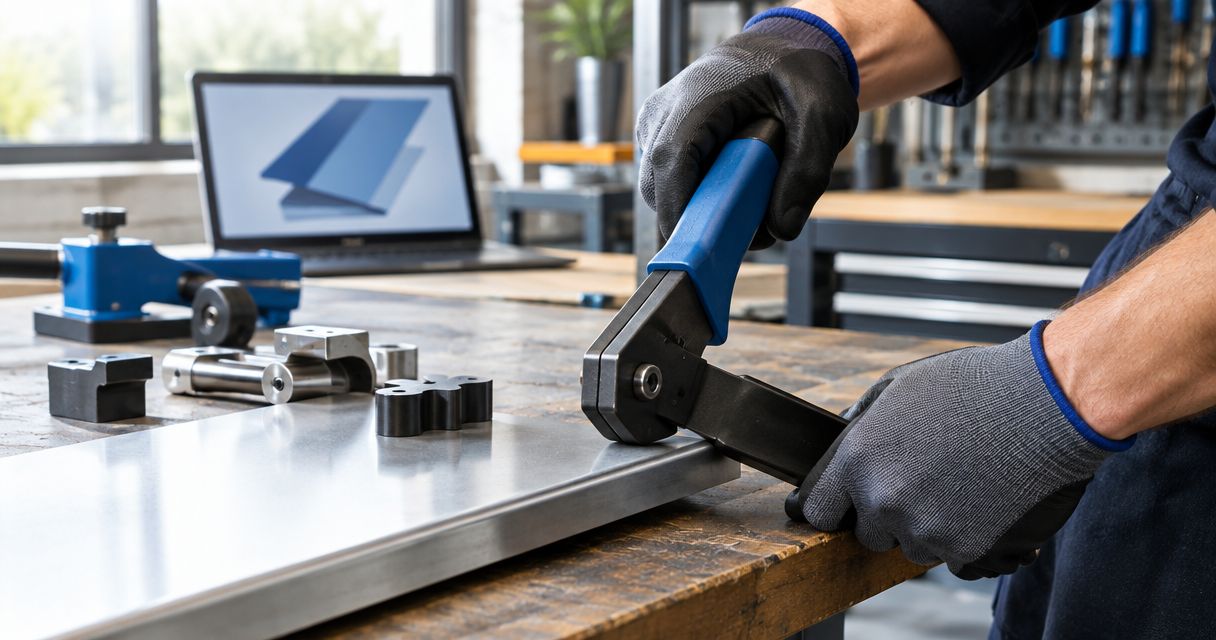
Aluminum panels hem differently than mild steel: lower yield strength, a narrower forgiving window on radius, and a real risk of surface marking if the punch nose or die radius doesn't match the flange geometry. This guide ranks the five hemming tooling types that hold up on aluminum panel work in 2026, with the verification steps to run before you order.
- Flat hemming die and punch sets are the best overall choice for standard 180-degree hems on aluminum panels in 2026.
- Teardrop hemming punches win for radiused corner hems where a sharp flat crease would crack thin aluminum.
- Sectional hemming tooling is the pick for mixed bend lengths and box-section work on the same press brake.
- Gooseneck hemming punches solve tight flange clearance on deep boxes where a straight punch body can't reach.
- Match clamping interface, rated closing load and radius to the aluminum alloy and thickness before requesting a tooling review.
Why this matters
Aluminum panels crack at tighter radii than steel and mark more easily under load, so the wrong hemming tool geometry shows up as a rejected part, not a warning light. Custom press brake tooling built from the finished-part drawing accounts for alloy, thickness and flange length before the punch ever touches the sheet — generic hemming tooling sized for steel gauges usually isn't.
A hemming operation on aluminum runs in stages: a pre-bend to roughly 30-45 degrees, then a final closing pass to 180 degrees. Each stage has its own tooling requirement, and skipping the pre-bend stage on aluminum is the most common cause of surface cracking at the fold. The rest of this guide breaks down which tooling type fits which stage and which part geometry.
What makes the best hemming tooling for aluminum panels
- Clamping interface match — the tool shank and clamping system must match the press brake (AMADA, TRUMPF, WILA, LVD, BYSTRONIC), not just the tonnage rating.
- Radius-to-thickness ratio — die and punch nose radius scaled to material thickness, since aluminum tolerates less deformation before surface cracking than mild steel.
- Rated closing load vs. alloy yield strength — aluminum needs less tonnage than equivalent-gauge steel, and over-clamping is what causes flange thinning and edge tearing.
- Flange geometry fit — hem length and flange geometry from the finished-part drawing, not a generic flange table.
- Segment and box clearance — for sectional tooling, individual segment width and box clearance against the part's internal returns.
- Installed height — the assembled tool height must clear the press brake's stroke and any downstream tooling in the same setup.
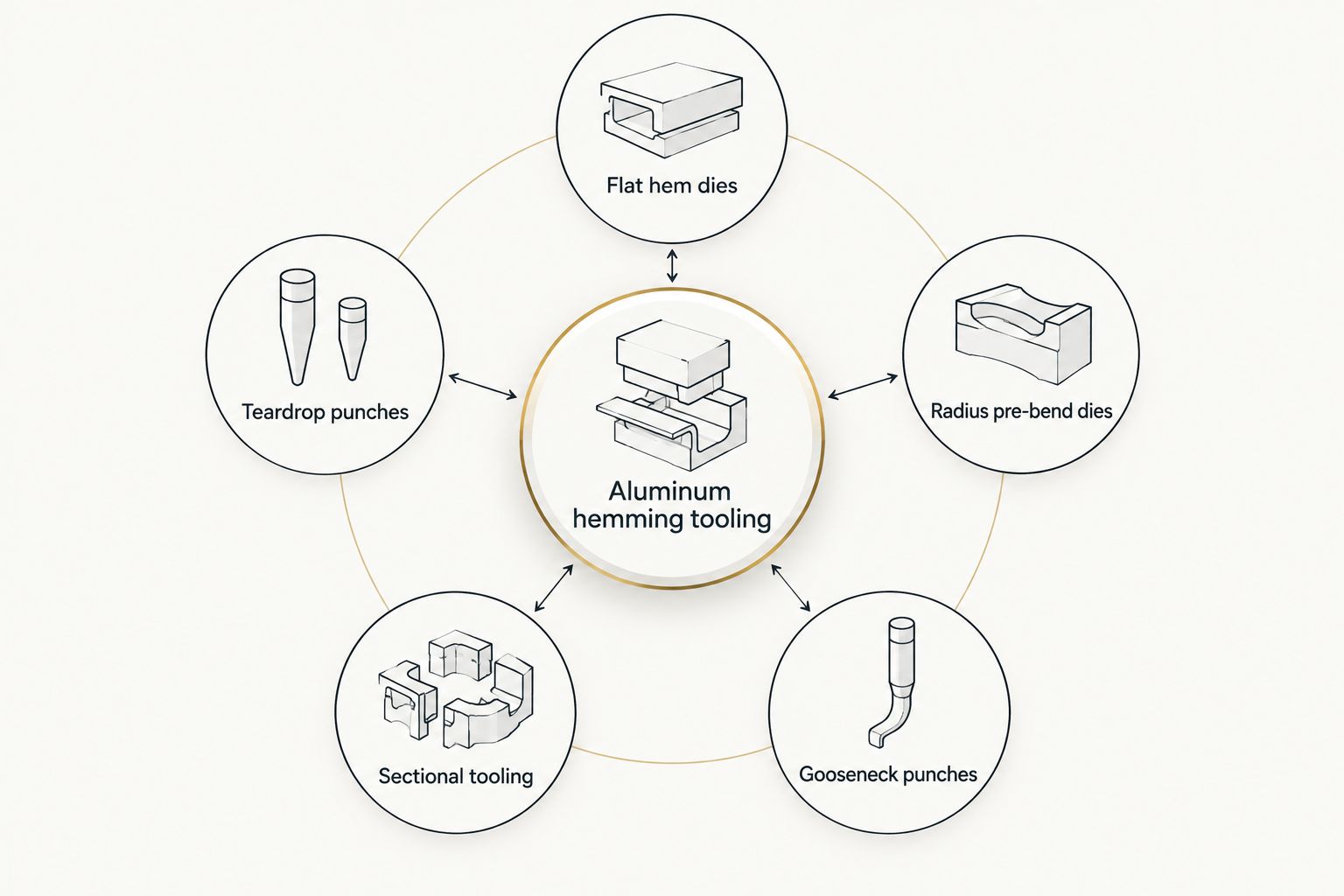
At a glance: hemming tooling for aluminum panels
| Tool type | Best for | Standout feature | Key limitation |
|---|---|---|---|
| Flat hemming die and punch sets | Standard flat hems | Consistent 180-degree closure across long bend lengths | Needs a separate pre-bend pass on thicker aluminum |
| Teardrop hemming punches | Radiused corner hems | Controlled radius prevents cracking at the fold | Slower cycle than a straight flat hem |
| Radius pre-bend dies | Staged pre-bend before final close | Sets the 30-45 degree angle cleanly before closing | Only one stage of a two-stage process |
| Sectional (split) hemming tooling | Mixed bend lengths and box sections | Segments swap without a full tool change | Segment fit and clamping load need checking per job |
| Gooseneck (acute-angle) hemming punches | Tight flange clearance, deep boxes | Reaches into box returns a straight punch can't clear | Reduced rigidity on long unsupported bend lengths |
Request a tooling review for your part drawing
Send finished-part geometry and machine interface before ordering.
1. Flat hemming die and punch sets: best hemming tooling for standard flat hems on aluminum panels
A flat hemming die and punch set closes a pre-bent flange down to a 180-degree flat seam, used on panel edges, enclosure lids and trim where the finished edge needs to be smooth and self-supporting. On aluminum, the die radius is sized close to material thickness so the closing pass doesn't thin the outer skin of the fold.
Flat hemming die pros:
- Produces a clean, consistent flat seam across long bend lengths
- Straightforward setup once the pre-bend stage is dialed in
- Works across common AMADA-style and WILA-style clamping interfaces
Flat hemming die cons:
- Requires a separate pre-bend operation on aluminum thicker than roughly 1.5mm
- Not suited to radiused corners or teardrop-profile hems
Best for: panel edges and enclosure seams needing a flat, closed hem. Verdict: Buy.
2. Teardrop hemming punches: best hemming tooling for radiused corner hems on aluminum panels
Teardrop hemming punches leave a controlled internal radius inside the fold instead of a sharp crease, which matters on aluminum panels where a flat hem at the wrong radius cracks the outer fiber. The punch nose profile is matched to the finished-part flange geometry rather than closed all the way flat.
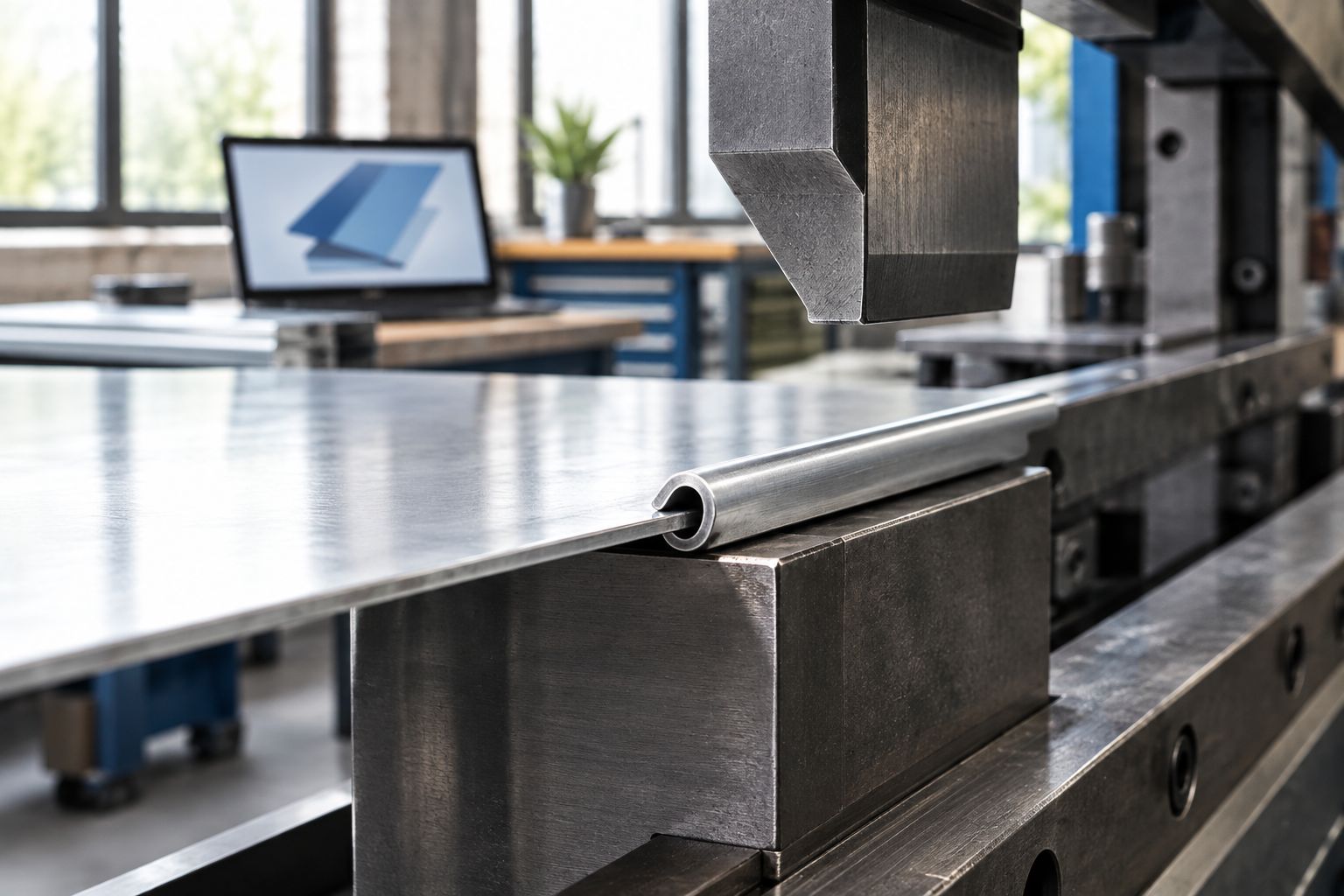
Teardrop hemming punch pros:
- Reduces cracking risk on tighter-radius corner hems
- Suitable for cosmetic edges where a visible crease line is unacceptable
- Pairs with most standard clamping interfaces
Teardrop hemming punch cons:
- Cycle time runs slower than a straight flat hem pass
- Radius must be re-verified for each new alloy or thickness combination
Best for: corner and edge hems on visible or cosmetic aluminum surfaces. Verdict: Buy.
3. Radius pre-bend dies: best hemming tooling for staging aluminum panels before final closing
Radius pre-bend dies set the flange to roughly 30-45 degrees before a flat or teardrop punch closes it the rest of the way. Skipping this stage and trying to close a flat hem in one pass on aluminum is the most common cause of edge cracking reported on thicker gauges.
Radius pre-bend die pros:
- Sets a repeatable pre-bend angle across the full bend length
- Reduces stress concentration at the fold before final closing
- Extends tool life on the final hemming die by removing the heaviest deformation step
Radius pre-bend die cons:
- Adds a second machine pass to the process
- On its own does not produce a finished hem
Best for: aluminum panels above roughly 1.5mm thickness going into a flat or teardrop hem. Verdict: Buy.
4. Sectional (split) hemming tooling: best hemming tooling for mixed bend lengths and box sections on aluminum panels
Sectional hemming tooling breaks the tool into individual segments that combine to match different bend lengths without swapping the full tool set. It's the right call on production runs where box sections, returns and varying panel widths run through the same press brake in one shift.
Sectional hemming tooling pros:
- Reconfigures for different bend lengths without a full changeover
- Handles box clearance around internal returns that a one-piece die can't reach
- Reduces tooling inventory versus stocking a dedicated die per length
Sectional hemming tooling cons:
- Segment fit and clamping load need checking per job, not assumed from the last setup
- More joints in the tool line mean more surfaces where a mismatch shows up as a step line on aluminum
Best for: production runs with varying bend lengths or box-section geometry. Verdict: Buy.
5. Gooseneck (acute-angle) hemming punches: best hemming tooling for tight flange clearance on aluminum panels
Gooseneck punches use an angled body to reach into deep boxes and tight returns where a straight punch shank would collide with the part before the tool reaches the fold line. On aluminum enclosures with tall side walls, this is often the only geometry that reaches the hem at all.
Gooseneck hemming punch pros:
- Clears deep box returns a straight punch cannot reach
- Enables hemming on enclosure geometry that would otherwise require a secondary operation
- Available in matched clamping interfaces for AMADA, TRUMPF, WILA, LVD and BYSTRONIC systems
Gooseneck hemming punch cons:
- Reduced rigidity on long unsupported bend lengths compared to a straight punch
- Installed height and machine stroke need checking before ordering, since the angled body changes clearance
Best for: deep box sections and enclosures with limited flange clearance. Verdict: Hold — confirm installed height and stroke clearance before ordering.
How this ranking works
The order above follows the six criteria listed earlier: clamping interface fit, radius-to-thickness ratio, rated closing load against the aluminum alloy's yield strength, flange geometry match, segment and box clearance where relevant, and installed height. Flat hemming dies rank first because they cover the largest share of standard aluminum panel work with the fewest variables to verify. The remaining four each solve one specific geometry problem that a flat die can't.
Skipping the pre-bend stage on aluminum thicker than about 1.5mm is the fastest way to crack the outer fold on a flat hem.
Which hemming tool should you choose?
For a straightforward flat-edge hem on aluminum panels in 2026, flat hemming die and punch sets are the default choice. Move to teardrop hemming punches for visible corner radii, add a radius pre-bend die ahead of either one once material thickness climbs past roughly 1.5mm, switch to sectional hemming tooling when bend lengths vary across a production run, and reach for gooseneck punches only when box depth leaves no other option. Verify clamping interface, radius, rated closing load, flange geometry, segment fit and installed height against the finished-part drawing before requesting a tooling review — that sequence catches the failure modes that show up after the tool is already cut.
FAQ
What's the best hemming tool for aluminum panels in 2026?
Flat hemming die and punch sets cover most standard aluminum panel hems in 2026. Switch to teardrop punches, sectional tooling or gooseneck punches only when corner radius, bend-length variation or box depth rules out a flat die.
Is flat hemming better than teardrop hemming for aluminum?
Flat hemming is faster and simpler for straight edges, while teardrop hemming controls the fold radius on corners where a flat crease would crack thin aluminum. Pick based on the flange geometry, not a default preference.
How thick can aluminum be for press brake hemming?
Most press brake hemming tooling handles aluminum panels from about 0.8mm to 3mm. Above roughly 1.5mm, a separate pre-bend stage is usually needed before the final flat or teardrop closing pass.
What radius should a hemming die use for aluminum panels?
A die radius close to one times material thickness is the common baseline for aluminum hemming. The exact radius should be verified against the specific alloy and flange geometry before the tool is built.
Do aluminum panels need different hemming tooling than steel?
Yes — aluminum tolerates less deformation before cracking and needs lower rated closing load than equivalent-gauge steel. Tooling sized for steel gauges often over-clamps aluminum and thins the fold.
Can sectional hemming tooling handle aluminum box sections?
Sectional hemming tooling handles box sections well because segments clear internal returns that a one-piece die can't reach. Segment fit and clamping load still need checking against the specific box geometry.
How much clamping load does aluminum hemming need compared to steel?
Aluminum hemming needs lower rated closing load than the same gauge in mild steel, since aluminum's yield strength is lower. Over-clamping is the main cause of edge thinning and tearing on aluminum hems.
What does a custom hemming tooling review need from a fabricator?
A tooling review needs the finished-part drawing, press brake make and clamping interface, aluminum alloy and thickness, and the required flange geometry. Those five inputs determine radius, rated load and installed height.
One last thing
The detail that gets missed most often on aluminum hemming jobs isn't the radius — it's the pre-bend angle. A flat or teardrop punch closing straight from flat stock without a 30-45 degree pre-bend stage concentrates all the deformation at one point on the fold, and that's where aluminum cracks first, not at the die radius itself.
Related guides
- Best WILA-compatible press brake tooling options
- Best AMADA-compatible press brake tooling brands
- Best press brake dies for stainless steel fabrication
- Best 10 press brake tooling manufacturers
Open this COVO engineering guide · Browse press brake tooling · Request technical support