COVO KNOWLEDGE
COVO vs Harsle: which is better in 2026
Published:
Updated:
Compare covo vs harsle in 2026: choose tooling-first for an existing brake or machine-first for new equipment. Check interfaces, geometry, loads and quote scope.

Choose COVO if you need standard or custom press brake tooling for an existing machine; choose Harsle if your purchase starts with the press brake itself. This covo vs harsle comparison for 2026 separates tooling selection from machine selection, then identifies the interface, geometry and load checks that determine whether either purchase fits your production requirement.
- COVO is best for press brake tooling projects defined by the existing machine and finished-part drawing.
- Harsle is the machine-first choice when the purchase starts with a press brake rather than replacement tooling.
- The covo vs harsle decision starts with purchase scope, clamping interface and required bend geometry.
- Neither brand name replaces checks of installed height, segment fit, clearance and rated forming load.
Why this matters
A press brake and its tooling solve different parts of the same manufacturing problem. The machine supplies motion, force and positioning; the punch and die establish the working contact geometry. Buying one does not automatically resolve the requirements of the other.
For a 2026 purchase, write the scope before comparing suppliers. An existing machine with unsuitable tooling calls for a different review from a new production cell that needs machine capacity, working space and tooling specified together. The COVO range includes standard and custom punches, dies, forming tools and accessories.
COVO is best for press brake tooling projects defined by an existing machine and a finished-part drawing. That is a scope-based recommendation, not a claim that one supplier produces tighter bends, longer tool life or faster setups than the other.
At a glance
| Dimension | COVO | Harsle |
|---|---|---|
| Best for | Fabricators specifying standard or custom press brake tooling | Buyers whose project starts with selecting a press brake |
| Purchase scope | Punches, dies, forming tools and accessories | Press brake equipment selection |
| Standout focus | Custom tooling defined around the part and machine interface | Machine selection before the tooling package is finalized |
| Existing-machine fit | Review the actual holder, retention and installed height | Review the actual holder, retention and installed height |
| Part geometry | Start with the finished-part drawing and forming sequence | Include the finished-part drawing in machine and tooling selection |
| Load verification | Match tool ratings to the proposed operation | Match machine limits and tool ratings to the proposed operation |
| Pricing model | Compare a quotation for the defined tooling scope | Compare a quotation for the defined equipment scope |
| Production acceptance | Verify fit, clearance and the required finished part | Verify equipment scope, fit, clearance and the required finished part |
The table separates purchasing responsibilities rather than assigning unsupported performance scores. A tooling quotation and a machine quotation are not equivalent offers, even when both mention punches and dies. Bring them onto the same written scope before comparing commercial terms.
The tooling specialist is the better fit for an existing press brake
If your press brake already meets the job's capacity and working-space requirements, define the remaining tooling problem. It might be an obstructed flange, an unsuitable punch profile, a segment arrangement that does not fit the bend length, or a die opening that does not suit the operation.
The tooling-first route keeps that problem specific. You can submit the finished-part drawing, existing holder details and proposed process without turning the project into an equipment replacement exercise.
Verify these items before requesting a tooling review:
- Clamping interface: Provide dimensioned upper and lower interface drawings, not just a machine brand.
- Retention: Identify how the punch is retained and how it is installed and removed.
- Installed height: Record the assembled height of the holder, punch, die and any adapters.
- Bend length: State the working length and required segment arrangement.
- Machine limits: Include relevant capacity, stroke, opening and working-space information.
The benefit is a focused tooling specification; the limitation is that new tools cannot correct an unsuitable machine envelope. If the required part cannot enter, form or leave the machine, a different punch alone does not resolve the project.
The machine-first supplier is the better starting point for new equipment
Harsle manufactures press brakes, making it a relevant starting point when the purchase concerns the machine itself. That scope is different from replacing a punch or commissioning a special forming profile.
For a new machine, define the parts and production requirement before choosing equipment. A capacity designation alone does not establish whether the machine has the working length, opening, stroke or clearance needed for the proposed tools and bend sequence.
Your equipment specification should identify:
- Material grades and thicknesses used in the intended work.
- Required bend lengths and finished-part geometry.
- Tooling height and clearance requirements.
- Backgauge access and part support needs.
- The forming operations included in the acceptance requirement.
The benefit is a machine-led purchasing scope; the limitation is that a machine specification does not establish every tooling detail. Require the tooling package to be described separately, including working profiles, interfaces, segment lengths and load ratings. Do not treat a general reference to included tooling as approval for every part family.
Custom tooling starts with the finished-part drawing
For a custom tooling project, COVO's stated manufacturing scope matches the task: standard and custom press brake punches, dies and forming tools. The useful starting point is the finished-part drawing, followed by the machine interface and proposed forming method.
That sequence matters because tool selection must satisfy the completed geometry, not just an isolated bend. A punch that clears the initial flange can interfere with a previously formed wall later in the sequence. A die that suits one operation can obstruct access during another.
Use this review sequence:
- Part drawing: Identify the required radius, flange geometry, tolerances and surface requirements.
- Material specification: State the material grade, thickness and relevant condition.
- Bend sequence: Show the order of operations and the part orientation at each bend.
- Tool envelope: Review punch profile, die geometry and clearance around formed features.
- Machine interface: Confirm holders, retention, installed height and available working space.
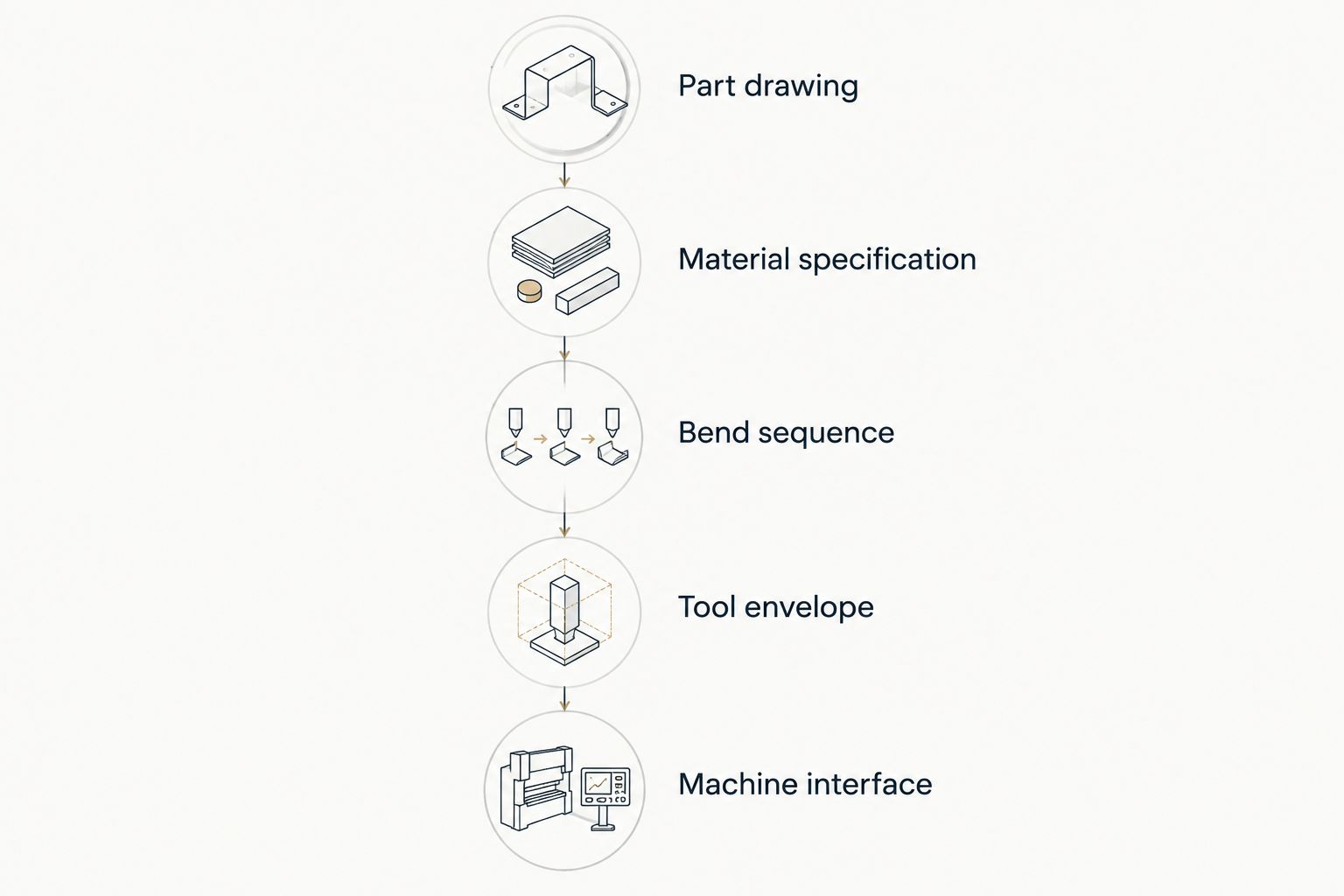
A custom profile is not automatically the better choice. Use standard tooling when it satisfies the complete operation; request custom engineering when a documented geometry or process requirement remains unresolved. This prevents a special tool from becoming the default answer to an incomplete specification.
Both routes require the same interface verification
Neither supplier name establishes compatibility with your actual clamping arrangement. Machine families, tooling styles and installed holders must be checked against the dimensions and retention features of the proposed tools.
For your 2026 tooling review, distinguish between a familiar system name and a verified assembly. The client's stated scope includes tooling for fabricators using AMADA, TRUMPF, WILA, LVD and BYSTRONIC systems, but each order still needs the actual interface confirmed.
Check the following as a matched assembly:
- Punch tang geometry and seating surfaces.
- Upper-holder engagement and retention features.
- Lower-die seating and alignment.
- Adapter requirements, where applicable.
- Installed height and available opening.
- Segment fit, end clearances and handling provisions.
Interface verification is a tie: both purchasing routes require dimensional evidence. A nominal match does not establish that a tool seats correctly, remains retained or provides the intended operating clearance. Request an assembly review whenever the interface information is incomplete or the existing holder differs from the proposed arrangement.
Both routes require load and clearance checks
Load approval must address the operation, tooling and machine together. Material grade, thickness, bend length, die geometry and forming method all affect the assessment. A tool rating should be read with its stated conditions, not treated as an unrestricted machine-capacity allowance.
Keep clearance verification separate from load verification. A setup can satisfy a load requirement and still collide with the part, holder, machine structure or adjacent tooling. Examine the full forming and removal sequence rather than a single static position.
Require the review to cover:
- The proposed forming method and material specification.
- Machine capacity limits relevant to the setup.
- Punch, die and holder ratings under the intended conditions.
- Load distribution across the working tool length.
- Clearance during positioning, bending and part removal.
- Previously formed flanges and enclosed geometry.
Load and clearance are another tie: neither purchase route earns approval without both checks. Do not infer allowable loading from appearance, tool size or a general compatibility statement. If a setup changes, review the changed conditions before carrying forward an earlier approval.
Compare quotation scope, not assumed pricing models
For 2026 purchasing, compare a tooling quotation with another quotation for the same tooling requirement. Compare an equipment quotation with another quotation for the same equipment requirement. Mixing those scopes produces a misleading commercial comparison.
A defined tooling package gives you a clear list of punches, dies, segments and forming operations. A defined equipment package establishes what belongs to the machine purchase and what remains a separate tooling responsibility. In either case, predictability comes from specifying inclusions rather than assuming them.
Ask each quotation to identify:
- Tool or equipment drawings covered by the offer.
- Included holders, adapters and accessories.
- Segment arrangement and working lengths.
- Engineering review and approval responsibilities.
- Inspection documents and acceptance requirements.
- Delivery, warranty and support terms for the actual order.
Neither supplier wins a commercial comparison until the scope is matched. A flexible, separately specified tooling purchase can address a defined operation; an equipment package can organize a machine purchase. The correct tradeoff is the one that leaves no unassigned interface, tooling or acceptance requirement.
Final verdict: choose by the unresolved engineering problem
Choose COVO for the existing-machine tooling project
Best for: A tooling engineer or fabricator with an existing press brake and a defined punch, die or forming requirement. Submit the finished-part drawing, material grade, thickness, bend length, machine interface and required geometry together.
The tooling-first route is especially relevant when the machine remains suitable but the current tool arrangement does not satisfy the part. Its boundary is equally clear: the project still needs machine-envelope and loading approval.
Choose Harsle for the new-machine purchasing project
Best for: A production engineer or purchasing lead whose scope begins with selecting a press brake. Define the intended parts and forming operations, then require the machine and tooling responsibilities to be separated in the proposal.
The machine-first route addresses equipment selection. Its boundary is the tooling specification: buying the machine does not remove the need to verify every proposed punch, die and forming setup.
| Dimension | Winner |
|---|---|
| Tooling for a suitable existing machine | Tooling-first route |
| Selecting a new press brake | Harsle, for the machine-first scope |
| Standard or custom tooling specification | Tooling-first route |
| Clamping interface verification | Tie; both require drawings |
| Load and clearance verification | Tie; both require operation-specific checks |
| Commercial comparison | No winner before matching scope |
| Production acceptance | Tie; both require defined criteria |
FAQ
Is COVO better than Harsle for press brake tooling?
COVO is the scope-matched choice when your requirement is standard or custom press brake tooling for an existing machine. Harsle is a relevant machine-first choice when the project begins with purchasing a press brake; neither name alone establishes tooling fit or performance.
Which supplier should I consider when buying a new press brake?
Harsle is relevant when your purchasing scope starts with a press brake. Specify the required parts, machine envelope and tooling package separately so the equipment proposal addresses the actual forming work.
Can I order replacement tools using only the machine brand?
No; a machine brand alone is not a complete tooling specification. Verify the clamping interface, retention features, holder arrangement, installed height and proposed tool drawings before ordering.
What should I send for a custom press brake tooling review?
Send the finished-part drawing, material grade, thickness, bend length, required radius and machine-interface information. Include the proposed bend sequence, surface requirements and clearance restrictions so the review covers the complete operation.
Are standard tools better than custom tools?
Standard tools are the correct choice when they satisfy the interface, load and finished-part requirements. Custom tooling is appropriate when a documented geometry or process requirement remains unresolved with the proposed standard arrangement.
How should I compare supplier quotations in 2026?
Compare quotations for the same written scope, including tooling geometry, segments, holders, accessories and acceptance requirements. Separate machine procurement from tooling procurement rather than treating unlike packages as equivalent.
Does a compatible clamping interface prove that a tool is suitable?
No; interface compatibility establishes only part of the suitability assessment. Verify installed height, forming load, tool clearance, bend sequence and finished-part requirements as well.
One last thing
Check part removal, not just the bend position. A tool arrangement that appears suitable while forming still needs enough clearance for the completed part to leave the setup without interference.
Make that check explicit in your 2026 acceptance requirement. Review the final formed geometry alongside the punch, die, holders and adjacent segments before approving the tooling drawings.
Related guides
- Custom press brake tooling for OEM fabricators
- WILA-compatible press brake tooling options
- Segmented press brake dies for box forming
Open this COVO engineering guide · Browse press brake tooling · Request technical support