COVO KNOWLEDGE
Best acute angle press brake dies compared 2026
Published:
Updated:
Compare acute angle press brake dies by clamping interface, die opening and radius profile to find the right fit before ordering tooling in 2026.
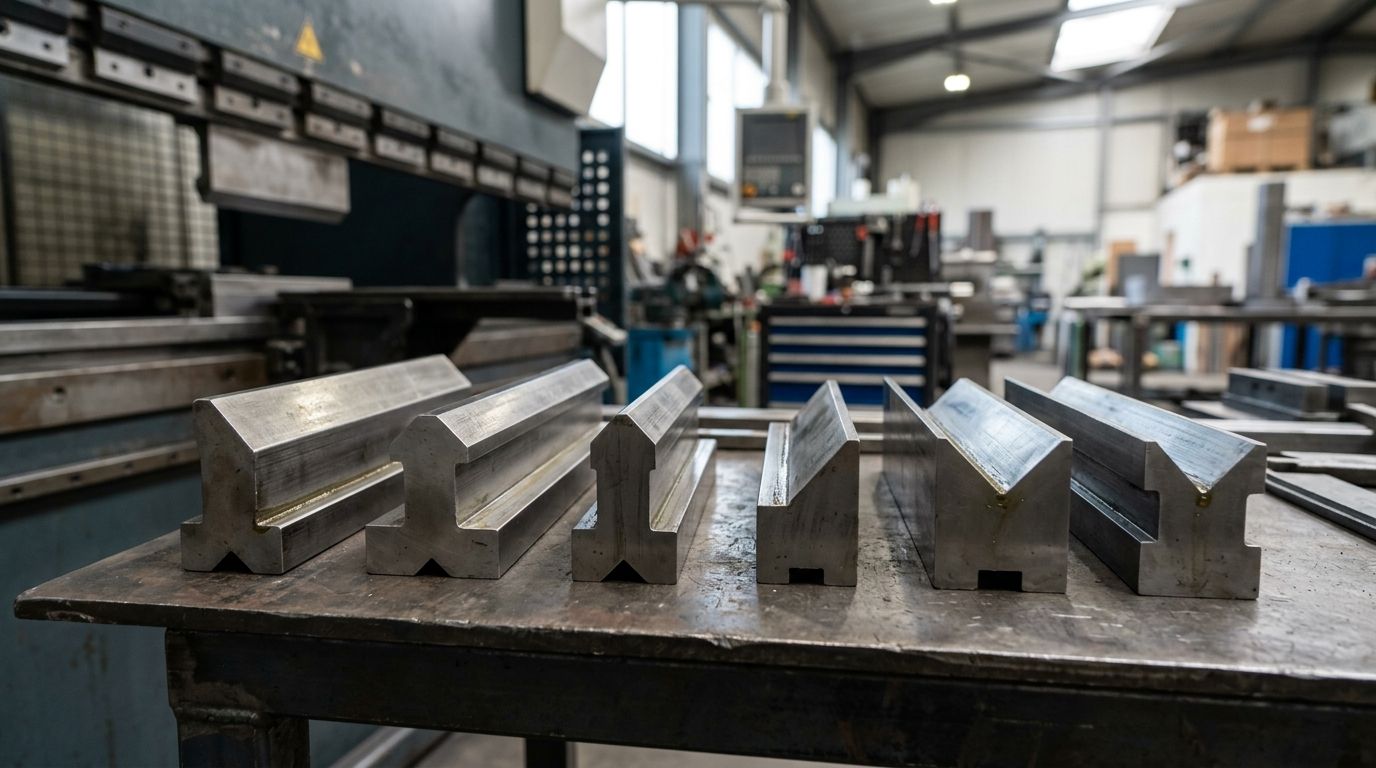
Acute angle press brake dies form angles tighter than 90 degrees in one hit, compensating for spring-back on high-strength material without a second restrike. Picking the wrong one means either the part springs back open past tolerance or the die shoulder interferes with the flange before the punch reaches bottom.
- Custom-ground acute angle dies from COVO fit non-standard flange geometry pulled straight from the finished-part drawing.
- Standard 28-30 degree acute angle V-dies cover routine job-shop bending without segment swaps.
- 20 degree tight acute dies buy clearance on deep box sections where a standard die shoulder would hit the wall.
- Segmented acute angle die sets change bend length and box clearance without re-tooling the whole press.
- Machine-specific interface acute dies (AMADA-style, WILA, TRUMPF, LVD, BYSTRONIC-compatible) drop into existing clamping without an adapter.
Best overall for 2026: the custom-ground acute angle die, machined to the finished-part drawing, clamping interface and flange geometry rather than pulled from a catalog range. Best for routine job-shop work: the 28-30 degree standard acute angle V-die, no segment changes needed for repeat production. Best for clearance-critical box parts: the segmented acute angle die set, which lets you swap segments instead of the whole tool when bend length or box height changes.
Why this matters
An acute angle die is not a smaller version of a standard V-die. The die opening, shoulder radius and installed height all shift once you go under 30 degrees, and a die sized for mild steel at 20 degrees will not hold tolerance on stainless or aluminum without a different opening ratio. COVO builds both standard-range and custom acute angle dies for AMADA, TRUMPF, WILA, LVD and BYSTRONIC-style clamping systems, and the difference between the options below usually comes down to flange geometry and box clearance, not brand preference.
Getting this wrong shows up on the shop floor as spring-back beyond print tolerance, die shoulder marks on the flange, or a punch that bottoms out before the target angle is reached. None of that is a tooling defect — it is a mismatch between die geometry and the part.
What makes the best acute angle press brake die
- Clamping interface match — AMADA-style, WILA, TRUMPF, LVD or BYSTRONIC-compatible, confirmed against the actual holder, not the machine brand alone
- Acute angle matched to spring-back — most acute dies run 20 to 30 degrees; the tighter the angle, the more spring-back margin it buys on high-strength steel
- Die opening sized to material thickness — the standard rule of thumb is 6 to 8 times material thickness for the opening dimension
- Shoulder radius matched to flange geometry — too tight a radius scores the surface, too loose a radius under-forms the bend
- Installed height compatible with ram stroke — checked against the press brake's stroke and shut height before ordering, not after
- Load rating per linear inch of bend length — rated against both material grade and bend length, since acute dies see higher unit loads than a standard 90 degree V-die
Acute angle press brake dies at a glance
| Die type | Best for | Standout feature | Key limitation |
|---|---|---|---|
| Custom-ground acute angle die | Non-standard flange geometry, clearance-critical parts | Ground to the finished-part drawing and machine interface | Longer lead time than a stocked profile |
| 28-30 degree standard acute V-die | Repeat job-shop production | No segment changes for routine acute bends | Limited flexibility on unusual flange angles |
| 20 degree tight acute die | Deep box sections needing shoulder clearance | Narrow shoulder profile clears tight box walls | Lower load rating per linear inch than a wider angle |
| Segmented acute angle die set | Box forming with changing bend length | Segments swap without retooling the full press | More setup steps to align and clamp segments |
| Machine-specific interface acute die | Matching existing clamping without an adapter | Drops directly into AMADA-style, WILA, TRUMPF, LVD or BYSTRONIC-compatible holders | Locked to that specific interface family |
1. Custom-ground acute angle die: best for non-standard flange geometry
A custom-ground acute angle die is machined from the finished-part drawing rather than selected off a standard range, which matters once the flange angle, radius or clearance falls outside catalog dimensions. COVO builds these to the exact clamping interface, material grade and thickness specified in the drawing, so the die opening and shoulder radius are set for that part, not for a general case.
This is the route to take when a standard 20-30 degree die leaves a witness mark on the flange, or when the box geometry needs a shoulder profile no catalog range covers. It costs more setup time upfront in review than pulling a stocked die off the shelf.
Custom-ground acute angle die pros:
- Matched to exact flange geometry and clamping interface
- Eliminates trial-and-error die swaps on non-standard parts
- Engineered against material grade and thickness, not a generic range
Custom-ground acute angle die cons:
- Requires a finished-part drawing and machine interface confirmation before quoting
- Longer lead time than an in-stock standard die
- Not the right call for a one-off low-volume run where a standard die already works
Best for: clearance-critical or non-standard flange geometry that a stocked acute angle die cannot form without marking the part. Verdict: Buy when the part geometry is confirmed and a standard die has already been ruled out.
Request a tooling review
Send the finished-part drawing and machine interface for engineering check.
2. 28-30 degree standard acute angle V-die: best for job-shop production
A 28-30 degree acute angle die covers the majority of acute bending requests that come through a job shop in 2026 — high-strength steel and stainless parts where a standard 88-90 degree air bend would spring back past tolerance. The die opening on this range typically runs 6 to 8 times material thickness, which is the same ratio used on standard V-dies, just applied to a tighter shoulder angle.
It holds up across repeat production runs without segment changes, which is the main reason job shops keep one in the standard tooling set rather than ordering custom for every acute job.
28-30 degree acute V-die pros:
- Covers most routine acute bending without a custom order
- Same 6-8x thickness opening ratio fabricators already size against
- No segment changes needed for repeat runs
28-30 degree acute V-die cons:
- Not suited to flange geometry tighter than the standard range covers
- Load rating drops relative to a standard 90 degree V-die at the same opening
Best for: high-strength steel and stainless parts needing routine acute bends in repeat production. Verdict: Buy for job shops running acute bends regularly without unusual flange constraints.
3. 20 degree tight acute angle die: best for deep box sections
A 20 degree acute angle die narrows the shoulder profile further than the standard 28-30 degree range, buying clearance on deep box forms where the die shoulder would otherwise strike the box wall before the punch reaches full depth. This is a clearance problem, not an angle-tolerance problem, so the die gets selected on box height and wall spacing as much as on the target bend angle.
The tradeoff is load capacity: a narrower shoulder concentrates force over a smaller contact area, so the rated load per linear inch of bend length drops compared to the wider 28-30 degree acute die.
20 degree acute die pros:
- Clears box walls that a standard acute die shoulder cannot pass
- Purpose-built for deep, narrow box forming
20 degree acute die cons:
- Lower load rating per linear inch than a wider acute angle
- Not needed on open flange work where clearance is not the constraint
Best for: deep box sections where standard acute die shoulder width interferes with the wall. Verdict: Buy when box clearance is the confirmed constraint; Skip if the part is an open flange with no clearance issue.
4. Segmented acute angle die set: best for box forming with changing bend length
A segmented acute angle die set breaks the die into individual segments that clamp and swap independently, which matters when bend length or box height changes between jobs and a solid die would need full replacement each time. This is covered in more detail in segmented press brake dies for box forming, including segment fit, clamping and load checks before requesting a review.
The segments still need to be checked for consistent load distribution across the full bend length — an uneven segment stack shows up as a wavy bend line, not a die defect.
Segmented acute angle die pros:
- Segments swap without retooling the full press
- Adapts to changing box clearance without ordering a new solid die
- Reduces tooling inventory versus stocking multiple solid acute dies
Segmented acute angle die cons:
- More setup steps to align and clamp segments correctly
- Segment mismatch can produce an uneven bend line if not checked before the run
Best for: box forming production with bend length or clearance that changes job to job. Verdict: Buy for shops running varied box geometry; Hold if bend length and box height stay fixed across production.
5. Machine-specific interface acute angle die: best for matching existing clamping
An acute angle die built to a specific clamping interface — AMADA-style, WILA, TRUMPF, LVD or BYSTRONIC-compatible — drops into the existing holder without an adapter plate, which keeps installed height and shut height unchanged from the standard tooling already on the press. This matters most in shops running mixed tooling ages where an adapter would eat into usable stroke.
The limitation is that the die is locked to that interface family; moving it to a different holder system means a new die, not a retrofit.
Machine-specific interface acute die pros:
- No adapter plate needed, installed height stays consistent
- Fits directly into the existing clamping and retention system
Machine-specific interface acute die cons:
- Locked to one interface family, no cross-compatibility
- Requires confirming the exact holder, not just the machine brand
Best for: shops standardized on one clamping interface who need acute angle capability without adapter tooling. Verdict: Buy once the exact holder and retention style are confirmed.
How we ranked these
Each type was checked against the six criteria above: clamping interface fit, acute angle range, die opening ratio, shoulder radius match, installed height compatibility and load rating per linear inch. None of the five compete for the same use case — the ranking is a decision tree by part geometry and production pattern, not a single leaderboard.
Which acute angle press brake die should you choose?
For a one-off part with unusual flange geometry, a custom-ground die from a confirmed drawing is the right call. For repeat job-shop production on high-strength steel or stainless, the 28-30 degree standard acute V-die covers most of the work. For deep box sections, go 20 degrees for clearance. For production runs with changing bend length, a segmented set avoids re-tooling. If none of the standard ranges fit the part, a custom-ground die reviewed against the finished-part drawing is the default answer in 2026.
FAQ
What is an acute angle press brake die used for?
An acute angle press brake die forms a bend tighter than 90 degrees in a single hit, which compensates for spring-back on high-strength steel and stainless parts without a second restrike operation.
What angle range counts as an acute angle die?
Most acute angle dies run 20 to 30 degrees, compared to the 88-90 degree range used on standard air-bend V-dies.
How is die opening sized for acute angle bending?
Die opening on acute angle dies generally follows the same 6 to 8 times material thickness ratio used on standard V-dies, applied to the tighter shoulder angle.
Is a segmented acute angle die better than a solid one?
A segmented die is better when bend length or box clearance changes between jobs; a solid die is simpler and sufficient when geometry stays fixed across production.
Do acute angle dies work on AMADA, WILA, TRUMPF, LVD and BYSTRONIC machines?
Yes, acute angle dies are built to match specific clamping interfaces including AMADA-style, WILA, TRUMPF, LVD and BYSTRONIC-compatible holders, so the interface needs confirming before ordering.
How much load can a 20 degree acute angle die handle?
A 20 degree die carries a lower load rating per linear inch of bend length than a wider 28-30 degree acute die, because the narrower shoulder concentrates force over less contact area.
Can COVO make a custom acute angle die from a part drawing?
Yes, COVO builds custom-ground acute angle dies from the finished-part drawing, material grade, thickness and clamping interface supplied for review.
What is the difference between an acute angle die and a standard V-die?
A standard V-die forms angles near 88-90 degrees for a single air bend, while an acute angle die forms tighter angles, typically 20-30 degrees, to offset spring-back on harder materials.
One last thing
The most common mistake in 2026 acute angle tooling requests is not the angle at all — it's ordering the die opening based on the machine's standard V-die range instead of resizing for the tighter shoulder, which produces a die that looks right on paper but scores the flange in the first production run.
Related guides
- Press brake punches ranked by radius tolerance
- Press brake dies ranked by tonnage capacity
- Best AMADA-compatible press brake tooling brands
Open this COVO engineering guide · Browse press brake tooling · Request technical support