COVO KNOWLEDGE
Press brake dies ranked by tonnage capacity 2026
Published:
Updated:
Press brake dies ranked by tonnage capacity in 2026: heavy-duty V-dies top the list, hemming dies rank lowest. Compare tiers, use cases and limits.
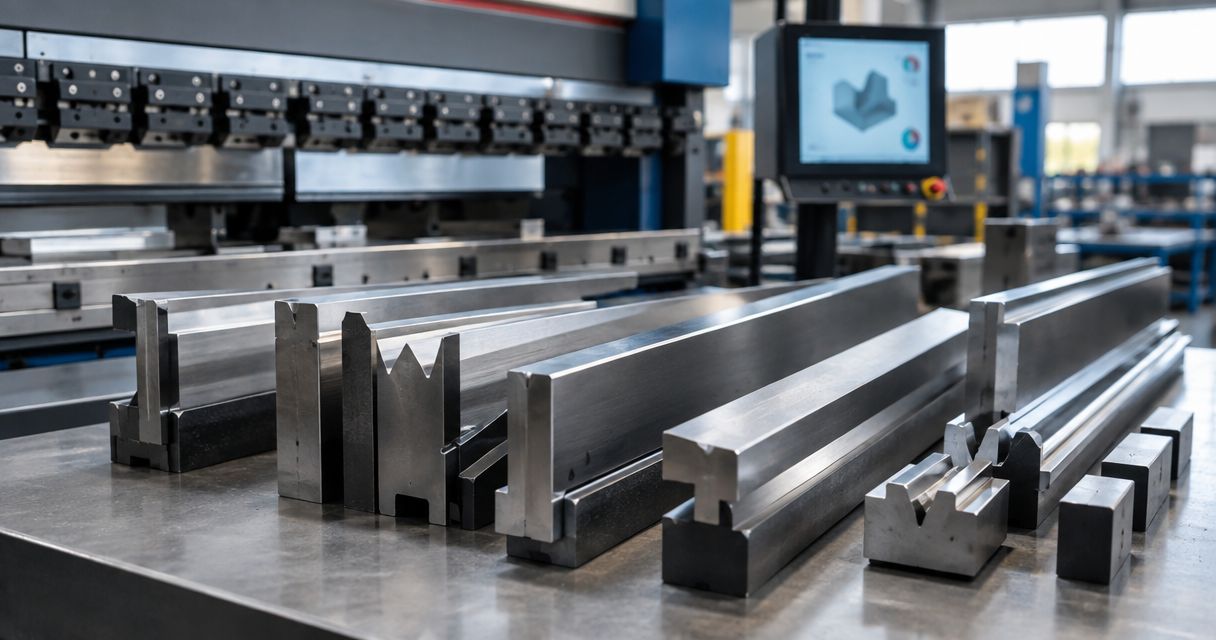
Press brake dies ranked by tonnage capacity in 2026 run from heavy-duty thick-body V-dies rated for the highest bending force down to hemming dies rated for the lightest closing loads. Sectional dies sit near the top for shops that change bend length often; radius and hemming dies sit at the bottom because they're built for finished-edge geometry, not raw force. The die that fits your machine's rated tonnage and your part's flange geometry beats the die with the biggest number on the spec sheet.
- Heavy-duty thick-body V-dies carry the highest tonnage capacity for heavy-gauge steel bending in 2026.
- Sectional press brake dies rank second for tonnage capacity and adjustable bend length in mixed production.
- Hemming and radius dies carry the lowest rated closing loads because they're built for edge geometry, not raw force.
- Match die tonnage capacity to machine rating and clamping interface before ordering, not after a crushed segment.
Why tonnage capacity ranking matters
A die's tonnage rating isn't a marketing number — it's the point where the die body, segment, or clamping interface starts to deform under repeated bending force. Run a part above a die's rated capacity and you crush the V-opening edges or crack a segment weld, not the machine.
COVO builds standard and custom press brake dies for AMADA, TRUMPF, WILA, LVD and BYSTRONIC systems, and the tonnage question comes up on nearly every quote request in 2026: can this die handle the material grade and thickness in the drawing, or does the job need a heavier body. COVO's tooling program starts every custom quote by checking that number against the finished-part drawing before anything gets machined.
What determines a die's tonnage capacity
Tonnage capacity isn't one spec — it's the combined result of five factors an engineer checks before specifying a die:
- V-die opening width — narrower openings concentrate force over less contact area, lowering the safe tonnage ceiling for a given material thickness
- Die body material and heat treatment — thicker, properly hardened bodies resist deformation at higher bending force
- Bend length and segment count — sectional dies distribute tonnage across joints, capping per-segment load even when total machine tonnage is high
- Clamping interface — American-style, European 100 mm, and manufacturer-specific interfaces each rate differently under sustained load
- Material grade and flange geometry — stainless and high-strength steel demand a wider opening ratio than mild steel at the same thickness
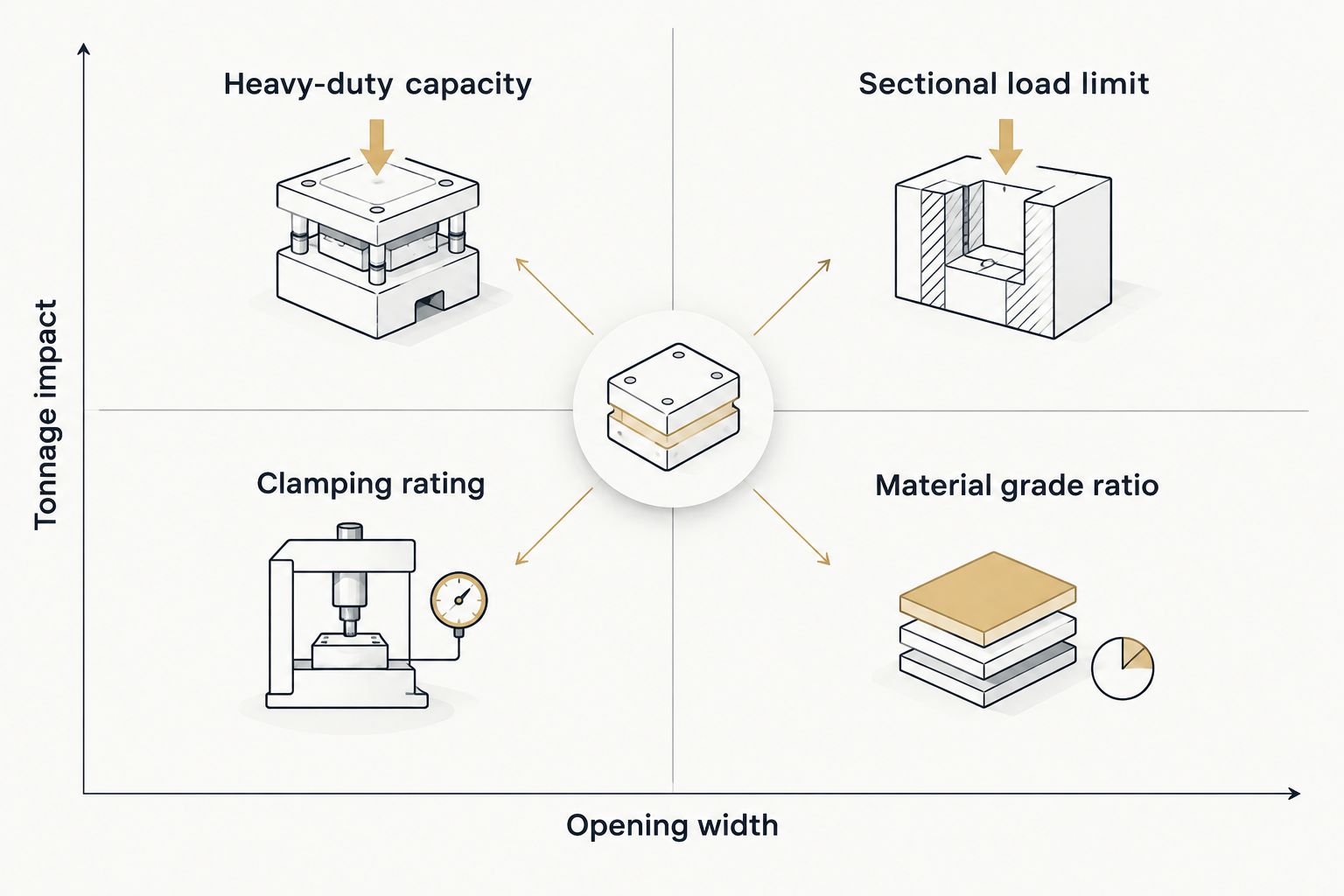
Press brake dies ranked by tonnage capacity — at a glance
| Die type | Tonnage capacity tier | Best for | Standout feature | Key limitation |
|---|---|---|---|---|
| Heavy-duty thick-body V-die | Highest | Heavy-gauge steel bending | Reinforced body resists edge deformation | Heavier, slower to swap on short runs |
| Sectional / segmented die | High | Mixed bend lengths, high-volume runs | Adjustable working length without a full die change | Per-segment load caps below solid-body rating |
| Standard American-style V-die | Medium-high | General fabrication, mixed material | Broad interface compatibility across shops | Lower ceiling than reinforced heavy-duty bodies |
| European-style (WILA/TRUMPF/LVD) precision die | Medium | Tight-tolerance, aerospace-grade parts | Consistent 100 mm interface across brands | Precision tolerances limit maximum rated tonnage |
| Box / U-die (offset die) | Medium-low | Closed-profile and box-section bends | Handles offset and Z-bends in one hit | Geometry limits usable tonnage vs a straight V-die |
| Radius / bottom-bending die | Low-medium | Large-radius forming, stainless and aluminum | Produces consistent radius without cracking | Not rated for high-force acute bends |
| Hemming die (flat/teardrop) | Lowest | Aluminum panel hemming, finished edges | Controlled pre-bend geometry for clean hems | Rated for closing load, not general bending force |
1. Heavy-duty thick-body V-die: best for heavy-gauge steel bending
A heavy-duty V-die carries a thicker body and wider land than standard tooling, spreading bending force across more material so the edges don't roll or crush under repeated heavy-gauge cycles. This is the die COVO specifies most often when a drawing calls for plate steel above standard gauge on a rated high-tonnage brake.
Heavy-duty V-die pros:
- Highest tonnage capacity of any listed die type
- Long service life under repeated heavy-gauge cycling
- Available custom-machined to match heavy-gauge steel bending drawings
Heavy-duty V-die cons:
- Added mass slows die changes on short-run jobs
- Overkill tonnage for thin-gauge or light-alloy work
Verdict: Buy — spec heavy-duty thick-body V-dies whenever the drawing calls for plate steel or heavy-gauge material near the machine's rated tonnage ceiling.
2. Sectional / segmented die: best for changing bend lengths in mixed production
Sectional dies split the working length into individual segments that bolt or clamp into a rail, letting a shop reconfigure bend length without swapping the whole die set. Tonnage capacity runs high in aggregate, but each segment carries its own rated load and joint clearance matters as much as total capacity.
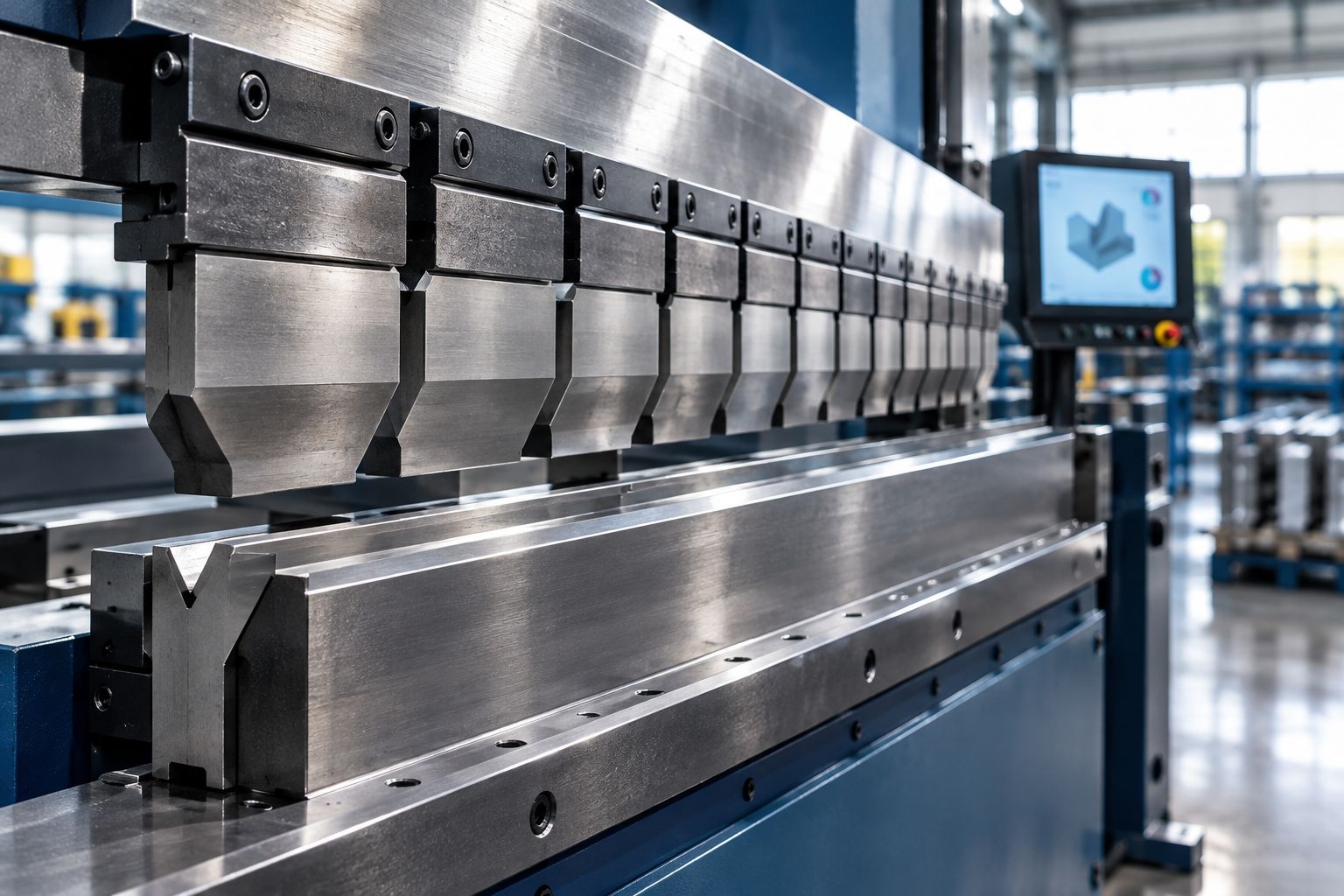
Sectional die pros:
- Reconfigures bend length without a full tooling change
- Distributes tonnage across joints for mixed-run flexibility
- Common on WILA-style systems; see WILA-compatible tooling options
Sectional die cons:
- Per-segment load rating caps below a solid-body die of the same length
- Segment fit and box clearance need verification before every reconfiguration
Verdict: Buy — the right call when bend length changes job to job and box clearance is checked against the drawing each time.
3. Standard American-style V-die: best for general fabrication with mixed material
Standard American-style V-dies cover the middle tonnage band most shops run day to day — mild steel, aluminum, and light stainless at common gauges. Interface compatibility is broad, which keeps this tier the default choice when a job doesn't demand extremes.
Standard V-die pros:
- Fits the widest range of press brake models and clamping interfaces
- Predictable tonnage rating across common material grades
- Lower installed cost of ownership than reinforced heavy-duty bodies
Standard V-die cons:
- Capacity ceiling limits use on heavy-gauge or high-strength steel jobs
- Not the right pick for tight aerospace-grade tolerances
Verdict: Buy — default here unless the drawing pushes into heavy-gauge territory or tight-tolerance aerospace work.
4. European-style (WILA/TRUMPF/LVD) precision die: best for tight-tolerance aerospace parts
European-style dies built to the 100 mm station standard trade some raw tonnage ceiling for repeatable clamping and tighter tolerance control across brands. That trade-off is exactly what aerospace and precision sheet-metal parts demand.
European-style precision die pros:
- Consistent 100 mm clamping interface across WILA, TRUMPF, and LVD systems
- Tighter repeatable tolerance on flange geometry
- Matches aerospace sheet metal tooling requirements
European-style precision die cons:
- Rated tonnage sits below heavy-duty bodies at the same opening width
- Precision manufacturing adds lead time on custom profiles
Verdict: Buy — the right tier when the drawing's tolerance stack matters more than raw bending force.
5. Box / U-die (offset die): best for closed-profile and box-section bends
Box dies and U-dies form offset and Z-bends in a single hit by shaping both legs of a profile at once. The geometry itself limits how much tonnage the die can absorb compared to a straight V-opening, so capacity sits in the medium-low tier even on a high-tonnage machine.
Box/U-die pros:
- Produces offset and closed-profile bends without a second setup
- Reduces handling on box-section parts
Box/U-die cons:
- Lower usable tonnage than a straight V-die of comparable size
- Limited to specific flange geometries by design
Verdict: Hold — order only when the part geometry genuinely calls for an offset or box profile; a V-die plus a second hit often outperforms it on flat runs.
6. Radius / bottom-bending die: best for large-radius stainless and aluminum forming
Radius dies bottom the material against a fixed profile instead of air-bending it, giving a consistent large radius without the cracking risk that high-strength or work-hardened material shows under acute bends. Stainless work in particular benefits — stainless typically needs a wider opening ratio, roughly 10 to 12 times material thickness rather than the 8x rule used for mild steel.
Radius/bottom-bending die pros:
- Consistent large radius across repeated cycles
- Lower cracking risk on stainless and work-hardened aluminum
- Fits stainless steel fabrication tooling programs
Radius/bottom-bending die cons:
- Not rated for high-force acute bending
- Bottoming requires more tonnage per bend than free-bending on thin gauge
Verdict: Buy — the correct pick anytime the drawing specifies a large radius on stainless or aluminum rather than a sharp acute bend.
7. Hemming die (flat/teardrop): best for aluminum panel hemming and finished edges
Hemming dies close a pre-bent flange into a flat or teardrop hem and carry the lowest rated capacity on this list because they're rated for closing load on a folded edge, not raw bending force on flat stock. That's by design — hemming is a finishing operation, not a forming one.
Hemming die pros:
- Produces clean, consistent finished edges on aluminum panels
- Controlled pre-bend geometry reduces surface marking
Hemming die cons:
- Lowest tonnage capacity of any type in this ranking
- Requires a separate pre-bend step before the closing hit
Verdict: Buy — the right call specifically for panel hemming; wrong call for anything else on this list.
Verify tonnage fit before ordering
Send your drawing and machine interface for a tooling review.
How this ranking was built
Each die type is ranked by rated tonnage capacity relative to the other tiers, cross-checked against the five factors above: opening width, body material, bend length and segment count, clamping interface, and material grade ratio. The order matches how the factors stack, not brand preference — a heavy-duty V-die outranks a hemming die because the geometry itself, not the manufacturer, sets the ceiling.
Which press brake die should you choose?
Start with the part drawing, not the die catalog. If the job is heavy-gauge steel near your machine's rated tonnage, specify a heavy-duty thick-body V-die. If bend length changes run to run, a sectional die keeps you from stocking a die set per length. For anything without an extreme on either end, a standard V-die covers the job in 2026 the same way it has for the last decade — check the clamping interface and installed height against your machine before you order, and let the finished-part drawing drive the tonnage decision, not the other way around.
FAQ
How is press brake die tonnage capacity calculated?
Tonnage capacity is set by the die's V-opening width, body material and heat treatment, and bend length relative to material thickness and grade. A wider opening at the same thickness raises the safe tonnage ceiling; a narrower opening lowers it.
Which press brake die has the highest tonnage capacity?
Heavy-duty thick-body V-dies carry the highest tonnage capacity on this ranking, built for heavy-gauge steel near a machine's rated ceiling. Sectional dies rank close behind for mixed-length production.
Are sectional dies rated lower than solid-body V-dies?
Yes, per-segment load caps below a solid-body die of the same length because tonnage is distributed across joints. Total rail capacity can still be high if segment fit and clamping are correct.
What is the standard V-die opening ratio for mild steel?
The common industry rule is 8 times material thickness for mild steel. Stainless and high-strength grades typically need a wider ratio, closer to 10 to 12 times thickness.
Can a hemming die be used for general bending?
No, hemming dies are rated for closing load on a pre-bent flange, not raw bending force on flat stock. Using one for general forming risks cracking the die or the part.
Do WILA, TRUMPF and LVD dies share the same tonnage rating?
They share a common 100 mm European-style clamping interface, but tonnage rating still depends on the specific die's opening width and body construction, not the interface alone.
Why does material grade change which die tier fits?
Higher-strength grades like stainless resist bending more than mild steel, requiring a wider opening and often a heavier body to stay within safe tonnage limits at the same thickness.
What happens if a die's tonnage rating is exceeded?
Exceeding rated tonnage crushes the V-opening edges, cracks segment welds on sectional dies, or deforms the clamping interface, damaging the tool rather than the machine.
One last thing
The factor most shops skip in 2026 isn't tonnage math — it's checking installed height and clamping interface against the actual machine before the die shows up. A die rated well within tonnage still won't clamp correctly if the interface doesn't match, and that mismatch costs more downtime than an undersized die ever does.
Related guides
- Best press brake dies for stainless steel fabrication
- Best sheet metal hemming tools for aluminum panels
Open this COVO engineering guide · Browse press brake tooling · Request technical support