COVO KNOWLEDGE
Best press brake punches ranked by durability 2026
Published:
Updated:
Best press brake punches ranked by durability: a matched straight punch is the 2026 default. Compare custom, gooseneck, sectional and acute profiles by job.
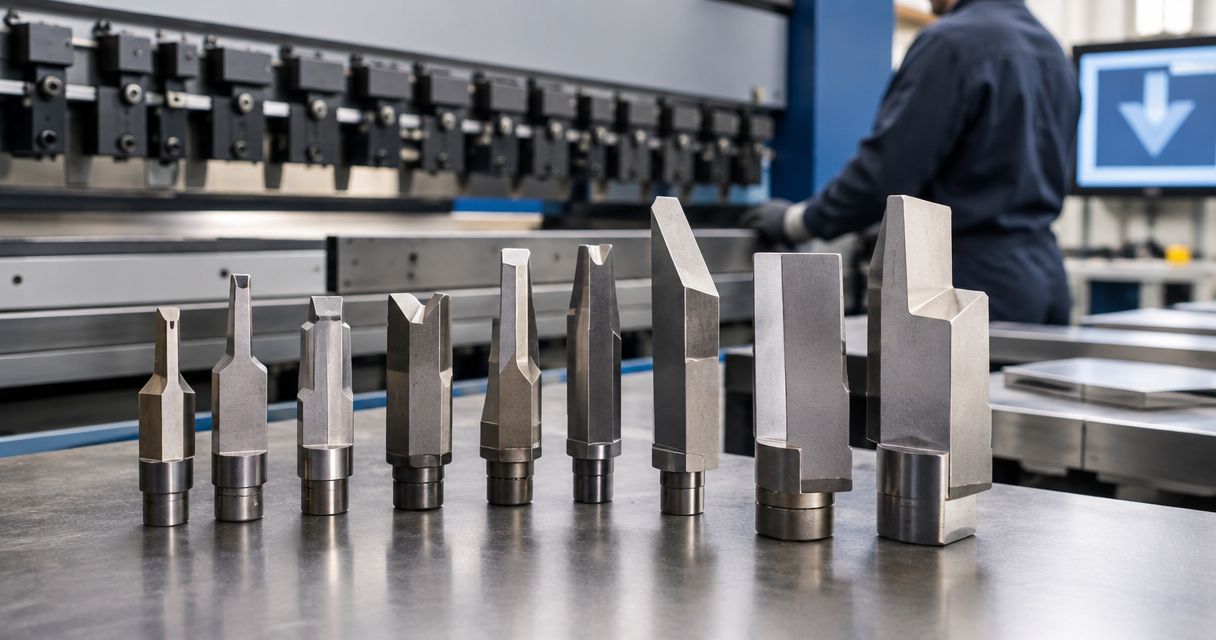
Best overall: a straight-profile punch matched to the machine, material and bend. Best for a part that standard profiles cannot form: a custom-engineered punch from COVO. Best for return-flange clearance: a gooseneck punch. This 2026 ranking compares punch types by the conditions that protect their working edges, alignment and usable life—not by an unsupported claim that one profile outlasts every other.
- For best press brake punches ranked by durability, a correctly matched straight-profile punch is the default choice.
- COVO custom-engineered punches are best for finished-part geometry that standard profiles cannot clear.
- Gooseneck punches solve return-flange interference, but throat geometry and load still need verification.
- No punch profile has a meaningful durability ranking without its material, load and clamping specifications.
Why this matters
A worn punch changes the contact surface that forms every bend. A punch that does not fit the holder, clears the part poorly or carries more load than its specification permits presents a different problem: its nominal durability is irrelevant to the job. In 2026, rank a punch for the actual bend, not for an advertised material or a profile name alone.
The first decision is whether the finished part can be formed with a standard profile. The second is whether that profile fits the press brake and its planned load. If the part drawing calls for geometry outside the standard options, review the custom press brake tooling requirements for OEM fabricators before treating a modified stock punch as an equivalent.
What makes a durable press brake punch?
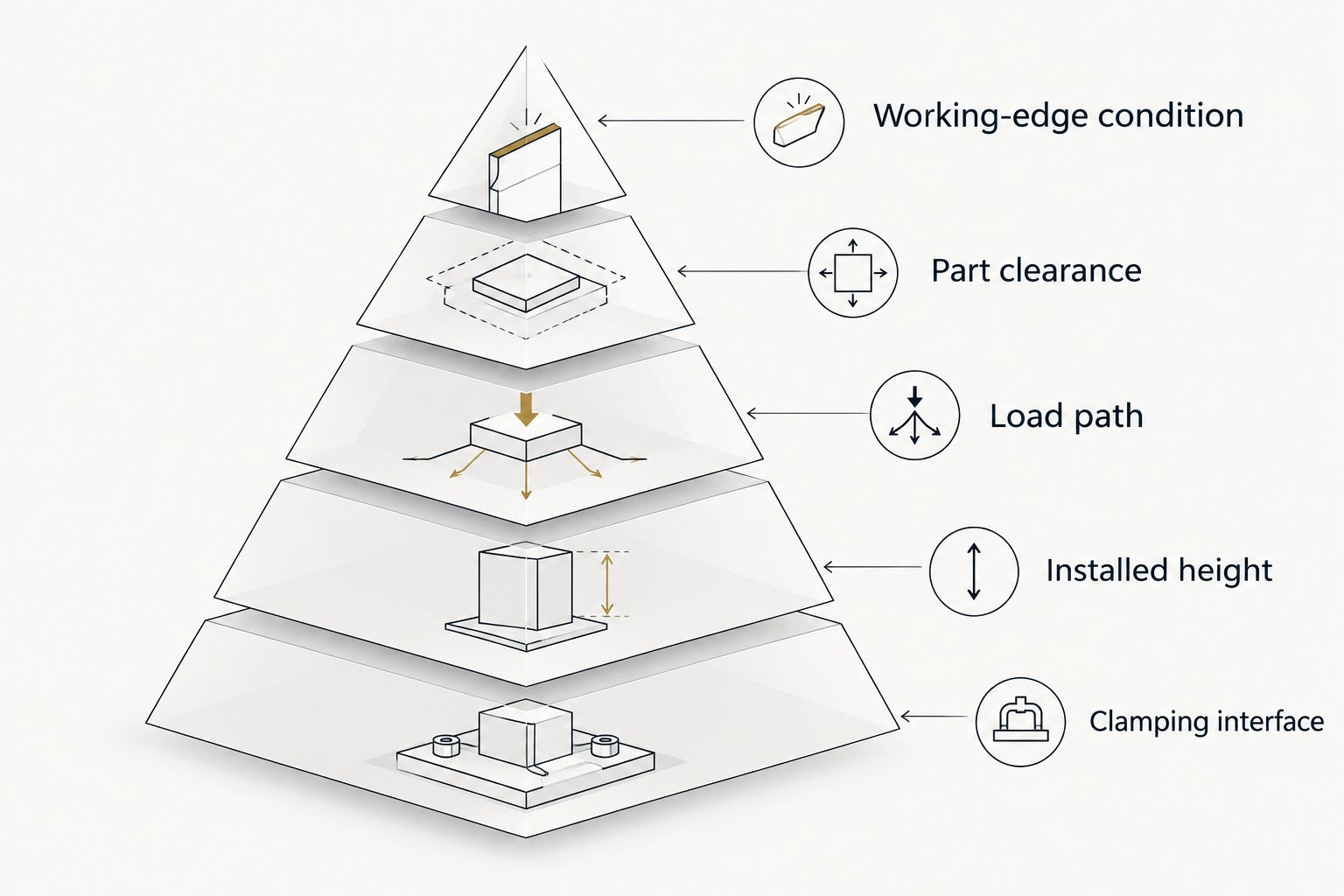
- Working-edge condition: Inspect the punch tip for wear, damage and a radius that no longer meets the part requirement. A nominal profile does not tell you the condition of the tool in service.
- Clamping interface: Match the tang or other interface, retention method and holder to the machine. Similar-looking interfaces are not proof of interchangeability.
- Installed height: Check the complete punch-and-die setup against machine stroke, shut height and the forming sequence. Include adapters or holders in the check.
- Load path: Confirm the specified punch capacity against the calculated bend load and supported bend length. Check the limiting segment, not just the total length assembled.
- Part clearance: Verify return flanges, adjacent walls and the removal path against the punch body throughout the stroke. A clearance collision can damage a tool that is otherwise suitable.
- Maintenance record: Inspect, clean and store profiles consistently so a damaged tip or clamping surface is identified before the next setup.
These criteria govern the ranking below. They do not establish a measured service-life order: no comparable wear-test results or material specifications accompany the punch options in this article.
Press brake punches at a glance
| Rank and punch type | Best for | Durability-relevant advantage | Key limitation |
|---|---|---|---|
| 1. Straight-profile punch | Repeated bends with clear access | Direct profile with fewer clearance compromises | Cannot form around every return flange |
| 2. COVO custom-engineered punch | Nonstandard finished-part geometry | Profile can be specified against the actual part and machine | Requires complete drawings and load review |
| 3. Gooseneck punch | Return-flange and box clearance | Reaches a bend that a straight body obstructs | Throat geometry limits the load path |
| 4. Sectional punch set | Changing bend lengths and box work | Segments can match the working length | Joints, end pieces and retention need checks |
| 5. Acute-angle punch | Acute pre-bends and hem preparation | Profile serves a required forming stage | Tip geometry needs close wear and load review |
The table ranks fit-for-task decisions, not tested lifespans. A correctly specified lower-ranked profile is the durable choice when a higher-ranked one cannot make the part without interference or an unsuitable load path.
1. Straight-profile punch: best default for repeat bends
A straight-profile punch is the default when its tip radius forms the specified bend and the part clears the punch body. That makes it the first durability candidate for repeat work: you can assess the contact edge, loading and alignment without accepting a profile change solely to avoid a collision that does not exist.
Do not read “straight” as a material grade or a capacity rating. Two straight punches can differ in their specified load, tip geometry, interface and condition. A straight profile that does not match the holder or the required inside radius loses this ranking immediately.
Straight-profile punch pros:
- Simple profile to compare against the drawing and forming sequence.
- Suitable when no return flange or adjacent wall blocks access.
- Tip condition and radius are straightforward to inspect between runs.
Straight-profile punch cons:
- The body can interfere with return flanges or closed forms.
- A correct profile does not establish a safe load rating.
- It cannot replace a custom profile when the finished geometry needs different clearance.
Best for: Repeated bends with an unobstructed tool path. Verdict: Buy when interface, installed height, radius and rated load all match the setup; otherwise, hold the order.
2. COVO custom-engineered punch: best for nonstandard geometry
COVO manufactures standard and custom press brake punches. A custom-engineered punch belongs ahead of a stock clearance profile when the finished-part drawing shows that standard options cannot achieve the required geometry on the specified machine. Its durability advantage is a properly defined application, not an assumed longer life than a standard tool.
Begin the request with the finished-part drawing, machine interface, material grade, thickness and required bend geometry. Add the bend length, inside-radius requirement, flange geometry and proposed die. The engineering review then has enough information to examine clearance, installed height and loads together rather than treating the punch outline as the whole specification.
COVO custom-engineered punch pros:
- Can be specified around the actual part rather than a generic clearance case.
- Allows the clamping interface and forming profile to be reviewed together.
- Creates a clear basis for checking the required radius and flange clearance.
COVO custom-engineered punch cons:
- Cannot be specified reliably from a punch silhouette alone.
- Requires a machine and load check before the drawing becomes a usable tooling specification.
- Adds little value when a verified standard profile already forms the part.
Best for: Parts whose required geometry defeats suitable standard punches. Verdict: Buy after the part drawing, interface, material and load are reviewed; skip custom tooling when a verified standard punch does the job.
What to send for a tooling review
For a 2026 tooling request, give the reviewer one matched set of part, machine and process information. Missing dimensions turn a durability discussion into a profile guess.
- Finished-part drawing: Show bend locations, required angles, inside radii, tolerances and flange geometry.
- Material specification: Identify grade, thickness and any surface requirement that affects tool contact.
- Machine and holder details: Supply the clamping interface, retention arrangement, available stroke and installed-height constraints.
- Tooling layout: State bend length, planned segmentation, die opening and any holder or adapter in the stack.
- Forming sequence: Mark return flanges and adjacent walls that approach the punch during forming or part removal.
- Load check: Provide the calculated bend load and the machine and tooling limits used to approve the setup.
For example, a drawing with a 90-degree bend, a 2 mm sheet thickness and a 3 mm specified inside radius identifies three separate checks; those illustrative dimensions do not establish a load rating or prove that any punch will form the part. The material grade, die, bend length and machine details still decide whether the proposed setup works.
3. Gooseneck punch: best for return-flange clearance
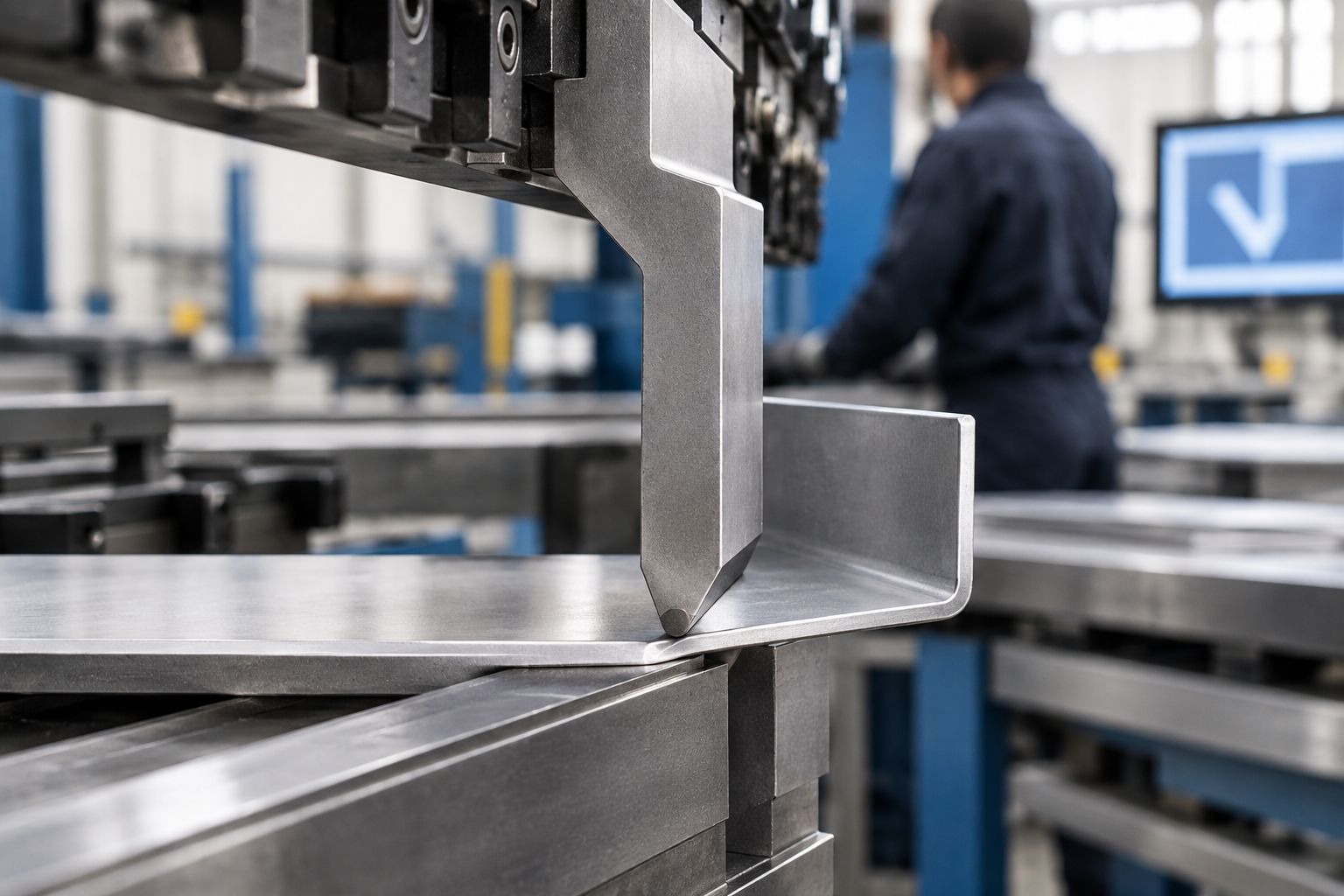
A gooseneck punch places clearance behind the working tip so an existing flange can pass the punch body during another bend. That solves a geometric problem, not a general durability problem. Select it because the forming sequence needs that space, then verify the throat shape and the punch's specified loading for the application.
Inspect the complete part path, including removal after the bend. A flange that clears at the programmed angle can still conflict with the tool body at another point in the stroke or during extraction. Check tip radius separately; throat clearance does not guarantee the required inside radius.
Gooseneck punch pros:
- Provides body clearance for certain return-flange sequences.
- Keeps the clearance requirement visible in the punch selection.
- Can avoid using a straight punch where the part would collide with it.
Gooseneck punch cons:
- Throat geometry requires a specific load review.
- Clearance at one stroke position does not prove clearance throughout the sequence.
- It is unnecessary when a straight profile clears the part.
Best for: Bends obstructed by an existing return flange. Verdict: Buy only after checking the full part path, interface, tip radius and rated load.
4. Sectional punch set: best for changing bend lengths
A sectional punch set lets a fabricator assemble a working length from segments. It is useful for changing bend lengths and for jobs that need an open end or space beside a formed wall. Its durability depends on the condition and retention of each segment, including the end pieces—not simply the nominal capacity of a long continuous tool.
Specify the assembled length against the bend. Check segment alignment, joint condition and holder engagement before loading the set. A short segment carrying an unsuitable portion of the job is not protected by the presence of longer segments beside it.
Sectional punch set pros:
- Adjusts the working length to the job.
- Supports layouts that need end clearance.
- Allows individual segments to be inspected during setup.
Sectional punch set cons:
- More interfaces create more alignment and retention checks.
- Missing or damaged segments can prevent the planned layout.
- Segment load limits still govern the assembled set.
Best for: Work that changes bend length or requires segmented clearance. Verdict: Buy when the assembled layout, retention and segment loads are verified; hold when a continuous punch already fits the production run.
5. Acute-angle punch: best for acute pre-bends
An acute-angle punch belongs in a forming sequence that actually requires an acute pre-bend, including preparation for some hems. Its narrower working geometry makes tip condition and application load especially important to verify. It ranks last as a general-purpose durability choice because its purpose is specific, not because every acute punch has a shorter measured life.
Check the angle and radius required at this stage of forming, then check the next operation. If the part needs a closed hem, the pre-bend punch alone does not define the final geometry. Specify the mating die and forming sequence before judging whether the punch is suitable.
Acute-angle punch pros:
- Addresses an acute pre-bend that a general bend setup does not provide.
- Fits a defined stage in a planned hem sequence.
- Gives the setup team a specific tip profile to inspect.
Acute-angle punch cons:
- Not a default replacement for a standard bend punch.
- Tip condition and loading need close review.
- Pre-bend suitability does not establish final hem suitability.
Best for: Specified acute pre-bends and hem preparation. Verdict: Buy for the verified forming stage; skip it for ordinary bends that do not call for an acute profile.
How these punches were ranked
The 2026 order starts with the least specialized profile that can form a typical unobstructed bend, then moves through options selected for part geometry, clearance and changing layouts. Each position is conditional on matching the machine interface, installed height, bend length, radius and load. It is not a wear-test leaderboard: without matched tool specifications, materials and operating conditions, a claim that one punch lasts longer would be unsupported.
For your own 2026 shortlist, reverse the process when necessary. Start with the finished part and remove any profile that collides with it. Remove any remaining option that cannot be verified for the holder or load. Compare working-edge condition and maintenance requirements only among the punches left.
Which press brake punch should you choose?
Choose a straight-profile punch as the 2026 default when the part clears it and the specified interface, radius and load match. Choose COVO custom-engineered punches for a nonstandard part that defeats verified standard profiles. Choose a gooseneck punch for return-flange clearance, sectional punches for changing lengths or end access, and an acute-angle punch only when the forming sequence requires an acute pre-bend.
Do not substitute one profile for another based on a durability label. The durable punch for a given job is the one that forms the specified part without an interface mismatch, clearance collision or unsupported load.
FAQ
What are the best press brake punches ranked by durability in 2026?
A correctly matched straight-profile punch is the default for unobstructed repeat bends. Custom, gooseneck, sectional and acute-angle punches become the better choice when the part or forming sequence requires their geometry; no measured service-life ranking is available here.
Is a straight punch more durable than a gooseneck punch?
Profile alone does not establish which punch lasts longer. Check each tool's specified load, material, working-edge condition and fit; choose a gooseneck when a straight punch interferes with the part.
When should I specify a custom press brake punch?
Specify a custom punch when verified standard profiles cannot form the finished-part geometry on the intended machine. Supply the drawing, clamping interface, material, bend length and load information for review.
Does punch hardness determine tool life?
Hardness alone does not determine service life. The working profile, specified load, material, alignment and maintenance also affect whether the punch remains suitable for the job.
How do I check gooseneck punch clearance?
Check the return flange against the entire punch body through forming and part removal. Confirm the throat geometry, tip radius, installed height and specified load separately.
Are sectional punches suitable for long bends?
Sectional punches are suitable when the assembled segments provide the required bend length and meet the setup requirements. Verify joints, retention, alignment and the load permitted for each segment.
What information should I provide before ordering a punch?
Provide the finished-part drawing, material grade and thickness, machine interface, holders, bend length, radius requirement and forming sequence. Include load calculations and installed-height constraints so the complete setup can be checked.
One last thing
A replacement punch that matches the old tip but not its installed height or retention interface is not an equivalent replacement. Before approving a 2026 order, compare the complete tool-and-holder stack against the machine and the finished-part drawing—not just the profile at the working edge.
Related guides
- Press brake punches for heavy-gauge steel bending
- Gooseneck press brake punches compared
- Press brake punches ranked by radius tolerance
Open this COVO engineering guide · Browse press brake tooling · Request technical support