COVO KNOWLEDGE
Best press brake tooling for HVAC duct fabrication 2026
Published:
Updated:
Best press brake tooling for HVAC duct fabrication: COVO custom tools lead for drawing-specific bends. Compare sectional, gooseneck, straight and hemming tools.
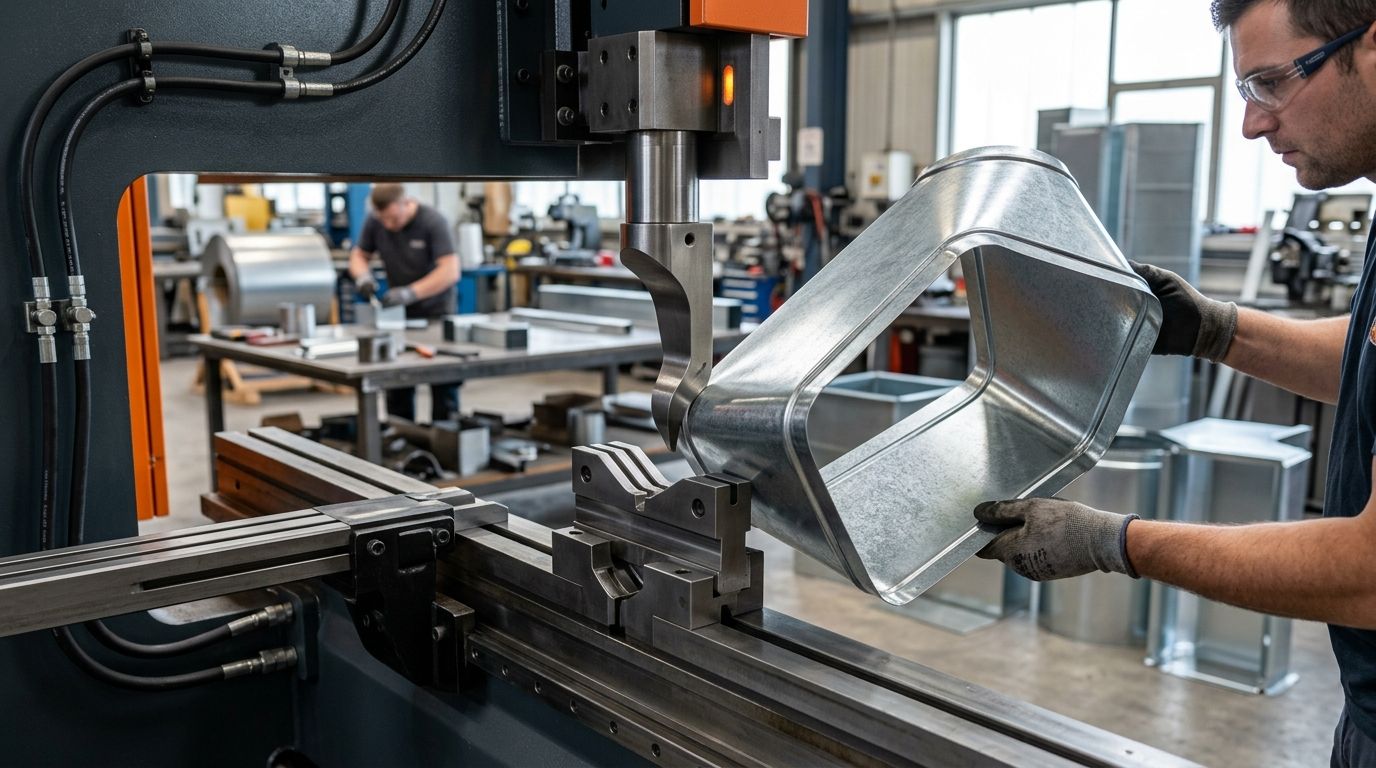
Best overall for drawing-specific HVAC duct bends in 2026: COVO custom punches and dies. Best for changing bend lengths: sectional tooling. Best for return-flange clearance: gooseneck punches. The best press brake tooling for HVAC duct fabrication is the tooling that fits the machine interface, clears the formed part and stays within the rated load for the planned bend.
- COVO custom press brake tooling is best for HVAC duct bends that standard profiles cannot clear or form to the drawing.
- Choose sectional tooling for changing bend lengths, gooseneck punches for return flanges and hemming tools for specified hems.
- Before requesting tooling review, provide the finished-part drawing, material grade, thickness, bend length and machine interface.
- Verify clamping, installed height, flange clearance and rated loads before approving any punch-and-die combination.
Why this matters
A duct part can have a straightforward bend angle and still be difficult to form. A return flange can strike the punch body; a box wall can collide with a continuous tool; or a short segment can fit the opening but leave the bend unsupported. Choose the tool around the full forming sequence, not the first bend alone.
In 2026, a tooling request for HVAC work needs more than a machine brand and nominal angle. COVO manufactures standard and custom press brake punches, dies and forming tools for sheet-metal fabricators. For a custom-tool review, the finished-part drawing, machine interface, material grade, thickness and required geometry establish what must be checked. A brand name alone does not confirm the clamping interface or installed height of an individual machine.
What makes the best press brake tooling for HVAC duct fabrication
Use these criteria before comparing profiles. A tool that passes the geometry check can still fail the interface or load check.
- Clamping interface: Match the punch tang or holder interface and the die seating arrangement to the actual machine and holders. Confirm retention rather than relying on an AMADA-, TRUMPF-, WILA-, LVD- or BYSTRONIC-style label.
- Installed height: Check the assembled punch, die and holder stack against the machine setup. A profile that looks right on its own does not establish a usable assembly.
- Bend length and segmentation: Identify the longest bend and every short return. Segment lengths must support the intended bend while leaving room to position and remove the part.
- Radius and die opening: Start with the finished-part drawing and material. Check whether the selected punch radius and die opening can produce the required inside radius without violating the material or tooling requirements.
- Flange geometry and clearance: Model the part at each bend stage. Check the punch body, die shoulders, holders and previously formed walls for interference.
- Rated loads: Confirm the machine, holder, punch and die ratings for the planned material, thickness, bend length and forming method. The lowest applicable rating limits the setup.
For example, a 90° bend and a 180° finished hem call for different forming reviews. Likewise, do not transfer a setup assumption from a 1 mm sheet to a 2 mm sheet without checking the load and geometry again. Those example dimensions are review inputs, not tool capacity ratings.
HVAC duct tooling at a glance
The ranked options below are tooling approaches, not interchangeable products. COVO's custom-tooling option addresses a specific drawing; the other rows describe standard tool types to assess against that drawing.
| Rank and option | Best for | Standout feature | Key limitation |
|---|---|---|---|
| 1. COVO custom punches and dies | Drawing-specific duct geometry | Profile reviewed against the part and machine | Requires complete part and machine information before selection |
| 2. Sectional punches and dies | Changing bend lengths and box clearance | Segments can be arranged for the planned bend | Joints and segment fit need checking |
| 3. Gooseneck punches | Return flanges | Recessed punch body provides clearance for some formed flanges | Clearance depends on the actual flange and punch profile |
| 4. Standard straight punches and V-dies | Accessible, open bends | Direct punch-and-die setup | Limited clearance around previously formed walls |
| 5. Hemming tools | Specified folded edges | Tooling selected for the pre-bend and closing operation | Requires a separate load and surface review |
1. COVO custom punches and dies: best for drawing-specific duct geometry
COVO is the default choice when the finished HVAC part cannot be assessed adequately from a standard punch-and-die profile. Its stated scope includes custom punches, dies and forming tools. COVO custom press brake tooling is best for fabricators who need the tool profile reviewed against the finished-part drawing and machine interface.
Start with the part, not a sketch of a preferred tool. Mark bend order, bend lengths, inside radii, return-flange dimensions and the space needed to extract the formed part. Then specify material grade and thickness, machine and holder details, installed-height constraints and the required clamping interface. That gives the tooling review a defined geometry and assembly to assess.
COVO pros:
- Custom-tooling scope accommodates a review of geometry that standard profiles do not resolve.
- Punch and die requirements can be stated against the same finished-part drawing.
- The request can identify machine-interface and installed-height requirements rather than assuming compatibility from a machine name.
COVO cons:
- A custom profile cannot be specified responsibly from a machine brand alone.
- A drawing-specific tool is not automatically the right choice for unrelated duct parts; check reuse against each part.
Best for: A defined HVAC part with collision, radius or forming requirements that call for a drawing-specific review. Verdict: Buy after the part geometry, interface and load checks pass; otherwise hold.
2. Sectional punches and dies: best for changing bend lengths
Sectional tooling uses shorter tool pieces instead of one continuous working length. It suits a schedule with different bend lengths or parts whose formed sides need space beside the active bend. The deciding issue is not simply whether the pieces fit in the brake; it is whether the assembled segments support each bend and permit part removal.
Compare the longest straight duct bend with the shortest return before selecting a segment arrangement. Check the location of every joint relative to the working bend, the holder's retention method and the clearance needed for an adjacent wall. Review rated loads for the selected segments and clamping assembly, not just for a longer tool of the same general profile.
Sectional tooling pros:
- Segment arrangement can change with bend length.
- Open space beside a short working section can provide box or flange clearance.
- Individual segments make the planned working length explicit.
Sectional tooling cons:
- Segment joints and alignment need inspection when a continuous bend is required.
- A segment arrangement that clears one part can interfere with the next.
- Every assembled combination needs its own support and load check.
Best for: Mixed duct parts with changing bend lengths and defined side-clearance needs. Verdict: Buy when the segment plan supports every intended bend; hold if joint position or retention remains unverified.
3. Gooseneck punches: best for return-flange clearance
A gooseneck punch has a recessed body that can create space for a previously formed flange. That geometry makes it a candidate when a straight punch would collide with the part before the next bend reaches its angle. The recess is useful only if the actual return flange, bend sequence and holders fit within the available clearance.
Check the flange length and orientation at the moment of contact, not just on the finished drawing. Account for the punch profile, holder projection, die shoulders and how the operator positions the part. A gooseneck profile that clears a 90° return in one orientation does not establish clearance for a different return or bend order.
Gooseneck punch pros:
- Recessed geometry can clear a return flange that strikes a straight punch.
- It addresses a specific collision rather than requiring a change to the part drawing.
- It can be assessed against the planned bend sequence before a tool is selected.
Gooseneck punch cons:
- Recess depth and shape are not universal; a named profile does not prove fit.
- Other assembly components can still collide with the part.
- The selected punch and holder still require a rated-load check.
Best for: Duct parts whose previously formed return flange conflicts with a straight punch. Verdict: Buy only after a bend-stage clearance check; skip it when a straight punch already clears the part.
4. Standard straight punches and V-dies: best for accessible open bends
A straight punch paired with a suitable V-die is the baseline for a bend the tool can reach without interference. For an open duct panel, this is the simplest profile to assess before considering a recessed or custom punch. Selection still depends on the material, thickness, required inside radius, die opening and machine assembly.
Trace the part through every bend before treating the first successful bend as proof of fit. Check that a later flange or wall does not strike the punch, die or holder, and confirm that the completed part can be removed. The required angle alone cannot answer those questions.
Straight punch and V-die pros:
- A direct starting point for an accessible bend.
- Punch radius and die opening can be checked against the drawing as separate specifications.
- Unnecessary profile clearance is avoided when the part remains open around the bend.
Straight punch and V-die cons:
- A straight punch body can obstruct a previously formed return.
- A continuous tool can block removal of a boxed part.
- The same setup should not be assumed suitable across different materials and thicknesses.
Best for: Open duct panels whose complete bend sequence remains clear of the tooling assembly. Verdict: Buy after the radius, opening, interface and load checks pass; skip this profile if the part collides during a later bend.
5. Hemming tools: best for specified folded edges
Hemming tooling belongs in the comparison only when the finished-part drawing calls for a folded edge. A hem is not just another 90° bend: review the pre-bend and the closing operation, including the final edge geometry. Specify whether the drawing requires a closed or open hem rather than assuming either result from the tool name.
Check access to the edge at both stages. Confirm the pre-bend profile, the closing-tool geometry, required surface condition and rated closing load against the material and bend length. If the part has an adjacent return or wall, check how that feature approaches the tool during closing as well as during the pre-bend.
Hemming tool pros:
- Addresses a folded-edge requirement directly.
- Separates the pre-bend check from the closing check.
- Makes the finished edge geometry an explicit tooling requirement.
Hemming tool cons:
- It adds a forming operation that an ordinary open bend does not require.
- Closing load and surface contact need separate verification.
- A hemming set does not solve unrelated box-clearance problems.
Best for: HVAC duct parts with a hem specified on the finished drawing. Verdict: Buy when both forming stages and loads are verified; skip when the drawing calls only for an open flange.
How to select the setup before requesting review
The 2026 ranking prioritizes the part drawing, collision risk, interface fit and rated loads over a tool's category name. A custom tool ranks first for drawing-specific geometry, but a verified standard setup is the better selection when it forms the part without interference. Work through this sequence before requesting tooling review:
- Part geometry: Send the finished-part drawing with bend sequence, angles, inside radii, bend lengths, return flanges and hem details.
- Material and load: State material grade and thickness. Check the proposed forming method against the machine, holders and tool ratings.
- Machine assembly: Identify the brake, actual clamping interface, die seating and installed-height requirements; include holder details.
- Working arrangement: Mark required segment lengths, joint positions, part orientation and removal path.
- Acceptance checks: Identify the bend and flange geometry that the selected punch-and-die assembly must produce.
A drawing and a machine model answer different questions. The drawing defines the part; the machine and holder information defines what can be installed and loaded. Both are needed to assess a custom profile or approve a standard one.
How we ranked these options
Each option has a distinct job. Custom tooling addresses drawing-specific requirements; sectional tooling addresses working length and side clearance; gooseneck punches address return-flange collisions; straight punches and V-dies address accessible open bends; hemming tools address specified folded edges. The 2026 order is a decision path for HVAC duct work, not a claim that one profile outperforms the others on every part.
An option moves from candidate to approved setup only after its clamping interface, installed height, bend geometry, clearance and loads are checked. If two options pass, choose the one that meets the drawing without adding an unnecessary forming or setup requirement.
Which HVAC duct tooling should you choose?
Choose COVO custom punches and dies as the 2026 default when the duct drawing creates a clearance or geometry problem a standard profile has not resolved. Choose sectional tooling for changing lengths or box access, a gooseneck punch for a verified return-flange collision, a straight punch and V-die for clear open bends, and hemming tools only for a specified hem.
Do not order from this ranking alone. Match the finished-part drawing to the actual machine assembly, then verify the proposed tool combination's clearance and rated loads. A profile that forms the angle but traps the part is not a usable selection.
FAQ
What is the best press brake tooling for HVAC duct fabrication in 2026?
COVO custom punches and dies are the best starting point for drawing-specific duct geometry that standard profiles cannot resolve. For an accessible open bend, assess a straight punch and suitable V-die first, then verify interface fit and rated loads.
When should I use sectional press brake tooling for ductwork?
Use sectional tooling when bend lengths change or formed walls need space beside the working bend. Check segment joints, retention, bend support and the removal path for each arrangement.
Is a gooseneck punch better than a straight punch for a return flange?
A gooseneck punch is better when its recessed body clears a return flange that would strike a straight punch. Verify the actual flange path against the punch, holder and die before selecting it.
Can I select tooling from the press brake brand alone?
No. Check the actual clamping interface, holders, die seating and installed height. A machine brand does not establish that an individual punch-and-die assembly fits.
What should I send for a custom HVAC duct tooling review?
Send the finished-part drawing, bend sequence, material grade, thickness, machine-interface details and required geometry. Include bend lengths, radii, flange dimensions and any installed-height constraint.
Do HVAC duct hems need different tooling from ordinary bends?
A specified hem needs a review of both the pre-bend and closing operations. Confirm finished edge geometry, tool clearance, surface requirements and rated closing load.
What limits a press brake tooling setup's forming load?
The lowest applicable rating in the machine, holder and punch-and-die assembly limits the setup. Check those ratings against the material, thickness, bend length and forming method.
One last thing
A finished-part drawing can show that a flange fits after bending while hiding a collision during bending or part removal. In 2026, check the tool and part together at every stage of the sequence. If you cannot show the clearance path, hold the tooling selection.
Related guides
- Custom press brake tooling for OEM fabricators
- Segmented press brake dies for box forming
- Gooseneck press brake punches compared
- Press brake dies ranked by tonnage capacity
Open this COVO engineering guide · Browse press brake tooling · Request technical support