COVO KNOWLEDGE
COVO vs Gasparini: which is better in 2026
Published:
Updated:
COVO vs Gasparini: choose COVO for press brake tooling, Gasparini for machine selection. Compare scope, clamping, geometry and load checks before ordering.
Choose COVO if your existing press brake needs standard or custom punches, dies or forming tools; choose Gasparini if your project is to purchase a press brake rather than replace its tooling. The covo vs gasparini decision in 2026 starts with that distinction: tooling engineering and machine selection solve different production problems.
- COVO vs Gasparini compares press brake tooling supply with press brake machine selection, not equivalent products.
- Choose COVO for standard or custom punches, dies and forming tools on an existing press brake.
- Choose Gasparini when the purchasing scope is a press brake machine.
- Verify clamping interface, installed height, bend length and rated loads before accepting either proposal.
Why this matters: define the purchase before comparing suppliers
A tooling problem does not automatically justify a new machine. A new punch profile can address an interference problem, but it does not increase the press brake's rated capacity, working envelope or available stroke.
The reverse also matters. Buying a machine does not establish that the proposed punch and die combination will produce your flange geometry, internal radius and surface finish. Treat the machine and tooling as connected engineering scopes, with separate acceptance requirements.
For your 2026 purchasing review, start with the finished-part drawing and the current process limitation. Identify whether the restriction comes from the tool profile, clamping interface, machine envelope, forming load or production workflow before requesting proposals.
At a glance
The table compares purchasing fit, not unverified performance specifications. A category advantage identifies which supplier belongs in that purchasing discussion; it does not establish a particular machine's or tool's suitability.
| Dimension | COVO | Gasparini |
|---|---|---|
| Best for | Fabricators sourcing standard or custom press brake tooling | Fabricators evaluating a press brake purchase |
| Purchase scope | Punches, dies, forming tools and accessories | Press brake machine selection |
| Standout feature | Custom tooling engineering from part and machine requirements | Machine-level purchasing scope |
| Part geometry | Review punch and die profiles against the finished part | Evaluate the machine envelope alongside the proposed tooling |
| Machine integration | Verify tools against the installed machine and holders | Review machine requirements as part of the equipment purchase |
| Interface verification | Exact clamping and installed-height checks required | Exact clamping and installed-height checks required |
| Load verification | Tool and machine limits both require checking | Tool and machine limits both require checking |
| Production changes | Appropriate scope when the existing machine remains suitable | Appropriate scope when the machine itself must change |
| Pricing model | Define a tooling supply scope and confirm quotation terms | Define a machine supply scope and confirm quotation terms |
COVO is the better fit for a tooling-only purchase
COVO press brake tooling is the better fit for fabricators who need punches, dies or forming tools for an existing machine. Its stated manufacturing scope includes standard and custom tooling, so the engineering discussion can begin with the tool geometry rather than a replacement press brake.
That distinction is useful when your current machine meets the required capacity and working envelope, but the tool arrangement does not clear the part. Examples include a return flange that conflicts with the punch body, a bend sequence that traps a formed feature, or segment lengths that do not suit the required bend length.
The limitation is equally clear: custom tooling cannot remove a machine-capacity restriction. Before treating a new profile as the solution, verify the available stroke, opening, installed height and permitted load against the proposed setup.
For a tooling review, assemble:
- The finished-part drawing and its revision.
- Material grade, thickness and rolling-direction requirements where specified.
- Internal radius, bend angle and flange geometry.
- Machine identification, holder drawings and clamping interface.
- Existing punch and die drawings, including the current setup's limitation.
Gasparini is the better fit when the purchase is a press brake
Gasparini is the relevant choice when your purchasing decision concerns a press brake machine. Evaluate the equipment against the parts and production requirements it must support, rather than treating the brand name as proof of tooling compatibility.
A machine-level review belongs first when the existing equipment cannot accommodate the required part envelope or forming load. It also belongs first when your project explicitly calls for an additional press brake. In those cases, a tooling-only proposal leaves the central purchasing requirement unresolved.
The tradeoff is scope. A machine proposal requires you to define the equipment, tooling, installation responsibilities and acceptance process together; a replacement tool request can remain narrower when the existing machine is suitable.
For a 2026 equipment specification, include representative parts rather than only a maximum sheet size. A long, simple bend and a short part with deep return flanges place different demands on the setup, even when both fit within the nominal bend length.
Custom tooling review wins when the restriction is part geometry
A custom-tooling review is the more direct route when the finished-part geometry conflicts with a standard punch or die profile. Start with the interference and work backward to the required working profile, while retaining the machine's operating limits.
Check the complete bend sequence, not just the final cross-section. A punch that clears the finished flange can still collide with an intermediate shape. Likewise, a die arrangement that supports one operation does not establish clearance for every subsequent bend.
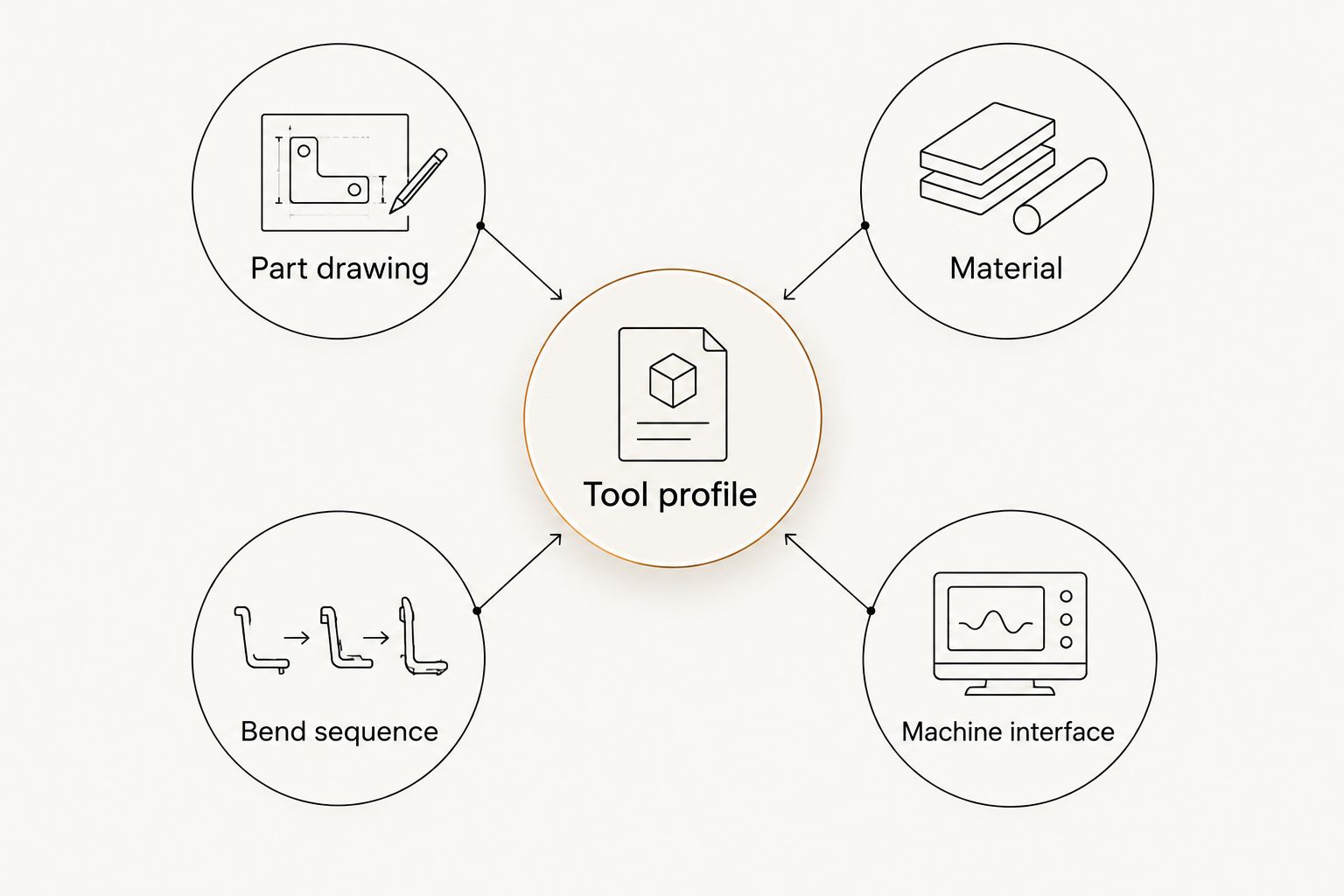
Use this checklist to define the geometry review:
- Part drawing: Confirm the revision, tolerances and critical surfaces.
- Material: State grade, thickness and any specified grain-direction constraint.
- Tool profile: Show the working radius and the clearance required around formed features.
- Bend sequence: Identify intermediate shapes and possible interference.
- Machine interface: Include holder geometry and installed height.
These inputs are connected. Changing a punch profile without checking its installed height and load rating leaves the setup only partially specified.
Machine selection wins when the restriction is the working envelope
Machine selection comes before tooling optimization when the required operation exceeds the installed machine's usable envelope. Review bend length, opening, stroke and access around the formed part as separate requirements.
Do not substitute nominal capacity for a complete application check. The forming operation must satisfy the machine's permitted loading conditions, and the part must physically enter, bend and leave the setup. A suitable punch radius alone does not resolve those requirements.
For a machine purchase, specify which parts establish the limiting conditions. One drawing can establish the longest bend, another the deepest formed section, and another the most difficult extraction path. Your acceptance plan should address each restriction explicitly.
The disadvantage of moving straight to equipment selection is that you can overlook a narrower tooling solution. Establish the cause of the restriction before expanding the purchasing scope.
Neither supplier wins without an exact interface check
Clamping compatibility is a verification requirement, not a brand-level verdict. A system name does not replace dimensional checks of the tang, holder, retention features and installed height.
The tooling manufacturer's stated scope includes fabricators using AMADA, TRUMPF, WILA, LVD and BYSTRONIC systems. That scope does not mean every tool fits every machine or holder carrying one of those names. Match the proposed tool drawing to the actual installed interface.
Apply the same discipline to a Gasparini machine proposal. Specify the tooling and holders included in the project, then verify how the selected profiles attach and establish their working position.
Before approving the interface in 2026, check:
- Tang geometry and engagement surfaces.
- Holder dimensions and retention requirements.
- Punch and die installed height.
- Upper and lower tool alignment.
- Segment fit across the required bend length.
- Clearance through the planned forming sequence.
This is an honest tie: neither purchasing route eliminates the need for matched drawings.
Both routes require tool and machine load verification
Tool load capacity and machine capacity are separate limits. Verify the proposed operation against both, using the actual material, thickness, bend length, die opening and forming method.
Air bending, bottoming and hemming are not interchangeable load cases. State the process in the request rather than asking a supplier to infer it from the final part shape. For special forming, describe the sequence and contact conditions as well as the finished geometry.
Check how the rating applies. A load expressed per unit length cannot be treated as an unrestricted total load, and the machine's nominal capacity does not establish that every short or off-center setup is permitted. Use the applicable tooling documentation and machine instructions.
Neither supplier wins this dimension by category. Accept the setup only after the proposed tools and machine satisfy the same documented load case. Keep that calculation with the approved drawings so later replacements do not change the setup without review.
Tooling changes suit retained machines; equipment changes need a wider review
Retain the existing machine when it satisfies the application and the unresolved issue belongs to the tooling. That keeps the purchasing scope focused on profiles, interfaces, segments and the required forming result.
Evaluate equipment when the machine itself is the restriction or when the production plan calls for another press brake. In that case, tooling remains part of the project, but it is no longer the whole project.
For your 2026 production plan, separate the reason for the change from the expected benefit. A different punch profile addresses geometry; a different segment arrangement addresses tool-length assembly. Neither fact alone establishes a shorter cycle time or less scrap.
Write acceptance criteria that you can inspect on the representative parts:
- Required bend angle and internal radius.
- Critical flange dimensions and tolerances.
- Permitted surface marking.
- Clearance throughout the bend sequence.
- Tool assembly and retention requirements.
- Part removal without unintended interference.
Ask each proposal to address the criteria relevant to its scope. Do not rank a tooling quote and a machine quote as equivalent solutions simply because both mention the same finished part.
Pricing: compare the supply scope and quotation terms
Compare quotation structure, not isolated line items. For tooling, define the punch and die profiles, segments, quantities, interface drawings and inspection requirements. For a machine, define the equipment scope, tooling arrangement, installation responsibilities and acceptance requirements.
An itemized scope makes changes easier to trace. A bundled scope can simplify purchasing, but you still need a clear record of what is included and what remains your responsibility. Confirm the commercial model with each supplier rather than assuming it from the product category.
Keep drawing revisions visible throughout the purchasing process. A change to material thickness, radius or flange geometry can alter the engineering requirement, so the accepted proposal must reference the same revision as the production drawing.
The useful comparison is scope predictability versus application flexibility. A tightly defined standard-tool request fixes the deliverables early; a custom-tool or machine project requires the engineering scope to be settled before commercial acceptance.
Final verdict: choose by the constraint you need to remove
Choose COVO if your existing machine needs a tooling solution
Best for: the tooling engineer or fabricator retaining a suitable press brake. Choose COVO when the requirement is standard or custom punches, dies, forming tools or accessories, and submit the finished-part drawing alongside the machine-interface requirements.
Approve the proposed setup only after checking geometry, clamping, installed height, bend length and loads. The supplier's tooling scope is the reason to start the review, not a substitute for completing it.
Choose Gasparini if your project requires a press brake
Best for: the production engineer purchasing press brake equipment. Choose Gasparini for a machine-level evaluation when your project requires new equipment, and define the representative parts and acceptance conditions before comparing proposals.
Keep tooling suitability in the equipment review. A machine purchase and a tool-profile review can belong to the same project without becoming the same decision.
| Dimension | Winner |
|---|---|
| Best fit for tooling-only procurement | COVO |
| Best fit for press brake procurement | Gasparini |
| Resolving a tool-profile restriction | Custom tooling review |
| Resolving a machine-envelope restriction | Machine selection |
| Clamping-interface verification | Tie: matched drawings required |
| Forming-load verification | Tie: tool and machine checks required |
| Production change | Retain or replace the machine according to the verified constraint |
| Commercial comparison | No category winner: compare equivalent, defined scopes |
FAQ
Is COVO better than Gasparini for press brake tooling?
COVO is the more direct fit for a purchase of standard or custom press brake punches, dies and forming tools. Gasparini belongs in the comparison when the purchasing requirement is a press brake machine.
Should I replace my tooling or buy a new press brake?
Replace the tooling when the existing machine meets the application requirements and the restriction belongs to the tool geometry or arrangement. Evaluate a new machine when the required operation exceeds the installed machine's permitted capacity or working envelope.
Will a tool fit because it uses the same tooling-system name?
A tooling-system name alone does not establish fit. Verify the tang, holder, retention features, installed height and alignment against the actual machine and proposed tool drawings.
What should I send for a custom press brake tooling review?
Send the finished-part drawing, material grade, thickness, required radius, flange geometry and machine-interface information. Include the bend sequence and existing tool drawings so the review addresses intermediate clearance as well as the finished shape.
Does buying a new press brake solve tool-clearance problems?
Buying a new press brake does not automatically resolve tool-clearance problems. The selected punch and die profiles still need verification against the part geometry, bend sequence and machine envelope.
How should I compare tooling and machine quotations in 2026?
Compare proposals against clearly defined purchasing scopes and acceptance requirements. Separate tooling geometry and interface requirements from equipment, installation and machine-acceptance responsibilities.
What load information is needed before approving press brake tools?
Approval requires the material, thickness, bend length, die opening and forming method, together with applicable tool and machine limits. Confirm whether ratings apply per unit length or to the complete setup, and check the permitted loading arrangement.
One last thing
Send the intermediate part shapes, not just the finished drawing. Tool interference can occur before the final geometry exists, so a review limited to the finished cross-section leaves a critical clearance question unanswered.
Add a marked bend sequence to your 2026 request. Identify the operation where clearance, support or extraction becomes difficult; that gives the engineering review a specific problem to resolve.
Related guides
- Custom press brake tooling for OEM fabricators
- Gooseneck press brake punches compared
- Segmented press brake dies for box forming
- Press brake dies ranked by tonnage capacity
Open this COVO engineering guide · Browse press brake tooling · Request technical support