COVO KNOWLEDGE
COVO vs Hunsone: which is better in 2026
Published:
Updated:
Compare covo vs hunsone: choose COVO for custom tooling review or retain a qualified Hunsone setup. Check clamping, clearance, loads and drawings before ordering.
Choose COVO for custom press brake tooling reviewed against your finished-part drawing, machine interface, material and required geometry; choose Hunsone for a repeat job if its existing tool set already has documented fit and accepted production results. In 2026, the useful comparison is custom engineering versus retaining a qualified setup—not a brand-name ranking.
- For covo vs hunsone, choose COVO for drawing-led custom press brake tooling review.
- Choose Hunsone for repeat work when its existing tooling has documented fit and accepted results.
- Verify clamping interface, installed height, flange geometry and rated load before approving either tool set.
- Compare tooling proposals against the same part drawing and machine specification, not supplier names.
Why this matters
A press brake tooling comparison starts with the part and machine, not the supplier. A punch profile that clears an open channel can obstruct a return flange later in the bend sequence. A tool described by system family still needs its actual clamping interface checked.
COVO manufactures standard and custom punches, dies, forming tools and accessories for fabricators using AMADA, TRUMPF, WILA, LVD and BYSTRONIC systems. That scope supports a drawing-led tooling review; it does not replace approval of the specific tool assembly.
For your 2026 purchasing decision, separate a new forming problem from a repeat order. New geometry requires engineering review. A replacement for a successful setup requires revision control, dimensional matching and confirmation that the process has not changed.
At a glance
| Dimension | COVO | Hunsone |
|---|---|---|
| Best for | Standard or custom tooling review against part and machine requirements | Repeat work if an existing tool set is already qualified |
| Standout feature | Custom engineering from finished-part geometry and machine interface | Continuity when an existing approved setup meets the job |
| Clamping interface | Verify the proposed tool drawing against the actual holder | Verify the replacement against the approved interface drawing |
| Bend clearance | Review punch and die profiles against the complete bend sequence | Retain a proven profile if part geometry and sequence are unchanged |
| Repeat orders | Review the approved revision before replacing existing tooling | Retain qualified tooling when its revision remains suitable |
| Load approval | Require ratings for the proposed tooling and assembly | Require ratings for the proposed tooling and assembly |
| Acceptance | Approve the tool against defined part and setup requirements | Approve the tool against the same requirements |
| Pricing model | Compare standard-tool and custom-tool proposal terms | Compare the proposal against the same scope and acceptance terms |
The Hunsone scenarios above are qualification conditions, not claims about its catalog, service or performance. Apply the same evidence standard to both suppliers.
COVO fits a drawing-led custom tooling brief
COVO press brake tooling is a fit for fabricators requesting custom engineering from a finished-part drawing. Start with the required result: bend angle, inside radius, flange geometry, surface requirements and dimensional tolerances.
Send the machine interface alongside the drawing. Include material grade, thickness and bend length; a part drawing alone does not define the tooling arrangement. Specify whether the operation is air bending, bottoming, hemming or another forming process.
The advantage is a purchasing brief centered on the actual forming problem. The limitation is that custom tooling still requires clearance, load and acceptance checks. A custom profile is not automatic proof that the entire part can be formed.
Use this route when a standard profile conflicts with a return flange, a formed wall or the required operation. Do not request custom tooling solely because the part looks complicated: first establish which feature prevents a standard arrangement from working.
Hunsone wins continuity when its setup is already qualified
Choose Hunsone for an unchanged repeat job when its existing tool set already produces accepted parts on your machine. This is an incumbent-process advantage, not an unsupported claim that one manufacturer makes better tooling.
An approved setup gives you a reference for tool geometry, segment arrangement, installed height and the bend sequence. Retaining that reference avoids introducing a different profile merely to change suppliers.
Before treating the job as a repeat, verify:
- The finished-part drawing revision is unchanged.
- Material grade and thickness remain within the approved process requirements.
- The machine, holders and adapters match the qualified setup.
- Tool wear or damage has not invalidated the reference geometry.
- The replacement drawing matches the approved tool revision.
The strength is continuity with an accepted process. The limitation is equally clear: qualification for an existing part does not establish suitability for a new radius, material or flange geometry. Reopen engineering review whenever those conditions change.
Neither supplier name proves clamping compatibility
Clamping interface is a tie until the drawings match your installed holder. A familiar machine-system name is useful for identifying a tooling family, but the actual interface controls fit and retention.
For a 2026 tooling order, request 2 drawings: the proposed tool assembly and the installed holder or adapter. Compare their reference surfaces, tang geometry, retention arrangement and seating position. Check the lower-tool interface as carefully as the upper interface.
Confirm installed height in the assembled condition. An adapter or different die holder changes the assembly being reviewed, even when the punch profile looks familiar.
Keep these checks separate:
- Mechanical fit: the tool seats in the intended holder.
- Retention: the specified mechanism secures the tool as intended.
- Working geometry: the assembled height and alignment suit the operation.
Both suppliers must satisfy those conditions. Neither receives a compatibility advantage from a label alone. Use drawings and machine documentation to approve the interface; do not make machine trials the first compatibility check.
COVO is the custom-review choice when clearance changes
A changed flange geometry is a reason to request a fresh profile review. COVO's stated custom engineering approach fits that task: evaluate the finished part together with the machine interface, material grade, thickness and required geometry.
Check the complete bend sequence before approving a clearance solution. A gooseneck profile can provide space around a formed flange, but clearance must include the tool body, holders and adjacent formed surfaces. Inspect intermediate positions, not only the final part shape.
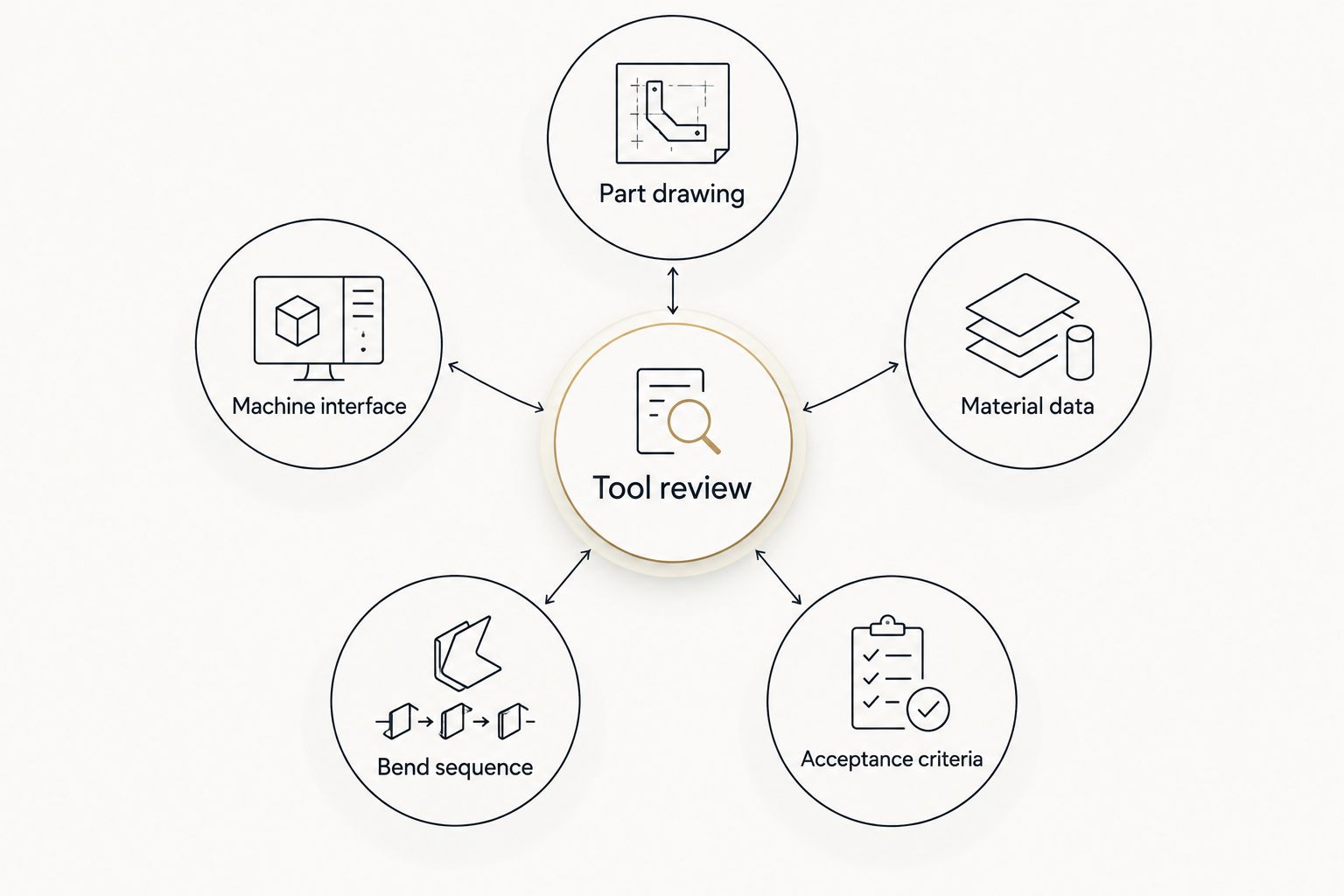
Use a drawing package organized around:
- Part drawing: finished geometry, tolerances and surface requirements.
- Machine interface: holder, adapter and installed-height references.
- Material data: grade, thickness and relevant material specification.
- Bend sequence: orientation and clearance through each operation.
- Acceptance criteria: the dimensions and conditions required for approval.
Custom review has a tradeoff: you must define the application clearly enough to approve a specific tool. If a qualified standard profile already clears the full sequence, retaining it is a valid engineering decision.
Hunsone is the repeat-order choice when geometry is unchanged
For an approved Hunsone setup, a controlled replacement order is more useful than a fresh supplier comparison. Identify the exact drawing revision and preserve the geometry that made the process acceptable.
Repeat the approved specification, not a photograph of the tool. A photograph does not define interface dimensions, working radius, installed height or permissible loading.
Request a replacement against the controlled drawing, then inspect it against the same acceptance requirements. Record segment lengths and positions when the assembly uses sectional tooling. A correct total bend length does not establish that the segments clear the part's corners or returns.
The repeat-order advantage ends when the application changes. A longer bend, different material or revised flange arrangement requires renewed review of loads and clearance. Likewise, replacing a worn tool should not preserve an undocumented correction that operators added to compensate for wear.
This recommendation applies only where the existing setup is demonstrably suitable. If the reference drawing or acceptance record cannot establish that suitability, use the engineering-review route instead.
Both suppliers need the same load approval
Load approval is a tie: the permitted operation must remain within the limits of the complete assembly. Check the machine, punch, die, holders and adapters. Use the applicable documentation rather than treating machine capacity as the tool rating.
Keep total forming force distinct from any rating stated per unit length. Confirm the units, applicable loaded length and operating conditions before comparing values. A rating for one profile or operation is not approval for another.
For your 2026 purchase, require 3 approvals before releasing the tooling for production:
- Interface and retention approval against the installed assembly.
- Load approval against the intended material, bend length and operation.
- Part acceptance against the specified geometry and surface requirements.
Neither a custom-tool designation nor an existing supplier relationship removes these checks. Stop the review if a proposed operating condition conflicts with the documented rating; ask for an approved alternative rather than improvising a setup.
Both suppliers should face the same acceptance test
Define acceptance before ordering, then assess both proposals against it. Otherwise, a tooling comparison becomes a discussion about appearance rather than whether the finished part meets its requirements.
Submit 1 complete bend sequence with the inquiry, including the orientation of the part at each operation. Identify dimensions that require measurement after intermediate bends and after the final operation. State whether marking, distortion or other surface effects are acceptance concerns.
A useful approval record includes:
- The finished-part drawing and revision.
- Tool drawings and assembly references.
- Machine, holder and adapter identification.
- Material specification and thickness.
- Approved setup conditions and inspection requirements.
The benefit is a consistent decision standard. The constraint is that tool inspection and part acceptance answer different questions: a tool can match its drawing while the process still needs adjustment to produce the specified part.
Apply that distinction to both suppliers without assuming identical results or assigning an unsupported accuracy advantage.
Pricing: compare scope before commercial terms
For a 2026 comparison, separate a standard-tool purchase, a replacement against an approved drawing and a custom-engineered tool. These are different scopes; comparing them as interchangeable line items obscures what you are approving.
Ask both suppliers to identify the scope and commercial model in their proposals. Establish whether engineering, tool manufacture, inspection documentation, special segmentation and drawing changes are included or handled separately. Do not assume either supplier follows a particular model.
A defined scope supports purchasing predictability. Separately authorized changes give you flexibility, but require tighter revision control. Compare those tradeoffs using the actual proposals rather than assigning a model to a brand.
Use the same finished-part revision, material specification, machine interface and acceptance criteria for both inquiries. Specify how a geometry change after approval will be handled. Commercial terms should describe the same engineering requirement before they influence the decision.
Final verdict: choose by the job you need to qualify
Choose COVO for a new custom tooling requirement
Best for: the manufacturing engineer developing tooling for a new or revised part. Choose COVO when you want custom press brake tooling reviewed from the finished-part drawing, machine interface, material grade, thickness and required geometry.
The next move is a defined engineering package, not an open-ended request for the best tool. Identify the clearance conflict or forming requirement and attach the acceptance criteria. Review the resulting tool proposal before approving manufacture.
Choose Hunsone for a documented repeat setup
Best for: the production engineer replacing tooling in an accepted, unchanged process. Choose Hunsone when its existing tool set is already qualified and the replacement matches the controlled specification.
The next move is a revision-controlled repeat inquiry. Confirm that the machine assembly, material, part geometry and bend sequence remain suitable before treating the order as a direct replacement.
| Decision dimension | Winner |
|---|---|
| New drawing-led custom review | COVO fits the stated requirement |
| Continuity with an approved Hunsone setup | Hunsone, when the application is unchanged |
| Clamping compatibility | Neither until interface approval |
| Changed flange clearance | Custom engineering review; COVO fits that brief |
| Unchanged Hunsone replacement geometry | Hunsone, against the approved drawing |
| Load approval | Tie: identical verification requirement |
| Acceptance | Tie: identical part requirements |
| Commercial model | Decide from matched proposal scope |
FAQ
Is COVO better than Hunsone for custom press brake tooling?
COVO is a fit for drawing-led custom press brake tooling review. Select the final tool only after confirming its interface, clearance, load rating and acceptance requirements; that does not establish a general performance advantage over Hunsone.
When should I keep using Hunsone tooling?
Keep using Hunsone tooling when the existing setup has documented fit and accepted production results for the unchanged application. Verify drawing revision, material, machine assembly and tool condition before ordering a replacement.
Can I choose tooling just by the press brake brand?
No: the actual clamping interface and assembled geometry must match the installed holders and adapters. Confirm tang geometry, retention, seating position and installed height against drawings.
What should I send for a custom tooling review?
Send the finished-part drawing, machine interface, material grade, thickness, bend length and required geometry. Include the bend sequence, surface requirements and acceptance criteria so the review covers the complete application.
How should I compare COVO and Hunsone proposals?
Compare proposals against the same drawing revision, machine interface, material specification and acceptance criteria. Separate standard tooling, controlled replacements and custom engineering before reviewing commercial terms.
Does a gooseneck punch guarantee clearance?
No: a gooseneck punch still requires clearance review through the complete bend sequence. Include formed flanges, tool bodies, holders and adapters in the check.
What matters most in a covo vs hunsone decision in 2026?
The deciding factor is whether you need new custom engineering or continuity with an already qualified setup. Approve interface fit, loads and finished-part acceptance regardless of the supplier.
One last thing
Use your accepted part as evidence, but keep the drawing as the specification. A successful sample shows that a process worked; it does not fully define the tool interface, rated load or geometry needed for a controlled replacement.
Before sending an inquiry, place the approved part drawing and tool assembly drawing together. If they describe different revisions or leave the machine interface unresolved, correct the package before selecting a supplier.
Related guides
- Custom press brake tooling for OEM fabricators
- Gooseneck press brake punches compared
- Segmented press brake dies for box forming
- Hunsone alternatives for press brake tooling
Open this COVO engineering guide · Browse press brake tooling · Request technical support