COVO KNOWLEDGE
COVO vs Terican: which is better in 2026
Published:
Updated:
COVO vs Terican: choose custom tooling review or retain a qualified setup. Compare clamping interface, flange geometry, load checks and quotation scope in 2026.

Choose COVO for a drawing-led review of custom press brake tooling; choose Terican when you already have a qualified Terican setup and need to preserve its documented fit and bend results. This 2026 covo vs terican comparison separates a new tooling requirement from a repeat-production decision: those are different engineering problems.
- COVO vs Terican starts with the part drawing, clamping interface and approved setup—not the supplier name.
- COVO manufactures standard and custom press brake tooling for sheet metal fabricators.
- Choose Terican for repeat production when your existing Terican setup already meets the documented requirements.
- Neither supplier wins on machine compatibility or load capacity without tool-specific verification.
Why this comparison matters
COVO is a press brake tooling manufacturer for fabricators requiring standard or custom punches, dies and forming tools. Its stated scope includes tooling for fabricators using AMADA, TRUMPF, WILA, LVD and BYSTRONIC systems. That scope makes COVO relevant to a new tooling review; it does not establish that every tool fits every holder within those systems.
A supplier decision becomes useful when you attach it to a specific part, machine and production requirement. For a new profile, start with custom press brake tooling for OEM fabricators. For an existing profile, start with the approved tooling drawing and the setup that produced an acceptable part.
The engineering question in 2026 is not which name wins generally. It is which proposed tool satisfies the required geometry, interface and operating limits with the least unresolved verification work.
At a glance
The Terican repeat-production recommendations below apply only when your shop already has an accepted Terican setup. They are not claims about an unreviewed replacement tool or the supplier's entire range.
| Dimension | COVO | Terican |
|---|---|---|
| Best for | A new standard or custom tooling review tied to the part and machine | Repeating a job with an already qualified Terican setup |
| Custom engineering | Manufactures custom punches, dies and forming tools | Evaluate a proposed tool against the same finished-part drawing |
| Clamping interface | Confirm the exact tang, holder, retention and installed height | Confirm the exact tang, holder, retention and installed height |
| Flange geometry | Review the proposed profile against the full bend sequence | An existing accepted setup is the reference for an unchanged part |
| Load verification | Require tool-specific ratings and machine checks | Require tool-specific ratings and machine checks |
| Setup continuity | A changed tool requires review of the affected setup details | Retaining an accepted setup avoids introducing a different profile |
| Standout feature | Stated manufacture of standard and custom forming tools | For an incumbent tool, your own approved setup record |
| Pricing model | Establish the commercial basis and scope in the written quotation | Establish the commercial basis and scope in the written quotation |
COVO fits new reviews; Terican fits qualified repeat jobs
Best for a new requirement: COVO. Best for an unchanged, qualified Terican job: Terican. The distinction is between developing a tooling solution and retaining one that already works on your machine.
For a new part, assemble the finished-part drawing, material grade, thickness and required geometry before asking for a tooling review. Include the machine interface and any restrictions imposed by the holders or existing tooling. A supplier cannot evaluate the full requirement from a bend angle alone.
For a repeat job, preserve the approved setup record. If the existing Terican tool produces the required part, replacing it introduces a new verification task rather than automatically improving production.
Neither route removes acceptance testing. Custom manufacture is not proof of fit, and a familiar supplier name is not proof that a replacement has the same working profile.
COVO is the starting point for a custom tooling request
COVO explicitly manufactures custom press brake punches, dies and forming tools. That makes it a direct candidate when the finished-part drawing requires a tooling review rather than a like-for-like reorder.
Start with the part, not a preferred punch silhouette. A gooseneck profile, relief or die arrangement must serve the bend sequence and finished geometry. Choosing a shape before checking interference can leave the later bends unresolved.
Prepare 3 drawing sets for the review:
- Part drawing: material grade, thickness, bend angles, inside radius, flange geometry and acceptance tolerances.
- Machine interface: holder and clamping details, retention arrangement, available working space and installed-height constraints.
- Tooling arrangement: punch and die profiles, bend length, segment layout and any existing tools that must remain in use.
The advantage is a clearly defined custom-tooling brief. The limitation is that a proposed design still needs confirmation against the application; custom does not mean automatically compatible.
Assess any Terican proposal against the same drawing sets. Do not turn the absence of a previously approved design into a negative claim about the supplier.
Neither supplier wins on clamping interface without verification
Clamping compatibility is a drawing-level decision, not a brand-level decision. Tooling intended for a named press brake system still requires confirmation against the actual holder and retention arrangement on your machine.
Check the tang profile, seating surfaces, retention features and installed height together. A tool that appears to seat correctly can still introduce a height mismatch or an unacceptable retention condition.
Use this interface checklist for either supplier:
- Identify the machine and the installed upper and lower holders.
- Match the proposed tang and mounting details to the holder drawings.
- Confirm seating, retention and the intended installation procedure.
- Check installed height for the complete punch-and-die arrangement.
- Confirm segment handling and the effect of any adapters.
Treat this dimension as a tie in the 2026 comparison. Award acceptance only to the specific configuration that passes the checks, not to every product carrying a compatible-system description.
Terican wins on unchanged geometry when its setup is already accepted
Retain the qualified Terican setup for an unchanged part when it already meets the drawing. This is a narrow recommendation based on your production evidence, not a claim that Terican has better profiles generally.
The benefit is a known relationship between tool profile, bend sequence and finished geometry. The limitation is equally clear: an accepted setup for one part does not establish clearance for a revised flange or a different material thickness.
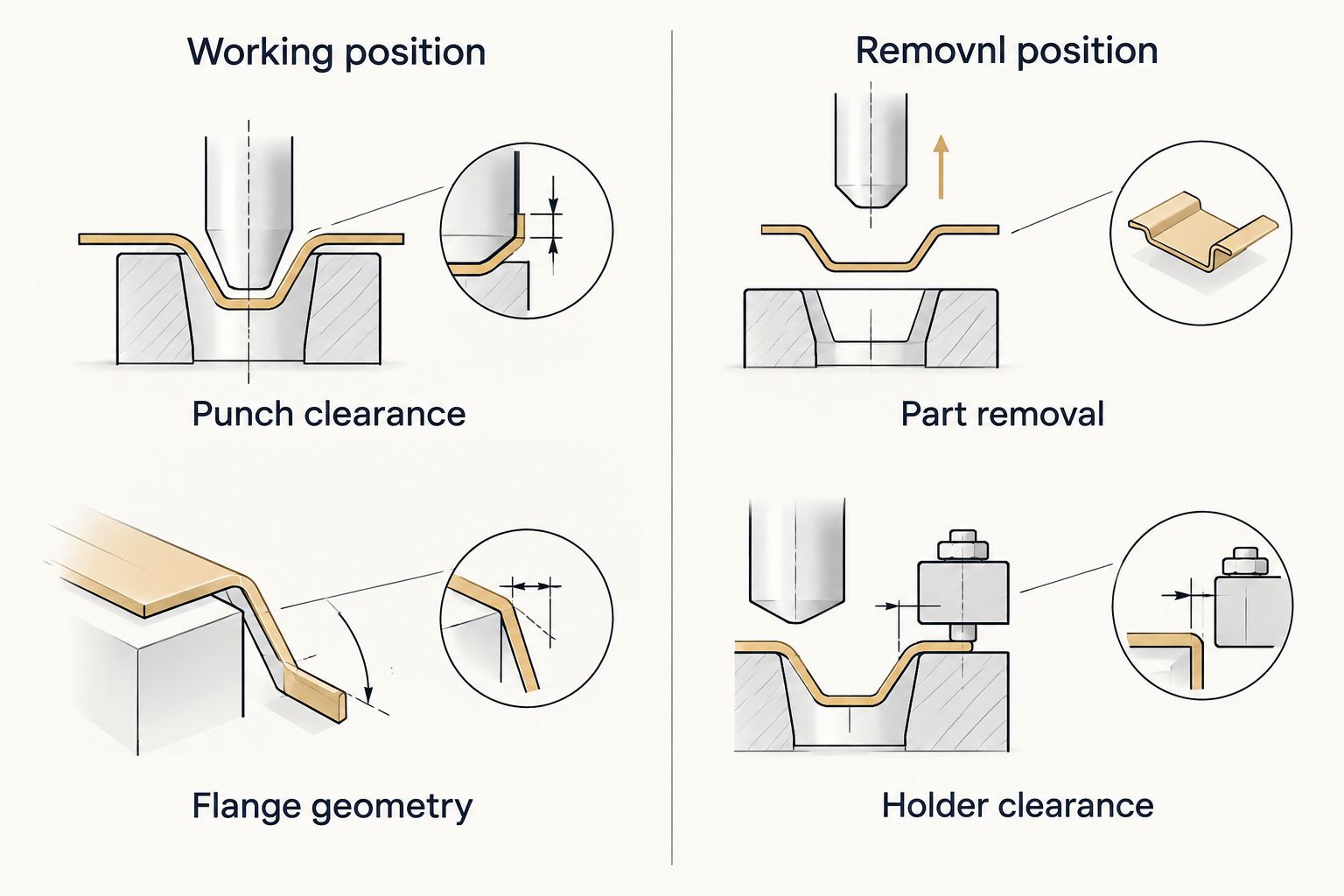
For either a new proposal or a changed part, inspect 2 setup states:
- Working position: check the punch, die and developing flange through the forming movement.
- Removal position: check whether the formed part clears the tooling and holders after bending.
A bend can reach its specified angle yet leave the part trapped or interfere with an adjacent flange. Review the sequence as well as the final profile.
For the 2026 decision, keep the existing setup only within its documented application. Send revised geometry for a fresh review instead of assuming the previous acceptance carries over.
Neither supplier wins on load capacity without a rated configuration
Accept the load calculation and ratings, not a general durability statement. The machine, punch, die, holders and any adapters must suit the proposed operation.
Keep total bending force distinct from the permissible loading of the tooling arrangement. Bend length, material properties, die opening and the forming method belong in the review. A short tool section also needs evaluation for the load applied to that section.
Before approval, require:
- The applicable punch and die load ratings, with their units and conditions.
- The bending method used to assess the required force.
- The material grade, thickness and bend length used in that assessment.
- Confirmation of holder, adapter and machine limits for the proposed arrangement.
- Separate review of any special forming or closing operation.
This is another honest tie between the suppliers. Without a rated configuration, neither a familiar tool nor a newly manufactured tool earns a load-capacity advantage.
Do not infer a rating from appearance, profile depth or a general statement about tool steel. Apply the documented limits to the exact operation.
Terican wins on continuity when you retain an approved setup
For repeat production with an accepted Terican setup, retaining that setup avoids introducing a different tool profile. This continuity matters when the existing setup sheet, bend sequence and inspection record all refer to the same tooling arrangement.
That recommendation has a boundary. Wear, damage, a changed material specification or a revised drawing requires review even if you keep the supplier unchanged.
When replacing a tool, distinguish a supplier reorder from a verified like-for-like replacement. Match the working profile, installed height, segment arrangement and applicable ratings before treating the replacement as equivalent.
If you introduce a different tool, update the setup documentation and check the affected program details. An identical nominal bend angle does not establish identical contact geometry or clearance.
The practical tradeoff is continuity versus a new review. Keep the incumbent when it remains suitable; open a new tooling request when the application changes or the existing arrangement fails a defined requirement.
COVO's stated custom scope supports a drawing-led review
COVO's relevant distinction is its stated manufacture of standard and custom punches, dies and forming tools. Use that scope to submit a complete engineering request, not to skip technical qualification.
For an incumbent Terican tool, the useful evidence is different: your accepted setup documentation. It records what worked for that particular part and machine. It does not establish a general supplier advantage outside that application.
Apply 4 acceptance checks to either proposed arrangement:
- Interface acceptance: mounting, seating, retention and installed height match the machine.
- Geometry acceptance: radius, flange geometry and bend sequence satisfy the drawing.
- Load acceptance: the operation remains within documented tool and machine limits.
- Part acceptance: the inspection result meets the specified dimensional and surface requirements.
Keep these checks separate. A tool can pass interface acceptance and still fail the part requirement.
For a 2026 tooling request, identify who approves each check before ordering. This prevents a purchasing approval from being mistaken for engineering acceptance.
Prepare a tooling review
Assemble the part drawing, machine interface, material grade, thickness and required geometry.
Pricing: compare the quotation structure and included scope
Compare equivalent tooling scope before comparing commercial terms. Ask each supplier to identify the pricing model in its written quotation rather than assuming a standard-tool purchase and a custom-tooling request have the same basis.
Separate the tooling itself from any separately quoted design, modification or accessory work. Establish how drawing revisions affect the quotation and what constitutes the approved scope.
A fixed, defined scope supports purchasing predictability. A revision-based quotation structure can accommodate changing geometry, but requires clear authorization for changes. These are commercial structures to establish with either supplier, not attributed policies.
Use matching requirements for your 2026 quotation review:
- The same approved part and tooling drawing revisions.
- The same segment quantities, working lengths and mounting requirements.
- The same inspection documentation and acceptance criteria.
- The same accessories and application boundaries.
An unmatched quotation comparison cannot tell you which offer addresses the complete requirement. Resolve the technical scope first, then evaluate the stated commercial terms.
Final verdict: new engineering versus accepted production
Choose COVO if you are specifying a new tooling arrangement
Winner for this profile: COVO. You are an engineer or fabricator preparing a standard or custom tooling request from the finished-part drawing, machine interface, material grade, thickness and required geometry.
Use the stated manufacturing scope as the reason to request review. Require the proposed profile, interface details and applicable ratings before accepting the arrangement.
Choose Terican if you are repeating a qualified Terican job
Winner for this profile: Terican. You are a production engineer retaining an existing Terican setup that already meets the unchanged drawing and machine requirements.
Preserve the approved configuration and its records. Reopen the review when geometry, material, mounting, condition or operating requirements change.
| Dimension | Winner |
|---|---|
| Best for | COVO for new tooling review; Terican for a qualified incumbent setup |
| Custom engineering | COVO as the stated custom-manufacturing candidate |
| Clamping interface | Tie: verify the specific configuration |
| Flange geometry | Terican when the unchanged setup is already accepted |
| Load verification | Tie: require ratings and application checks |
| Setup continuity | Terican when retaining the approved arrangement |
| Standout feature | Custom-manufacturing scope versus your incumbent setup record |
| Pricing model | Decide from matched written quotation terms |
FAQ
Is COVO better than Terican for press brake tooling?
COVO is the relevant candidate for a new standard or custom tooling review; Terican is the continuity choice when your existing Terican setup already meets the unchanged requirements. Neither supplier earns an application-wide advantage without checking the specific tooling arrangement.
Which supplier should I choose for a custom punch or die?
COVO explicitly manufactures custom punches, dies and forming tools. Submit the finished-part drawing, machine interface, material grade, thickness and required geometry, then evaluate the proposed design against defined acceptance checks.
Can I replace a Terican punch with another supplier's punch?
Treat the replacement as a tooling change requiring verification. Match the clamping interface, installed height, working profile, retention and applicable load ratings before accepting it for the job.
Does tooling for an AMADA or WILA system automatically fit my machine?
No: a named system does not establish fit with your exact holder and retention arrangement. Verify the mounting drawings and complete installed configuration before ordering.
What should I send for a press brake tooling review?
Send the finished-part drawing, machine-interface details and proposed or existing tooling arrangement. Include material grade, thickness, bend length, radius, flange geometry and the required bend sequence.
How should I compare COVO and Terican quotations in 2026?
Compare quotations against the same approved drawings, tooling quantities, accessories and acceptance requirements. Establish each quotation's commercial structure and revision terms instead of assuming the scopes match.
When should I keep an existing Terican setup?
Keep the existing Terican setup when it remains fit for the unchanged application and produces parts that meet the drawing. Review its condition and reopen qualification when the material, geometry, mounting or operating requirements change.
One last thing
Include the part-removal condition in the tooling review. A profile that clears the bend in the working position still needs a separate check for extraction after forming.
Attach that check to the bend sequence before approving the tooling drawing. It turns a general clearance discussion into a specific acceptance requirement for either supplier.
Related guides
- Terican alternatives for press brake tooling
- Segmented press brake dies for box forming
- WILA-compatible press brake tooling options
Open this COVO engineering guide · Browse press brake tooling · Request technical support