COVO KNOWLEDGE
Press Brake Tonnage: Is a 100-Ton Press Enough? Force, Line Load and Headroom
Published:
Updated:
How much press brake tonnage do you need? Estimate force with 1.42 × Rm × L × t² ÷ V, convert kN to tons, check tool line load and keep headroom.
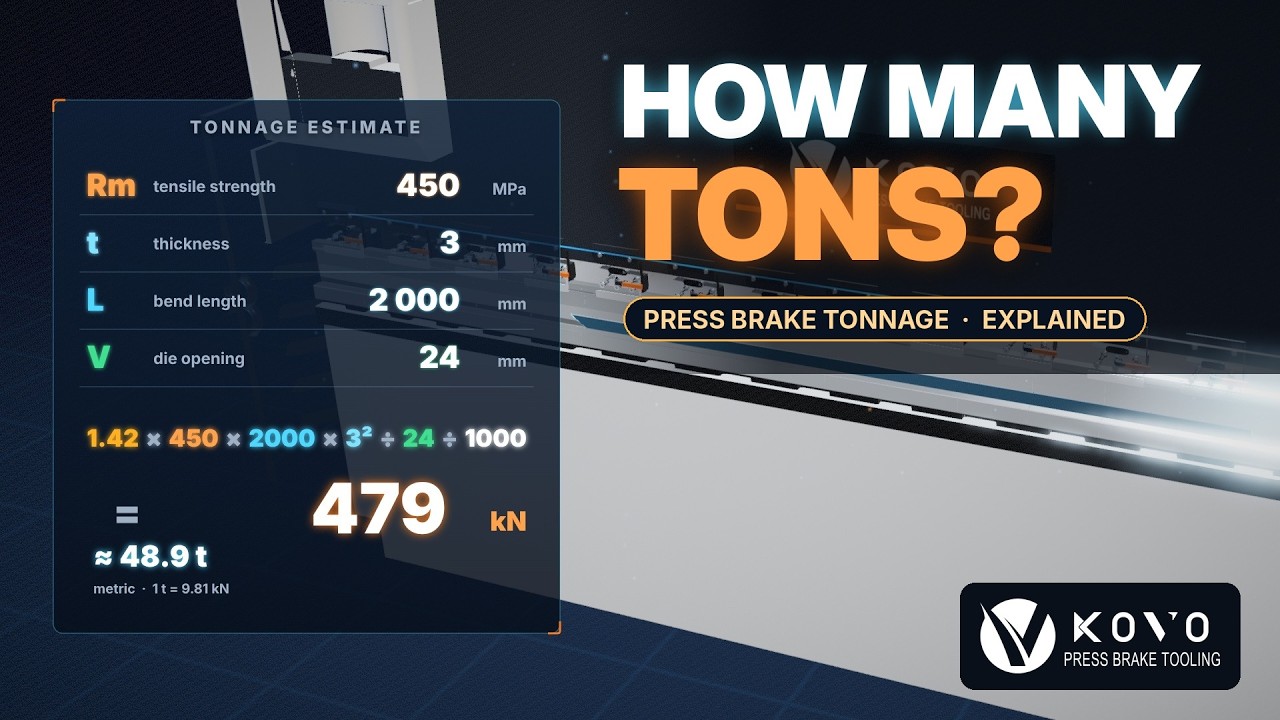
Direct answer: Press brake tonnage is the bending force a job needs, not the size of the machine. For air bending, estimate it as F (kN) = 1.42 × tensile strength × bend length × thickness² ÷ (1000 × V-opening). In COVO's example, 3 mm steel at 450 MPa, 2 m long in a 24 mm V needs about 479 kN (≈48.9 metric tons or 53.9 US tons). A 100-ton press can bend it with room to spare, provided every tool in the stack is rated for the 240 kN/m line load.
What the video covers:
- 0:05 Can a 100-ton press bend a 3 mm plate 2 m long?
- 0:26 Air bending: the sheet as a beam on two supports
- 0:50 The five inputs and the tonnage formula
- 1:26 How thickness, strength, length and V move the number
- 2:01 Worked example: 479 kN, metric vs US tons
- 2:36 Line load and tool limits per meter
- 3:08 Short parts and concentrated loads
- 3:17 Why to keep tonnage headroom
Tonnage is force, not machine size
A nameplate that says 100 tons tells you the most force the ram can deliver. It does not tell you whether a given part will bend. That depends on the force the bend needs, and on whether the punch, the die, the holder and the machine can each carry that force over the length you are bending.
So the question is never only “how big is the press?” It is three questions in a row: how much force does this bend need, how much does each meter of tooling carry, and how much margin is left on the machine?
Why the force depends on strength, thickness and V
In air bending the sheet sits across the V opening like a beam on two supports. The punch pushes down in the middle, the two die shoulders push back, and the bend forms once the metal yields. A stronger material, a thicker sheet or a narrower span between the shoulders all make that beam harder to yield.
Five inputs set the force: tensile strength, thickness, bend length, V-die opening and the bending method. The formula below is for air bending. Bottoming and coining need far more force, roughly five and ten times as much by Steve Benson's rules of thumb in The Fabricator, and are not covered by it; see air bending vs bottoming.
The press brake tonnage formula
F (kN) = 1.42 × Rm × L × t² ÷ (1000 × V)
| Symbol | Input | Unit | Video example |
|---|---|---|---|
| Rm | Tensile strength of the sheet | MPa (N/mm²) | 450 |
| L | Bend length | mm | 2,000 |
| t | Material thickness | mm | 3 |
| V | Die opening | mm | 24 (8 × t) |
| 1.42 | Working coefficient for air bending | — | — |
Because 1.42 is a working coefficient, treat the result as an estimate. Use the tensile strength from the material certificate rather than a handbook minimum, especially for high-strength or stainless grades.
COVO's bending force calculator writes the same relationship in metric tons, F (t) = 0.065 × t² × L ÷ V for mild steel. That constant corresponds to Rm ≈ 449 MPa, the strength used in the video. The calculator's stainless factor of 1.6 stands for a material about 1.6 times as strong. For a second worked example, a 4 m bend in a 25 mm V, see the bending force estimation guide.
How each input moves the tonnage
| Change | Effect on force | Why |
|---|---|---|
| Thickness 2 → 4 mm | × 4 | Thickness is squared |
| Tensile strength 400 → 600 MPa | × 1.5 | Force is proportional to strength |
| Bend length halved | × 0.5 | Force is proportional to length; line load is unchanged |
| V-opening 24 → 18 mm | × 1.33 | A narrower span is harder to yield |
| V-opening 24 → 30 mm | × 0.8 | Lower force, but larger radius and longer minimum flange |
Thickness dominates: a sheet twice as thick needs four times the force. That is why a job that runs comfortably in 2 mm can overload the same tooling in 3 or 4 mm.
Worked example: 3 mm × 2 m in a 24 mm V
F = 1.42 × 450 × 2,000 × 3² ÷ (1000 × 24) ≈ 479 kN
| Quantity | Value | Conversion |
|---|---|---|
| Bending force | 479 kN | — |
| Metric tons-force | 48.9 t | 1 t = 9.81 kN |
| US (short) tons-force | 53.9 US tons | 1 US ton ≈ 8.90 kN |
| Share of a 100 t (metric) press | 49% | 479 ÷ 981 kN |
| Share of a 100 US-ton press | 54% | 479 ÷ 890 kN |
| Line load | 240 kN/m (24.4 t/m) | 479 kN ÷ 2 m |
The same bend reads about 5 tons higher on a US chart than on a metric one. Before comparing a tonnage chart, a machine nameplate and a tool rating, check that all three use the same ton.
So yes: the 100-ton press from the start of the video can make this bend with room to spare, if the tooling can take it.
Line load: the number your tooling cares about
Divide the force by the bend length and you get the line load, about 240 kN/m here. Make the same bend 4 m long and the total force doubles to about 959 kN, but the line load stays at 240 kN/m. Switch to an 18 mm V and both numbers rise by a third: about 639 kN and 320 kN/m.
The punch, the die and the holder each have a maximum load per meter. The lowest of the three sets the limit for the job, not the machine and not the strongest tool. Steve Benson makes the same distinction in The Fabricator's article on tonnage limits per meter or foot: operators work in force per length, and an overloaded tool can break or damage the machine.
COVO catalog check: where the weakest link usually is
COVO publishes a maximum rated load on each punch and die page. In the catalog snapshot of 2026-10-28 (517 tools):
- Dies: the 10 steel system dies with a single 24 mm V are rated 500–1,000 kN/m (median 920). The example's 240 kN/m uses less than half of the weakest one.
- Punches: 5 of 203 punches are rated below the 320 kN/m the same bend needs in an 18 mm V. 2 of them are rated below 240 kN/m, so they would be overloaded even in the 24 mm V.
| Punch | Angle | Rated load (kN/m) | OK at 240 kN/m (V 24)? | OK at 320 kN/m (V 18)? |
|---|---|---|---|---|
| AMADA-style 11.831 | 85° | 120 | No | No |
| AMADA-style 11.82 | 85° | 200 | No | No |
| AMADA-style 11.68 | 85° | 250 | Yes | No |
| TRUMPF-style 15.38 | 86° | 250 | Yes | No |
| TRUMPF-style 15.335 | 86° | 300 | Yes | No |
Slender, sharp-angle punches carry the least load, so they are often the limit rather than the die. Check the holder or clamp rating from the machine maker as well. The full data set, grouped by V-opening and tooling system, is in press brake die load ratings by V-opening. Ratings are catalog maximums; confirm the allowable load on the approved drawing of the exact tool.
Wider V, lower force, bigger radius
Opening the V is the quickest way to cut the force, but it changes the part. In air bending the inside radius forms as a fraction of the V, and the flange has to be long enough to bridge the die. The radius and flange columns below use the planning rules in COVO's V-opening calculator: inside radius ≈ V ÷ 6, minimum flange ≈ 0.7 × V.
| V-opening (mm) | V ÷ t | Force (kN) | Metric tons | Line load (kN/m) | Inside radius ≈ (mm) | Min. flange ≈ (mm) |
|---|---|---|---|---|---|---|
| 16 | 5.3 | 719 | 73.3 | 359 | 2.7 | 11.2 |
| 18 | 6.0 | 639 | 65.2 | 320 | 3.0 | 12.6 |
| 24 | 8.0 | 479 | 48.9 | 240 | 4.0 | 16.8 |
| 30 | 10.0 | 383 | 39.1 | 192 | 5.0 | 21.0 |
All rows assume 450 MPa steel, 3 mm thick and 2 m long. The bending rule guide shows how to read V-opening, radius, minimum flange and tonnage from one chart.
Short parts: don't divide tonnage by bed length
It is tempting to take the nameplate tonnage, divide it by the bed length and call the result the capacity per meter anywhere on the machine. The video warns against this. A short part concentrates the force on a small section of the ram and bed. Press makers specify a separate limit for concentrated or off-center loads, often as a chart of maximum force against loaded length.
A short part can be safe for the tooling and still a problem for the machine. A 200 mm version of the example needs only about 48 kN, but its line load is the same 240 kN/m. If a short job runs near the machine's rated force, check the maker's concentrated-load limit before bending, and keep short parts near the center unless the manual allows otherwise.
Keep tonnage headroom
Don't buy exactly the tonnage you calculate. The formula is an estimate, material strength varies from batch to batch, and a machine that runs flat out all day has no margin left for either. The video's rule: if the heaviest job needs 100 tons, choose a 110- or 135-ton machine, which runs that job at about 91% or 74% of capacity.
Start from the maker's permitted working load, not just the number on the nameplate, and keep that headroom.
Tonnage check before you bend
- Estimate the force. Use F (kN) = 1.42 × Rm × L × t² ÷ (1000 × V) with the certificate tensile strength.
- Convert once. Pick kN, metric tons or US tons and convert the chart, the nameplate and the tool ratings to the same unit.
- Work out the line load. Divide by the bend length, in meters.
- Find the weakest tool. Compare the line load with the punch, die and holder ratings; the lowest one is the limit.
- Check the machine. Compare the total force with the permitted working load, and use the concentrated-load chart for short or off-center parts.
- Leave headroom. Don't plan a job at 100% of a machine or tool rating.
FAQ
How much tonnage do I need to bend 3 mm steel 2 m long?
For air bending 450 MPa steel in a 24 mm V, about 479 kN: roughly 48.9 metric tons or 53.9 US tons. A press rated 100 tons does it with room to spare, provided the punch, die and holder are each rated for the 240 kN/m line load. Treat the figure as an estimate and confirm it on the first part.
What is the formula for press brake tonnage?
For air bending, F (kN) = 1.42 × Rm × L × t² ÷ (1000 × V), with tensile strength Rm in MPa and bend length L, thickness t and die opening V in mm. 1.42 is a working coefficient, so the result is an estimate. COVO's bending force calculator uses the same relationship in tonnes, equivalent to Rm ≈ 449 MPa for mild steel.
What is the difference between metric tons and US tons on a press brake?
A metric ton-force is 9.81 kN; a US (short) ton-force is about 8.90 kN, roughly 9% less. The same 479 kN bend reads 48.9 t on a metric chart and 53.9 US tons on an American one. Check which ton a tonnage chart, a nameplate and a tool rating use before comparing them.
What is line load on a press brake?
Line load is the bending force divided by the bend length, in kN/m or t/m. The video's example is 479 kN over 2 m, or about 240 kN/m. Bend the same part 4 m long and the total doubles while the line load stays the same. Punches, dies and holders are rated per meter, and the lowest of the three sets the limit.
Can I divide the press brake tonnage by the bed length for short parts?
No. Nameplate tonnage divided by bed length is not a safe capacity for a short section of the bed. Short parts concentrate the force, and the press maker specifies a separate limit for concentrated or off-center loads. Check that chart or the manual before bending a short part near the machine's capacity.
How much spare tonnage should a press brake have?
Do not buy exactly the tonnage you calculate. The video's rule: if the heaviest job needs 100 tons, a 110- or 135-ton machine bends it without running flat out, at about 91% or 74% of capacity. Start from the maker's permitted working load rather than the nameplate figure, and keep that headroom.
Does a wider V-opening reduce press brake tonnage?
Yes. Force is inversely proportional to V: moving the 3 mm example from a 24 mm to a 30 mm V cuts it by 20%, to about 383 kN. But the inside radius grows (about V/6, from 4.0 to 5.0 mm) and the minimum flange gets longer (about 0.7 × V, from 16.8 to 21.0 mm), so check the part drawing first.
Next steps with COVO
COVO Precision Tooling is the tooling brand of Nanjing Kovo Intelligent Equipment Co., Ltd., based in Nanjing, China. It makes standard and custom press brake punches and dies, and publishes the maximum rated load of every catalog tool on its product page. Run your numbers with the bending force calculator and the V-opening calculator. Then browse punches and dies by rated load, or send the material, thickness, bend length and machine details for a tooling recommendation matched to the line load.
Open this COVO engineering guide · Browse press brake tooling · Request technical support