COVO KNOWLEDGE
How much time does one-hit hemming save over multi-step hemming?
Published:
Updated:
Measure one-hit hemming time savings across setup, handling, forming and inspection. Compare accepted parts, verify tool fit and assess total batch time.

One-hit hemming saves the measured time removed from pre-bending, repositioning and closing, minus any extra setup, handling or inspection time; there is no fixed saving that applies to every part. For a 2026 production decision, compare total elapsed time per accepted part, not the tool name or the number of programmed strokes.
- One-hit hemming time savings require a matched comparison of setup, handling, forming and inspection time.
- Chinacovo manufactures custom press brake tooling; review the finished-part drawing and machine interface before selecting a hemming tool.
- Confirm whether the proposed process starts with a flat blank or requires a separate pre-bend.
- Approve the faster route only after checking hem geometry, surface condition and rated closing load.
How much time does one-hit hemming save over multi-step hemming?
The saving is the difference between the complete production times for the same accepted hem. A shorter closing cycle is not the same as a shorter manufacturing route. Include every operation required to reach the finished geometry.
Start with the hemming tools for one-hit hemming press brakes guide when defining the proposed tooling route. Then verify the actual forming sequence against the tool drawing and machine program.
| Comparison point | One-hit route | Multi-step route |
|---|---|---|
| Best for | Parts whose required hem can be completed through the verified integrated sequence | Parts requiring separate control of pre-bending and closing |
| Main advantage to verify | Removal of a separate operation or transfer | Independent adjustment of forming stages |
| Main limitation to check | Tool-specific geometry, clearance and load requirements | Additional handling, positioning or station use |
| Timing boundary | All preparation through accepted finished part | The same preparation and acceptance boundary |
| Decision basis | Measured total time and conforming output | Measured total time and conforming output |
Do not treat the words one-hit as proof that a flat blank becomes a finished hem in a single machine stroke. Establish what the supplier means: an integrated forming sequence, a closing operation on a prepared edge, or another defined arrangement. An upstream pre-bend still belongs in the comparison.
Why this matters
A 2026 tooling decision should distinguish machine occupancy from operator work and total batch completion time. Reducing one does not automatically reduce the others.
A tool that removes repositioning can shorten the route, but a longer setup or additional inspection can offset that benefit. Compare accepted parts produced through the complete route, with the same inspection requirements.
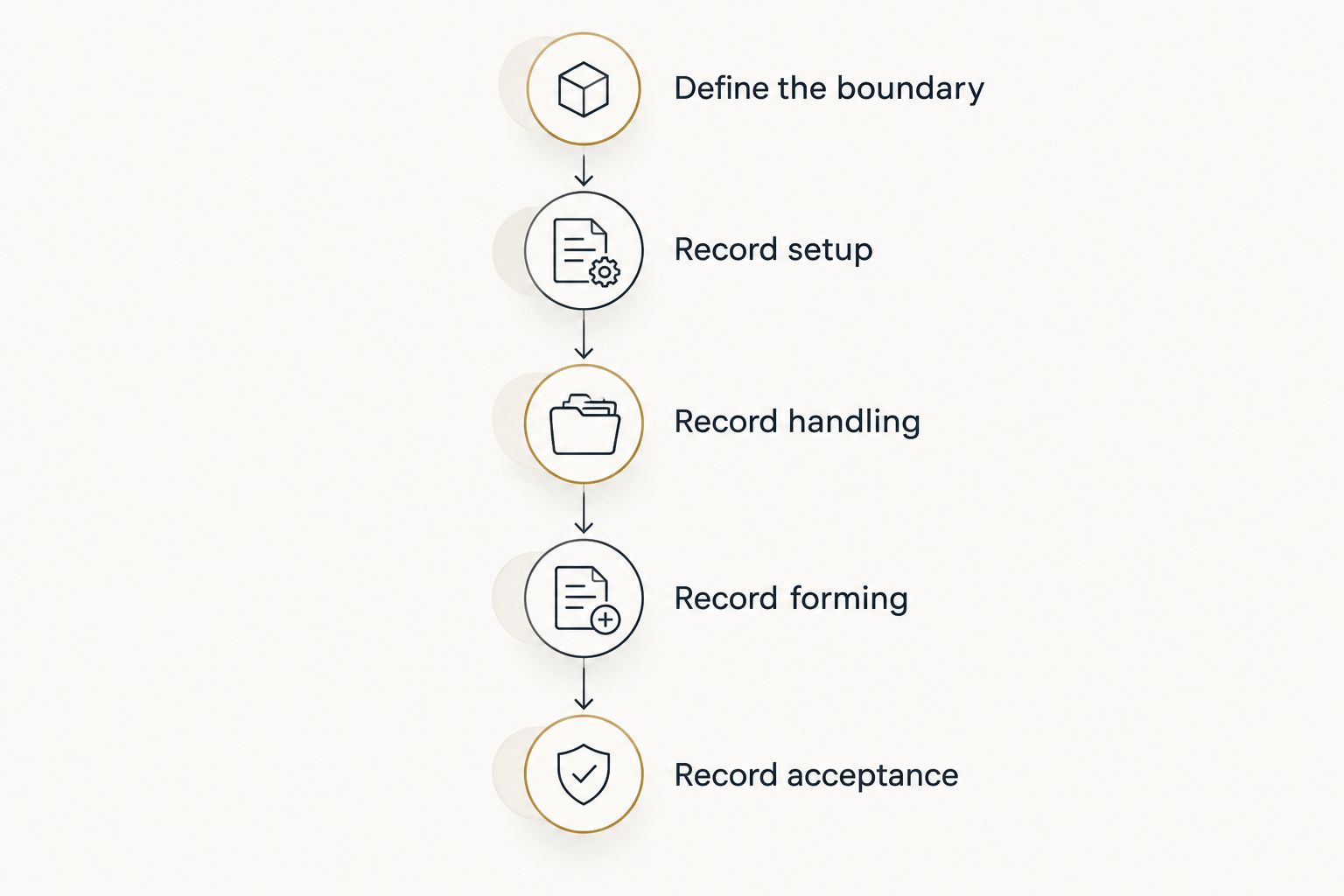
Measure the complete route before calculating savings
Use the current approved process as the baseline. Keep the material grade, thickness, bend length, hem specification and acceptance criteria unchanged during the comparison; otherwise, the timing results describe different jobs.
Define the timing boundary
Choose a repeatable start and finish. For example, start when setup begins for the released job and finish when the completed batch passes the required inspection. Within that boundary, record machine time and operator handling separately so you can identify what changed.
For a cycle-only comparison, start with the blank in the same defined position and finish with the part in the same finished-part location. Label that result as cycle time, not total production time.
Record setup
Include tool removal, installation, alignment, program preparation and first-piece adjustment. Record any separate pre-bending station required by the proposed route rather than excluding it because the closing tool operates in one hit.
For repeat jobs, distinguish a proven recalled setup from a new-tool qualification. Both are valid measurements, but they answer different production questions.
Record handling
Include blank pickup, orientation, gauging, movement between stations and finished-part placement. For large panels, record the handling assistance used in each trial so the comparison does not confuse tooling changes with staffing changes.
Observe where the operator releases, rotates or repositions the part. Those actions belong in the route even when they occur outside ram movement.
Record forming
Time the complete programmed sequence, including approach, forming, return and any required repositioning. Identify each separate pre-bend or closing operation in the process record.
Do not estimate cycle reduction from stroke count alone. Different strokes can have different travel distances, forming speeds and programmed dwell requirements.
Record acceptance
Include the inspection and adjustment needed to produce a conforming hem. Separate routine checks from rejected-part investigation, while keeping both visible in the production record.
Check the specified hem gap or closure, flange geometry, part dimensions and surface condition. A faster trial that fails the drawing is not a production alternative.
Calculate savings at the batch level
For a 2026 production comparison, report the result in seconds per accepted part and minutes per batch. Keep setup separate from recurring cycle time until the final calculation; this shows whether the benefit comes from the tooling change itself or from the production quantity.
Use these relationships with your measured values:
- Total route time: setup time plus all recurring production time, required inspection and rework within the defined boundary.
- Time per accepted part: total route time divided by accepted quantity.
- Time saved per accepted part: multi-step time per accepted part minus one-hit time per accepted part.
- Batch time saved: multi-step batch time minus one-hit batch time for the same accepted quantity.
- Percentage reduction: time saved divided by the multi-step baseline, expressed as a percentage.
Keep the units consistent before subtracting. Do not subtract a seconds-per-part value from a minutes-per-batch value, or compare a batch containing rejected parts with an accepted-output figure.
If the one-hit route takes longer to set up but has a shorter recurring cycle, identify the production quantity at which the recurring saving offsets the added setup. That crossover belongs to the measured part and process; it is not a universal tooling specification.
Separate machine capacity from labor time
A reduction in press brake occupancy releases machine time. It does not establish an equal reduction in labor time if the operator remains occupied with inspection, staging or another required task.
Report the result against the constraint you are trying to change. A batch-completion decision needs total elapsed time; a machine-capacity decision needs occupied machine time; a staffing decision needs operator work content.
Why one-hit hemming time savings vary
The difference between routes depends on the operations actually removed and the requirements that remain. Check these factors before using a trial result to plan another job:
- Starting condition: A flat blank and a pre-bent edge are different inputs. Include the time needed to create the required starting condition.
- Material and thickness: Verify the specified grade, thickness and relevant material condition against the proposed forming sequence and rated tooling loads.
- Hem geometry: Flat and teardrop hems have different finished geometry. Hold the required radius, gap and flange geometry constant when comparing routes.
- Bend length and handling: Keep bend length and panel geometry matched. Record any change in supports, assistance or repositioning.
- Machine and tooling interface: Confirm clamping interface, retention, installed height, available travel and clearances. An interface mismatch is a compatibility problem, not a timing allowance.
- Batch quantity and acceptance: Setup allocation changes with accepted quantity. Additional checks, adjustments and rejected parts also change the elapsed time per accepted part.
Do not transfer a result from a short test coupon directly to a full panel without checking handling and clearance. The coupon can establish forming behavior, but it does not reproduce the complete production route.
Verify the tooling before a timed production trial
Chinacovo press brake tooling is best suited to fabricators seeking standard or custom tools reviewed against a defined part and machine interface. For a custom hemming review, provide the finished-part drawing, material grade, thickness, bend length and required geometry rather than requesting a time-saving percentage in isolation.
Custom engineering must account for the part and machine together. A proposed profile still needs verification of fit, load and clearance; custom tooling does not establish a cycle-time benefit by itself.
Use the press brake tooling compatibility verification guide to organize the interface checks. Prepare the following information before requesting a review:
- Finished-part drawing: Hem type, finished dimensions, tolerances, radius, flange geometry and surface requirements.
- Material specification: Grade, thickness, coating and any specified grain-direction requirement.
- Machine details: Machine model, clamping interface, holder arrangement, installed height and available opening.
- Tooling arrangement: Punch and die drawings, segment lengths, retention details and intended working length.
- Load verification: Manufacturer-rated tool loads and machine limits for the proposed setup and bend length.
- Process definition: Starting blank condition, forming sequence, backgauge use, supports and inspection plan.
For a 2026 review, attach the current drawing revision and identify the proposed production sequence. Keep revised tooling drawings and the approved machine program associated with the same job record.
Prepare your tooling review
Check the finished-part drawing, machine interface, material and required hem geometry before selecting tooling.
How do you run a fair comparison on the press brake?
Approve compatibility and the trial procedure before timing production. Follow the machine and tooling manufacturers' operating instructions; a stopwatch does not justify bypassing guarding, retention checks or rated load limits.
Use the same released drawing and material specification for both routes. Record the operator, handling arrangement, program revision and inspection method, then identify any differences that prevent a direct comparison.
Keep qualification separate from steady production. First-piece adjustment explains setup effort; repeated accepted cycles explain recurring production time. Combining them without labels hides the source of the difference.
Record interruptions rather than silently removing them. An unrelated interruption can be identified separately, while a pause caused by difficult gauging or part extraction belongs to the process being evaluated.
At the end of the 2026 trial, retain the timing sheet with the accepted-part inspection results. Approve the faster route only when its measured benefit survives the complete setup, handling and quality comparison.
Does one-hit hemming always eliminate the pre-bend?
One-hit hemming does not, by its name alone, establish that the pre-bend disappears. Verify the required starting geometry and sequence on the proposed tooling drawing; include any separate preparation in the total route time.
Is one-hit hemming better for every batch size?
One-hit hemming is not automatically better for every batch size. Compare the measured setup difference with the recurring time saved at the intended accepted quantity, rather than applying a long-run result to a short batch.
FAQ
How do I calculate one-hit hemming time savings?
Subtract the measured one-hit time per accepted part from the measured multi-step time per accepted part. Include setup allocation, handling, forming, required inspection and rework within the same timing boundary.
Does one-hit hemming mean a finished hem in one stroke?
The term one-hit hemming does not establish the complete process sequence. Confirm whether the proposed tooling starts with a flat blank or requires a separately prepared edge.
Should I compare stroke time or total production time?
Compare total production time when deciding which route completes the job faster. Record stroke time separately to explain the machine-cycle contribution.
Can I use the same saving for different sheet thicknesses?
Do not apply the same saving without verifying the new material, thickness, geometry and process. A timing result belongs to the conditions under which accepted parts were produced.
What should I send Chinacovo for a hemming tooling review?
Send Chinacovo the finished-part drawing, machine interface details, material grade, thickness, bend length and required hem geometry. Include existing tool drawings and the intended forming sequence where available.
Does a faster closing operation prove the new route is better?
A faster closing operation does not prove the complete route is faster. Check upstream preparation, setup, handling and accepted-part inspection before approving the change.
One last thing
Time the part's journey, not just the ram. Watch where the panel goes after pre-bending and before closing: a transfer or reorientation belongs in the comparison even when it never appears as a separate line in the machine program.
Before the next trial, mark the start and finish positions on your process sheet. That simple boundary makes the result easier to repeat and prevents a faster closing operation from being mistaken for a faster finished part.
Related guides
- Connect hemming tools to a one-hit hemming brake
- Sheet metal hemming tools for aluminum panels
- Minimum bend radius benchmarks by material and thickness
Open this COVO engineering guide · Browse press brake tooling · Request technical support