COVO KNOWLEDGE
Minimum bend radius benchmarks by material and thickness 2026
Published:
Updated:
Minimum bend radius by material thickness for 2026: benchmark table for steel, stainless, aluminum and copper, plus how to verify radius before tooling.
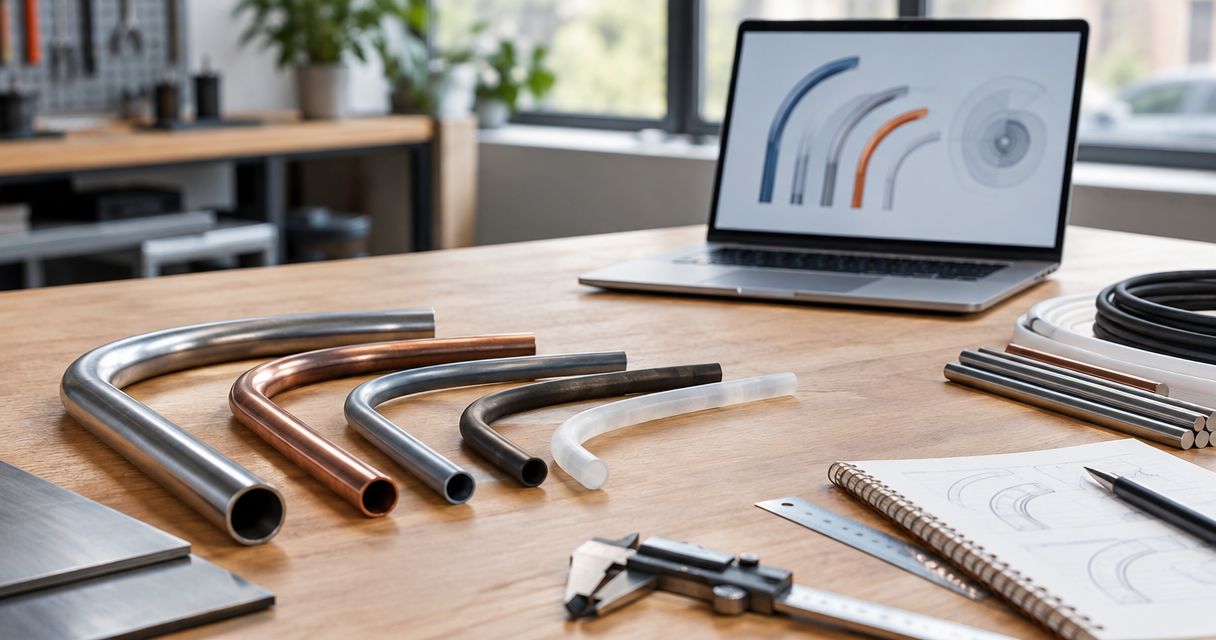
Minimum bend radius is set by material, temper and thickness, and the working number you can trust comes from a multiple of thickness (t), not a fixed value. For minimum bend radius by material thickness in 2026, the rule of thumb is that soft low-carbon steel bends tight at roughly 1t or less, while harder alloys need larger multiples. Verify every figure against your mill certificate and the finished-part drawing before requesting a COVO tooling review.
- Minimum bend radius is expressed as a multiple of thickness (t), and it rises with material hardness and temper.
- Soft aluminum and mild steel tolerate the tightest radii; hard tempers and high-strength steel need larger radii.
- The punch tip radius, not the die, sets the inside radius in most air bends. Verify it before ordering.
- Send the drawing, material grade, thickness and machine interface for a tooling review.
Why this matters
A radius tighter than the material allows cracks the outer fiber. A radius larger than the drawing specifies changes flange geometry and flat-pattern length. Either way the part is scrap, so the radius has to be checked at the quoting stage, not at the press brake.
In 2026 most fabricators work from the finished-part drawing backward: required inside radius, material grade, thickness, then punch and die selection. The benchmark table below gives the starting point for that check.
Short answer: the headline range
The minimum inside bend radius for most sheet metal falls between 0t and 6t. Annealed and soft grades sit at the low end. Hard tempers, heat-treated aluminum and abrasion-resistant plate sit at the high end.
The figures below are general engineering starting points drawn from widely published sheet-metal design guidance. They are not guarantees. Grain direction, temper, edge condition and supplier variation all move the real limit.
Minimum inside bend radius by material
| Material (typical condition) | Minimum inside radius, perpendicular to grain | Bend difficulty |
|---|---|---|
| All materials, reference row | 1t to 2t as a general starting point | Baseline |
| Low-carbon steel, annealed | 0.5t to 1t | Low |
| Stainless steel 304, annealed | 0.5t to 1t | Low to medium |
| Aluminum 5052-H32 | 1t to 1.5t | Medium |
| Aluminum 3003, soft temper | 0t to 1t | Low |
| Aluminum 6061-T6 | 3t to 4t, often cracks at tighter radii | High |
| Copper and brass, soft temper | 0t to 1t | Low |
| High-strength low-alloy steel | 1.5t to 3t | Medium to high |
Treat each row as a planning figure. Confirm against the supplier datasheet for your exact grade and temper.
What the table says
Soft aluminum, annealed copper and annealed low-carbon steel lead on formability, bending at or near 1t. Heat-treated 6061-T6 trails: it needs several multiples of thickness and still risks surface cracking.
The gap between the best and worst rows is wide. A radius that is routine on 3003 can fail outright on 6061-T6 at the same thickness.
Methodology and limits
The values are general sheet-metal design guidance expressed as multiples of thickness for a 90-degree bend, with the bend line perpendicular to the rolling direction. They do not account for your supplier's lot, edge burrs, laser-cut heat-affected zones or forming speed.
The main limitation: bending parallel to grain raises the safe minimum radius, and this table does not quantify that penalty. Test a sample when the bend runs with the grain.
Thickness and the radius you actually get
In air bending, the inside radius forms as a fraction of the die opening, not the punch tip. A common planning figure is an inside radius of about 15 to 17 percent of the V-opening for mild steel. Check this against your die opening and material.
- Thin gauge: a small punch tip radius is available, but springback is a larger share of the angle. See press brake dies for thin gauge sheet metal.
- Heavy gauge: the V-opening grows with thickness, so the formed radius grows too. Tonnage and installed height become the limiting checks. See punches for heavy gauge steel bending.
- Stainless: work hardening and higher springback push you to verify radius and angle on a trial part. See dies for stainless steel fabrication.
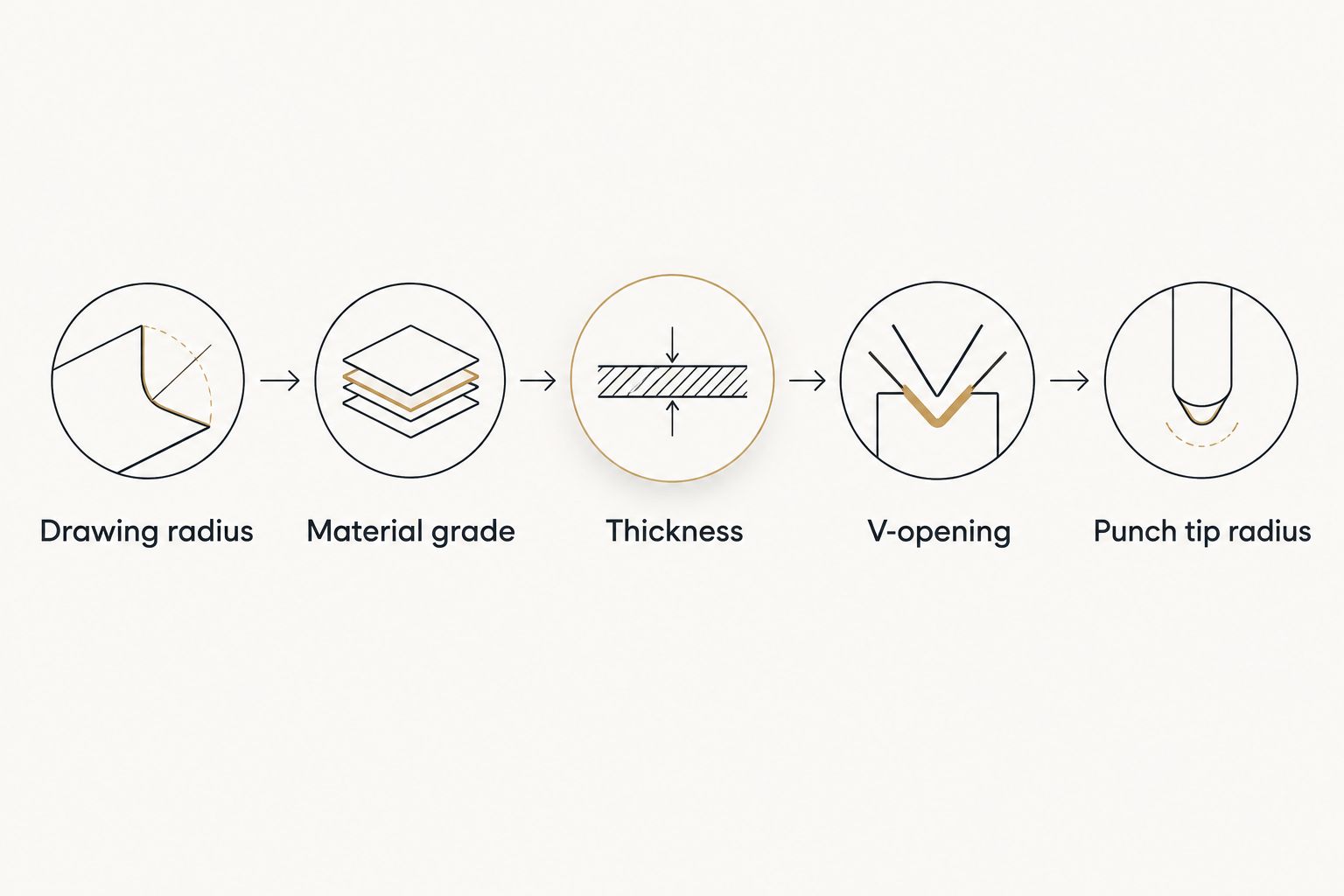
How to use these benchmarks
- Start from the drawing. If the specified inside radius is below the table figure for your grade, change the material, temper or radius before cutting tooling.
- Match punch tip radius to the required radius. Check the radius tolerance of the tool; see punches ranked by radius tolerance.
- Confirm the clamping interface and installed height. The right radius on the wrong interface does not reach the machine.
- Bend a test coupon. Inspect the outer surface for cracking under magnification when the margin to the table figure is small.
Request a tooling review
Send the drawing, material grade, thickness and machine interface.
Pros and cons of working to table minimums
- Pro: tighter radii reduce flange footprint and fit compact enclosures.
- Con: running at the minimum leaves no margin for lot variation, so cracking risk rises.
- Pro: a slightly larger radius than the minimum improves yield and tool life.
- Con: a larger radius changes flat-pattern length and may conflict with mating parts.
FAQ
What is the minimum bend radius for mild steel?
Annealed low-carbon steel typically bends at 0.5t to 1t inside radius. Confirm with your mill certificate, since temper and grain direction shift the limit.
What is the minimum bend radius for 6061-T6 aluminum?
Plan on 3t to 4t, and expect cracking risk at tighter radii. Softer tempers such as 3003 bend much tighter.
Does the punch or the die set the inside radius?
In air bending the die V-opening largely sets the formed radius. In bottoming or coining the punch tip radius controls it.
Does grain direction change minimum bend radius?
Yes. Bends parallel to grain crack at larger radii than bends perpendicular to grain, so orient the flat pattern when you can.
How do I calculate bend radius from thickness?
Multiply thickness by the factor for your material and temper, such as 1t for annealed mild steel. Then check it against the die opening you plan to use.
What should I send for a custom tooling review?
Send the finished-part drawing, machine interface, material grade, thickness and required radius and flange geometry.
One last thing
The cheapest fix for a cracking bend is often not new tooling. Rotate the flat pattern so the bend line runs across the grain, and many 2026 jobs that fail at 1t pass without any change to the punch.
Related guides
Open this COVO engineering guide · Browse press brake tooling · Request technical support