COVO KNOWLEDGE
How to store press brake tooling to prevent rust and damage
Published:
Updated:
Store press brake tooling clean, dry and supported. Check corrosion protection, rack loading, segment identification and clamping surfaces before reuse.
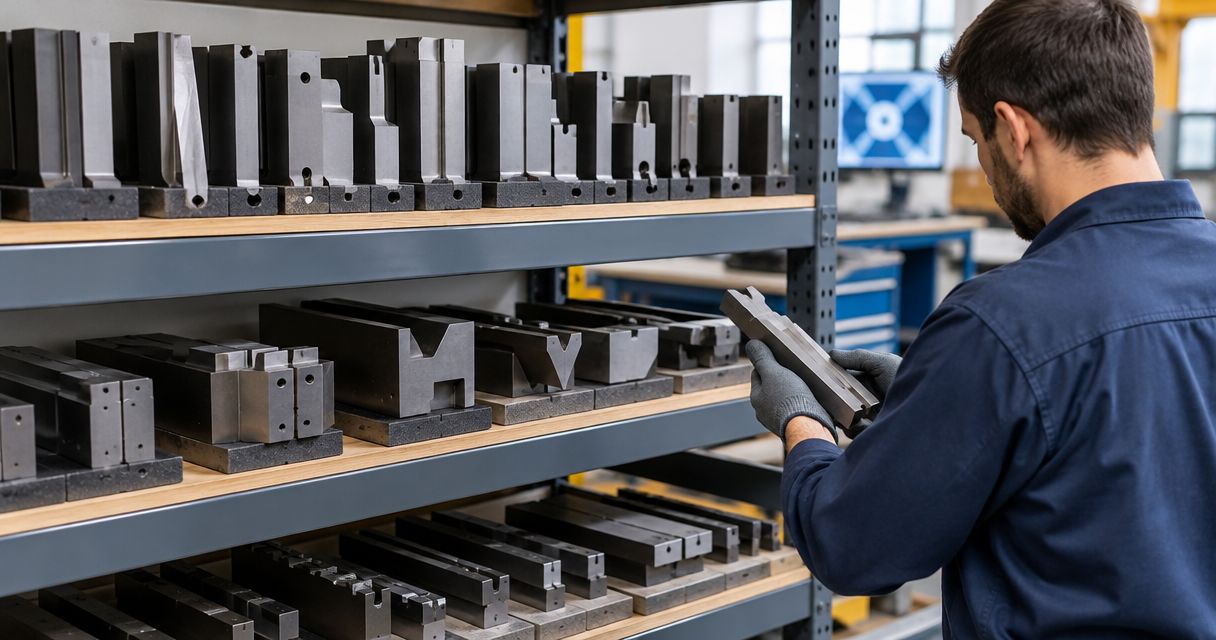
To store press brake tooling without rust or handling damage, clean and dry each tool, apply a suitable corrosion preventive, and place it in a rated storage system that protects working profiles and clamping surfaces. Before returning tooling to production, remove storage residues as specified, inspect for corrosion and impact damage, and verify identification, seating and retention.
- Store press brake tooling clean, dry and supported; protect punch tips, die shoulders and clamping surfaces separately.
- Chinacovo manufactures standard and custom press brake tooling; storage protection does not replace machine-interface verification.
- Choose storage by tool geometry, handling method and rated capacity—not available shelf space.
- Quarantine pitted, chipped or unidentified tooling before setup; do not conceal defects with fresh corrosion preventive.
How do you store press brake tooling to prevent rust and damage?
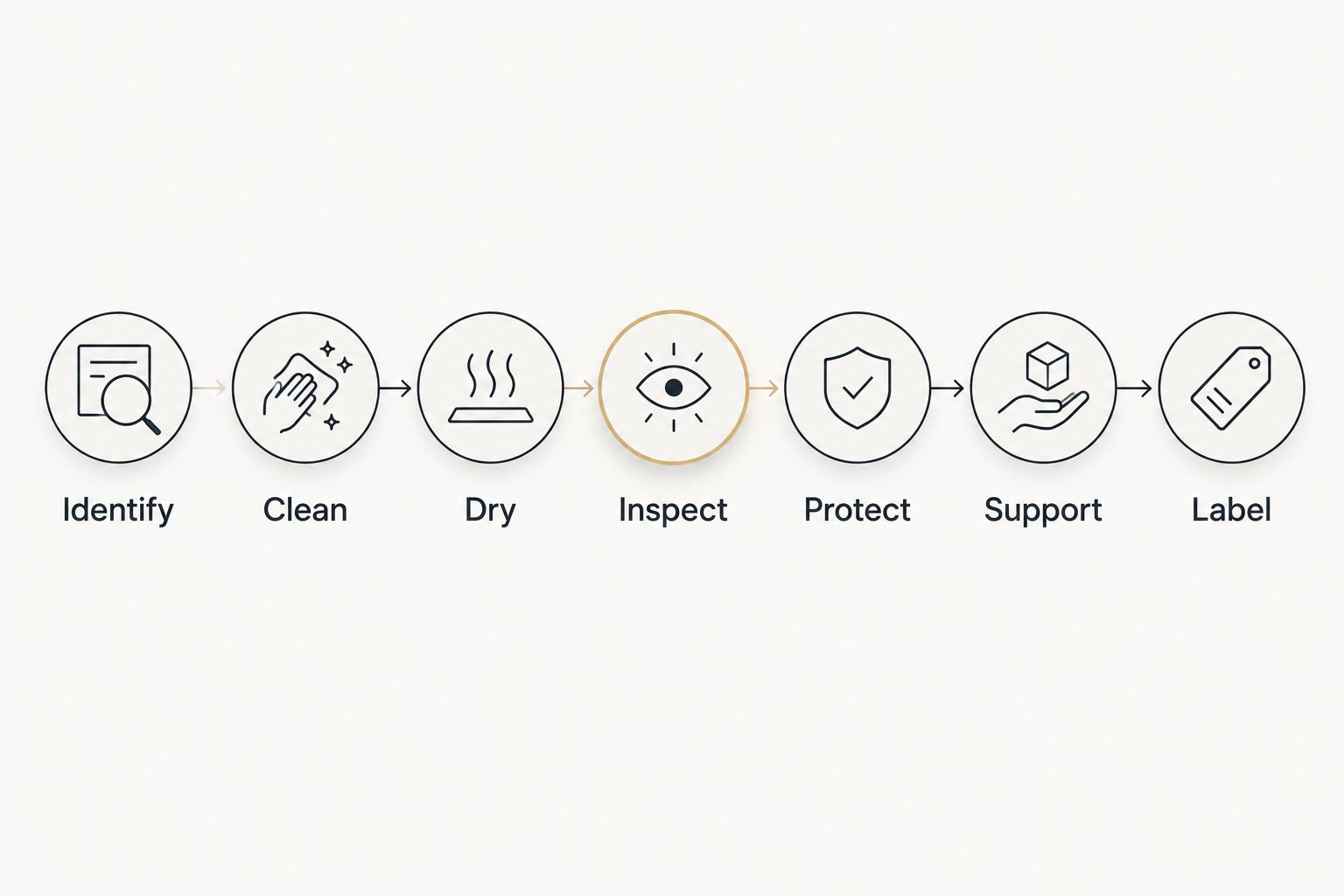
Use the following sequence whenever punches, dies or forming tools leave production. Make this the baseline for your 2026 storage procedure, with the tool manufacturer's instructions controlling cleaning chemistry, protective treatments and handling.
For the condition assessment, use the checks in how to inspect press brake dies for wear before reordering. Inspect before applying a protective film so that contamination does not hide damage.
- Identify the tool. Record the tool reference, profile, segment length and clamping interface. Keep matched components associated with their assembly drawing.
- Clean the surfaces. Remove swarf, sheet-metal debris and process residues with a compatible cleaner and non-damaging cleaning materials. Do not scrape precision surfaces with an improvised steel tool.
- Dry completely. Check recesses, mounting features and enclosed areas where cleaning liquid collects. Do not seal damp tooling inside packaging.
- Inspect and segregate. Examine punch tips, die shoulders, seating faces and retention features. Separate questionable tooling from production-ready stock.
- Apply corrosion protection. Select a preventive approved for the tool material, coating and intended storage conditions. Follow its application and removal instructions.
- Support and restrain. Use designated supports that keep working edges clear of adjacent tools and prevent rolling, tipping or sliding.
- Label and release. Mark the storage location and tool status. Require a pre-use check before the tool returns to a press brake.
These steps address different failure mechanisms. A protective film does not prevent a chipped punch tip, and a padded drawer does not eliminate condensation.
Why this matters
Storage must preserve both the forming profile and the machine interface. A damaged punch radius affects contact with the sheet; contamination or damage on a seating surface interferes with correct mounting.
Organize your 2026 tooling register around usable condition, not simply inventory quantity. A tool that is present but unidentified, corroded or awaiting inspection is not ready for production.
Treat storage as part of setup control. Keep inspection status, tool identity and handling requirements visible at the point where an operator selects the tool.
Which storage arrangement should you use?
Choose the arrangement after checking tool mass, dimensions, support geometry and retrieval method. Cabinet capacity alone does not establish that an individual drawer, shelf or holder can carry the intended load.
| Storage arrangement | Best for | Advantages | Limitations and verification |
|---|---|---|---|
| Dedicated tooling cabinet | Sectional tools retrieved frequently | Separates profiles and provides defined locations | Check each drawer rating, retention and access; an enclosed cabinet still requires dry contents |
| Engineered rack | Long tools and lifting-assisted handling | Provides accessible support positions | Verify support spacing, restraint, anchoring and the load on each storage level |
| Partitioned drawer | Short segments and associated accessories | Keeps small items organized and prevents loose mixing | Provide suitable inserts; do not allow tips or shoulders to strike partitions |
| Protected transport case | Tooling moved between controlled locations | Keeps identified components together during transport | Secure tools against movement and verify that packaging is dry before closure |
Choose a dedicated location for each identified tool or matched set. A storage arrangement fails its purpose if retrieving one component requires dragging another across a working edge.
Dedicated cabinets: protect profiles inside the drawer
Inspect the actual contact points between tooling and inserts. A drawer liner is not sufficient if a punch rests on its tip or a die bears against a vulnerable working shoulder.
Keep segment lengths visible without lifting a stack. Follow the cabinet manufacturer's loading and opening instructions, and do not assume a closed drawer proves that its contents are secure.
Engineered racks: verify support and restraint
Long tooling needs support that prevents instability during storage and retrieval. Confirm support locations, rated loading and restraint with the rack supplier rather than choosing shelf spacing by appearance.
Keep the retrieval path clear for the approved handling equipment. Do not place a tool where its removal requires reaching beneath an unsecured tool or standing in its potential fall path.
Cases and packaging: protect without trapping moisture
Clean and dry tooling before wrapping or enclosing it. Select packaging materials that are compatible with the corrosion preventive and the tool's surface treatment.
Do not treat transport packaging as permanent storage without inspection. Condensation, damaged wrapping and retained cleaning liquid require attention before the package returns to its assigned location.
Why storage protection requirements vary
Use these factors to define your 2026 storage instructions. They determine what needs checking; they do not justify a universal coating, humidity limit or inspection interval.
- Moisture exposure: Leaks, washdown, damp packaging and condensation require different corrective actions. Remove the moisture source rather than repeatedly coating wet tooling.
- Surface condition: Bare steel, coated surfaces and existing corrosion need compatible treatment. Confirm cleaning and protection instructions for the actual tool.
- Tool geometry: Narrow tips, projecting profiles and retention features require supports that avoid concentrated contact on vulnerable areas.
- Handling frequency: Frequently retrieved tooling needs protection that operators can inspect and remove correctly before setup.
- Storage duration: Longer inactive periods require a documented protection and inspection plan suited to the environment and preventive used.
- Adjacent processes: Grinding debris, coolant mist and chemical exposure affect the cleanliness of an otherwise orderly storage location.
Record the observed condition when tooling is inspected. If corrosion recurs, investigate the environment, cleaning method and protective treatment instead of simply shortening the interval between applications.
How should you prevent rust without contaminating the next job?
Use a corrosion preventive selected for tooling storage, following its technical instructions and any restrictions from the tool manufacturer. Do not assume that a lubricant used elsewhere in the shop is suitable for every coating, clamping surface or forming operation.
Apply the treatment only after cleaning and drying. Cover the specified surfaces without filling recesses with unnecessary material or leaving pools that obscure inspection.
Before setup, remove the preventive wherever the machine, tooling or process instructions require clean surfaces. Check the forming faces as well as the clamping interface: residue transferred to sheet metal creates an additional cleaning concern for downstream finishing.
For your 2026 work instruction, identify the approved product, application method, removal method and inspection responsibility. Keep its safety information accessible and follow the specified ventilation and handling precautions.
Should you use desiccants or vapor corrosion inhibitors?
Desiccants and vapor corrosion inhibitor packaging serve different functions: desiccants absorb moisture, while vapor corrosion inhibitors provide corrosion protection within suitable packaging. Neither replaces clean, dry tooling or correction of water ingress.
Verify enclosure suitability, material compatibility and maintenance instructions with the packaging supplier. Do not place an unspecified quantity in an open rack and assume that the tools are protected.
How do you prevent impact damage and mixed segments?
Store punches and dies so that their working profiles cannot contact adjacent tools during normal placement and removal. Use supports and separators designed for the geometry, not loose material that shifts when a drawer moves.
Keep short segments restrained and identifiable. Similar appearance does not establish matching installed height, punch radius, die opening or clamping interface.
Your location record should include:
- Tool identification and drawing revision, where applicable.
- Punch or die profile and relevant working dimensions.
- Individual segment lengths and the intended assembled bend length.
- Clamping interface and retention arrangement.
- Permitted loading information from the tooling documentation.
- Inspection status and any restriction on use.
Do not add identification by grinding, stamping or engraving a precision surface without manufacturer approval. Keep labels readable without covering a defect or interfering with seating.
Before combining tools retrieved from different locations, verify press brake tooling compatibility before ordering or setup. Matching storage labels are a selection aid, not proof of mechanical compatibility.
What should you do if stored tooling has rust or damage?
Quarantine tooling with pitting, cracks, chips, damaged retention features or uncertain seating condition. Identify the affected surface and document the condition before cleaning removes evidence.
Do not use abrasive paper, powered wire wheels or grinding as an automatic remedy. Removing material from a punch radius, die shoulder or clamping surface changes geometry; rust removal does not establish that the tool remains serviceable.
A tooling review should consider:
- Whether corrosion is superficial or includes material loss.
- Whether the affected area carries forming or clamping loads.
- Whether the working profile remains within its drawing requirements.
- Whether retention features remain intact and functional.
- Whether repair requires revised dimensional or loading documentation.
Release repaired tooling only against documented acceptance criteria. Appearance alone is not a dimensional inspection, and a successful mounting attempt is not a load-capacity assessment.
What should you check before returning stored tooling to production?
Use the 2026 setup record to connect the stored tool to the actual machine and job. Confirm that cleaning is complete, surfaces are inspectable and any quarantine restriction has been formally resolved.
Check the clamping interface, seating faces, retention mechanism, installed height and segment arrangement against the setup documentation. Confirm the required bend length, material grade, thickness, radius and flange geometry before approving the tooling combination.
Chinacovo press brake tooling is best suited to fabricators selecting standard or custom tools against defined part and machine requirements. For custom engineering, provide Chinacovo with the finished-part drawing, machine interface, material grade, thickness and required geometry; storage condition remains a separate verification requirement.
Do not assume that a custom profile resolves damaged mounting surfaces or that an undamaged tool fits every holder. Selection, condition and compatibility each need their own acceptance check.
FAQ
What's the best way to store press brake tooling between jobs?
Store press brake tooling clean, dry, protected against corrosion and restrained in a rated storage system. Keep working profiles separated and tool identification visible, then inspect before reuse.
Should press brake punches and dies be stored upright or flat?
Use the orientation specified for the storage system and tool geometry. The support must prevent instability and protect working profiles; neither upright nor flat storage is universally correct.
Can I wrap press brake tooling in plastic to prevent rust?
Plastic wrapping alone does not establish corrosion protection. Clean and dry the tool first, verify packaging compatibility and avoid enclosing moisture with the tooling.
How often should I inspect stored press brake tooling?
Set inspection frequency from the storage environment, protective treatment and tool manufacturer's instructions. Inspect before reuse and investigate immediately after water exposure or a handling incident.
Can I remove rust from a punch with abrasive paper?
Do not use abrasive paper on a precision tooling surface without an approved method. Material removal changes geometry, and pitting requires assessment rather than cosmetic cleaning.
Should I leave protective oil on the clamping interface?
Follow the machine and tooling instructions for the required clamping-surface condition. Remove storage preventive wherever those instructions require clean surfaces before mounting.
What information should I send Chinacovo for a tooling review?
Send Chinacovo the finished-part drawing, machine interface, material grade, thickness and required geometry. For stored tooling with suspected damage, also provide identification, affected-surface photographs and inspection findings.
One last thing
Inspect the storage contact points, not just the tooling. A chip embedded in an insert or a damaged divider can mark a clean tool every time it is returned.
Add that check to the return-to-storage procedure. A protected tool needs a clean, stable resting place—not merely a protective coating.
Related guides
- Can worn press brake punches be reground instead of replaced?
- How long do press brake dies last before replacement?
- Can you mix press brake punches and dies from different brands?
Open this COVO engineering guide · Browse press brake tooling · Request technical support