COVO KNOWLEDGE
Is a mini press brake worth it for a small fab shop in 2026?
Published:
Updated:
A mini press brake is worth it for verified part families. Check bending load, tooling interface, flange geometry and clearance before choosing your machine.
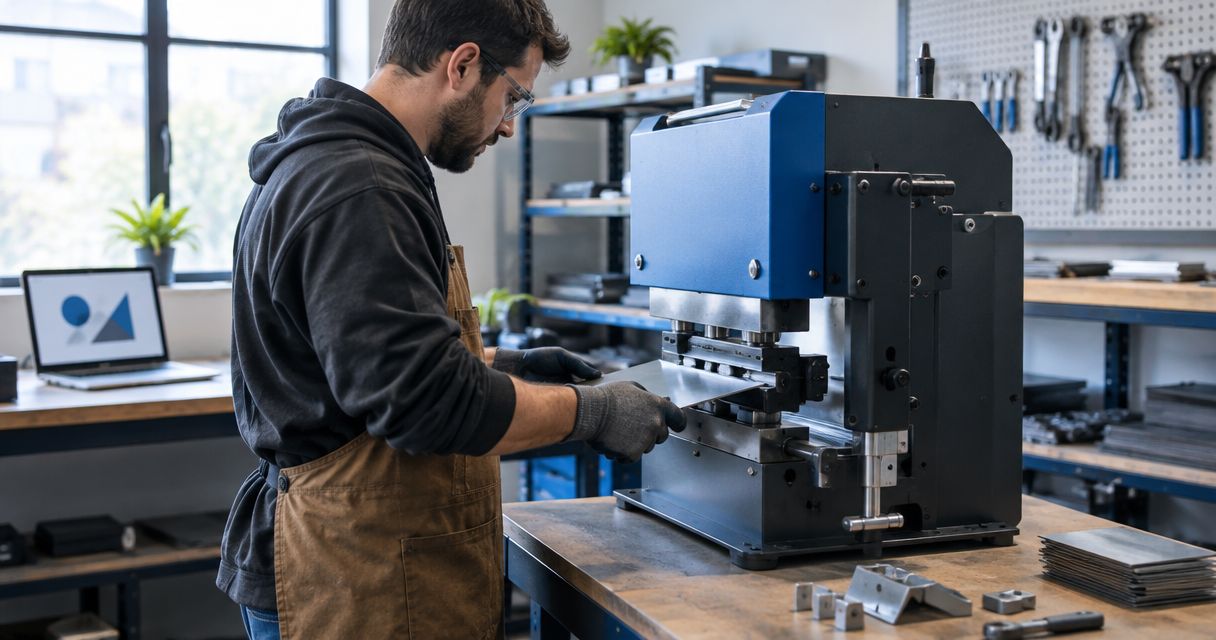
A mini press brake is worth it for a small fab shop in 2026 when your recurring parts fit its verified bending capacity, working length, tooling interface and clearance envelope. Include tooling, setup, inspection and safe material handling in the decision; a compact machine is not a substitute for checking whether you can form the finished part.
- Choose a mini press brake for recurring parts that fit verified load, bend length and clearance limits.
- Check press brake tooling, installed height and flange geometry before selecting a machine.
- Keep larger or incompatible work on another verified process rather than forcing it onto a compact brake.
- Chinacovo supplies standard and custom press brake punches and dies; specify the machine interface before requesting tooling review.
Is a mini press brake worth it for a small fab shop in 2026?
Choose a mini press brake around a defined part family, not around the machine's footprint. It earns a place when the required bends fit the complete machine-and-tooling assembly and you have enough recurring work to justify operating that assembly.
The press brake tooling guide for small fab shops supports the tooling side of this decision. Machine selection still requires the manufacturer's capacity information and an application review against your drawings.
| Option | Best for | Main advantage | Main constraint |
|---|---|---|---|
| Mini press brake | Recurring short parts within verified capacity | A dedicated bending process for a defined part family | Working length, opening and tooling compatibility restrict the usable envelope |
| Existing full-size press brake | Parts already covered by a validated setup | Uses an established machine and tooling arrangement | Small jobs still require scheduling and setup on that machine |
| Manual folding brake | Parts compatible with its clamping beam and folding geometry | Direct folding operation for suitable sheet-metal work | Its forming geometry differs from punch-and-die bending |
| Outsourced bending | Work outside your verified in-house capability | Keeps incompatible forming operations off your equipment | Supplier coordination and drawing control remain necessary |
Why this matters
A short bend is not automatically an easy bend. Material strength, thickness, die opening and forming method all affect the required force; an existing flange can also obstruct the punch before the next bend reaches its target angle.
For your 2026 equipment review, separate machine capacity from part feasibility. A machine can satisfy the force requirement and still fail the job because the backgauge cannot locate the blank, the installed tools leave insufficient opening, or the completed part cannot be removed.
Keep the decision tied to actual drawings. A purchasing comparison built around nominal tonnage and overall dimensions leaves out the conditions that determine whether the machine produces an acceptable part.
Mini press brake: best for a defined part family
A mini press brake is a sensible candidate when you repeatedly make parts with bend lengths, materials and geometry that fall inside its documented operating limits. Verify the entire family, including its most demanding variants. The shortest part is not necessarily the limiting case.
Select representative drawings that cover your longest bend, highest-strength material, thickest sheet, shortest flange and most restrictive return geometry. These characteristics need not occur on the same part. Each exposes a different limit.
The advantage is a dedicated process; the limitation is a narrower verified operating envelope. Do not assume that every bracket, cover or enclosure qualifies simply because the finished assembly is small.
For a 2026 purchasing decision, ask the machine supplier to identify the proposed punch, die, holder and bending method for those drawings. An application response tied to specific tools is more useful than a statement that the machine handles small sheet-metal parts.
Existing full-size press brake: best for validated setups
Keep work on your existing press brake when the current tooling and setup already meet the drawing requirements and production scheduling does not justify another machine. Adding equipment does not eliminate programming, tool handling or inspection.
The advantage is that you retain a known process. The constraint is that small parts still occupy machine time and require their own setup, even when the equipment has much greater capacity than the job requires.
Compare the current process with the proposed compact process using the same acceptance criteria. Include first-piece approval, angle verification, flange measurement and any surface requirements. A smaller machine must prove the required result, not merely fit the blank.
Manual folding or outsourced bending: best for different constraints
A manual folding brake deserves consideration when the part is compatible with the machine's clamping beam, fingers and folding motion. It is not a direct replacement for a press brake process: the tooling geometry and how the sheet is supported differ.
Outsourcing is a separate option when a part falls outside your verified capability or does not justify an in-house setup. You still need controlled drawings, material requirements and inspection criteria. Transferring the bend operation does not transfer responsibility for defining the part.
Compare alternatives against the required geometry, not against machine size alone. For your 2026 review, identify which operations each option can complete and which operations would remain elsewhere.
What determines whether a mini press brake pays off?
The value varies with the work you can actually route through the machine. Review these factors before building an investment case:
- Part-family fit: Check whether recurring drawings share compatible bend lengths, material specifications and tooling requirements.
- Load requirements: Verify forming force against the machine, punch, die, holder and clamping limits for the proposed operation.
- Tooling compatibility: Confirm the clamping interface, retention arrangement, seating surfaces and installed height.
- Geometric access: Check flange geometry, return clearance, backgauge access and part removal throughout the bend sequence.
- Setup burden: Account for tool changes, program preparation, first-piece inspection and operator handling.
- Process coverage: Identify bends that would still require another machine or an outside supplier.
Do not turn these checks into an assumed savings figure. Use your job records and a demonstrated setup to compare the current route with the proposed route. Keep recurring production work separate from occasional jobs that only appear to fit.
How do you verify the part before choosing the machine?
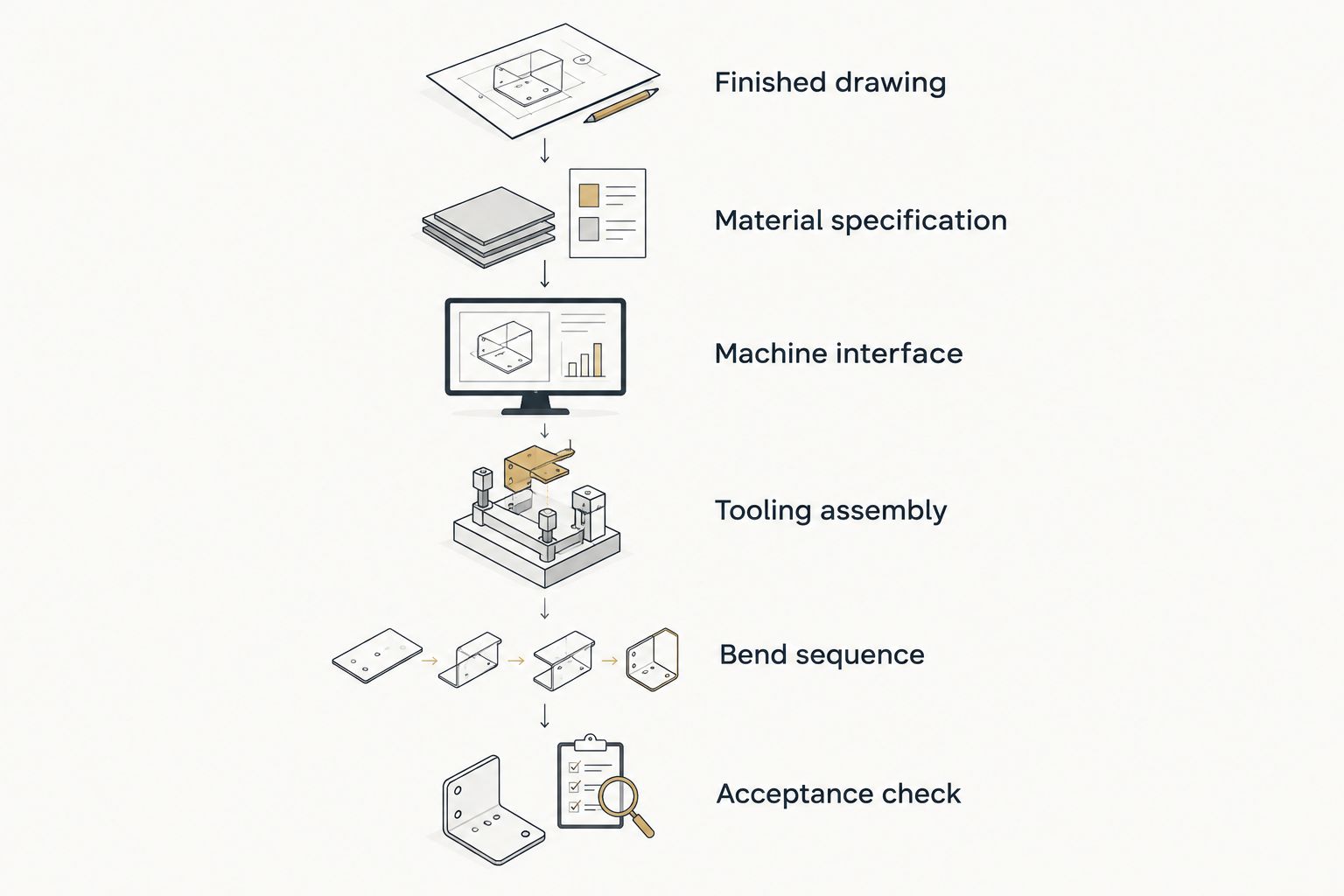
Use the following sequence to prepare an engineering review. It starts with the finished part because the tool and machine must satisfy that geometry, not the other way around.
- Finished drawing: Provide the controlled drawing and identify bend angles, inside radii, flange dimensions, tolerances and surface requirements. Include the intended bend sequence when one is already established.
- Material specification: State the material grade and thickness, not only a gauge designation. Identify grain direction where the drawing or process requires it, and provide applicable material properties for the load assessment.
- Machine interface: Supply the machine model, manufacturer documentation, clamping interface, holder drawings and available opening. Record stroke, throat restrictions and backgauge travel relevant to the part.
- Tooling assembly: Define the proposed punch, die, adapter and holder combination. Check seating, retention, installed height, segment fit and load ratings as an assembly.
- Bend sequence: Verify support, locating surfaces and clearance at every bend. Include the intermediate part shapes and the route for removing the finished component.
- Acceptance check: Agree how the sample part will be inspected. Confirm the angle, flange dimensions, radius and surface condition against the drawing before approving production.
A drawing review identifies conflicts before you commit to a setup. It does not replace manufacturer operating instructions, safeguarding requirements or a controlled trial on the proposed equipment.
Which tooling checks matter most on a compact brake?
Tool fit includes more than whether the punch enters the clamp. Verify the tang or mounting geometry, retention method, seating surfaces, holder arrangement and installed height. A nominal tooling-system label does not establish compatibility with a particular compact machine.
Check the lower tooling with equal care. The die must seat correctly, remain aligned with the punch and carry the approved load through its support arrangement. Adapters belong in the clearance and load review; they are not neutral additions.
For sectional tooling, check the assembled bend length and segment arrangement. Confirm that segment joints, end clearances and retention suit the operation. A tool set that fits the blank can still interfere with return flanges or prevent part removal.
Chinacovo manufactures standard and custom press brake punches, dies and forming tools. Chinacovo press brake tooling is best suited to fabricators seeking standard or custom tools for a specified machine interface and finished-part geometry. The manufacturing scope does not establish compatibility with an unspecified mini press brake; provide the machine and part specifications for review.
Can a mini press brake make short flanges and tight radii?
A mini press brake can make a short flange or specified radius only when the material, tooling and forming method support that geometry. Compact machine size does not establish either capability.
For air bending, the die opening affects sheet support and the resulting bend geometry. A flange must remain adequately supported during forming. Do not select a narrower opening solely to reach a shorter flange without reviewing the resulting load and material behavior.
Use the minimum flange length guide by V-die opening to frame the support check. Confirm the actual application against the proposed die geometry and material rather than treating a general guideline as approval.
For radius requirements, distinguish the punch nose radius from the achieved inside bend radius. The relationship depends on material and process. Inspect the formed part against the drawing instead of assuming the punch profile alone guarantees the result.
Can a mini press brake bend boxes and return flanges?
A mini press brake can bend a box only when the tooling and machine provide clearance through the complete sequence. Check intermediate shapes, not just the final drawing.
Return flanges introduce possible interference with the punch body, holder and previously formed walls. A relieved punch profile or sectional arrangement can address some geometries, but neither removes the need to verify installed height, load and extraction clearance.
Make part removal an explicit approval step. A bend sequence is incomplete until you can remove the finished part without an unapproved tool adjustment or handling method.
How should you approve a mini press brake for production?
Approve the process against a representative sample made with the proposed machine, tooling, material and bend sequence. A demonstration using a different alloy, easier flange or substitute tool does not establish acceptance for your drawing.
Record the tool identification, setup conditions, locating method and inspection results. For a 2026 approval file, keep that record with the controlled part drawing and the relevant machine and tooling documentation.
Inspect more than the bend angle. Check flange dimensions, radius requirements, twist, surface marking and any downstream assembly features affected by bending. Use the drawing's acceptance criteria rather than creating a separate standard for the compact machine.
Do not treat the machine's small footprint as a safety assessment. Verify the manufacturer's safeguarding and operating requirements, including the intended method for positioning and supporting small parts.
FAQ
Is a mini press brake worth it for a small fab shop?
A mini press brake is worth considering when recurring parts fit its verified load, bend length, tooling and clearance limits. Compare the demonstrated process with your existing route before committing.
Is a mini press brake better than a manual folding brake?
A mini press brake is the better candidate when the part requires a compatible punch-and-die bending process. A manual folding brake remains an alternative for geometry suited to its clamping beam and folding motion.
Can a mini press brake bend stainless steel?
A mini press brake can bend stainless steel when the specified grade, thickness, bend length and forming method remain within the approved machine-and-tooling limits. Material identity alone does not establish capacity.
Will my existing press brake tooling fit a mini press brake?
Existing press brake tooling fits only when the clamping interface, seating, retention, installed height and load ratings match the proposed machine. Verify drawings rather than relying on a tooling-system name.
What should I send for a custom tooling review?
Send the finished-part drawing, material grade, thickness, required geometry and machine-interface information. Chinacovo's tooling review should also receive the proposed bend sequence and relevant clearance requirements.
Can a mini press brake make enclosure boxes?
A mini press brake can make enclosure boxes when each bend and the finished-part removal route fit the machine-and-tooling envelope. Check return flanges, punch clearance, segment arrangement and backgauge access.
What should I check before buying a mini press brake in 2026?
Before buying a mini press brake in 2026, verify representative parts against machine capacity, tooling compatibility, clearance and inspection requirements. Approve a sample produced with the proposed material and setup.
One last thing
Start the final review with the part you expect to be hardest to remove, not the easiest flat bracket. Extraction exposes tooling and clearance conflicts that a simple bend demonstration leaves hidden. If that part cannot complete its approved sequence and leave the machine safely, revise the tooling or keep it on another verified process.
Related guides
- Press brake tooling for electrical enclosures
- Segmented press brake dies for box forming
- Minimum bend radius by material and thickness
Open this COVO engineering guide · Browse press brake tooling · Request technical support