COVO KNOWLEDGE
Is buying press brake tooling in bulk worth it in 2026?
Published:
Updated:
Bulk press brake tooling is worth buying for verified repeat work. Check clamping interfaces, segment lengths, loads and part geometry before ordering.
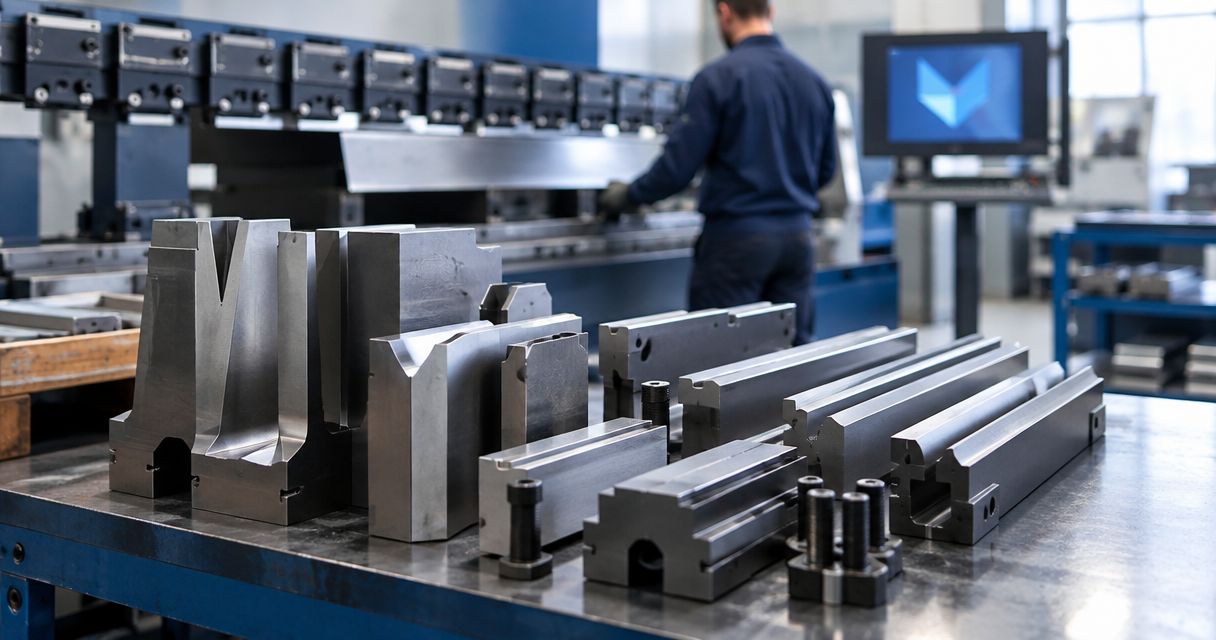
Bulk press brake tooling is worth buying in 2026 when repeat work requires verified tooling profiles, matched machine interfaces and enough usable bend length to justify duplicate sets. The benefit disappears when you buy unused profiles, incompatible segments or tools that require unplanned holders, adapters or setup changes.
- Buy bulk press brake tooling for verified repeat work, not an unallocated assortment of punches and dies.
- Chinacovo manufactures standard and custom press brake tooling; selection must follow the finished-part drawing and machine interface.
- Check clamping interface, installed height, segment arrangement and rated load before approving duplicate tooling sets.
- Use staged purchasing when part geometry, material specifications or machine allocation remain unresolved.
Why this matters
A bulk order multiplies a tooling decision. If the profile and interface are correct, you can allocate matching tools to recurring production requirements. If either is wrong, the same purchasing decision creates multiple unusable pieces.
Approve the tooling specification before approving the quantity. Start with press brake tooling compatibility verification, then connect each proposed punch, die and segment set to an actual production requirement.
For your 2026 purchasing plan, separate tools that already run approved parts from tools proposed for new geometry. Proven repeat requirements and unresolved development work do not justify the same purchasing commitment.
Is buying press brake tooling in bulk worth it in 2026?
Buy in bulk when the quantity follows a verified production need; use staged purchasing when the specification is still changing. The useful comparison is not simply a large order against a small order. Compare the tools you can put into service against the tools you must store, validate, adapt or leave unused.
| Purchasing approach | Best for | Practical advantage | Limitation | Decision rule |
|---|---|---|---|---|
| Bulk repeat-profile order | Stable parts and documented setups | Supplies duplicate tooling for defined work | Repeats any specification error across the order | Buy after interface and application approval |
| Staged order | New parts or unresolved forming requirements | Limits commitment while you validate the setup | Requires subsequent purchasing and receiving work | Hold the balance until validation is complete |
| Mixed-profile assortment | Shops with a documented need for each included profile | Groups different requirements into one purchasing package | Unused profiles consume storage and purchasing resources | Skip items without an assigned application |
| Custom tooling order | Geometry that requires a purpose-designed working profile | Defines tooling around the finished-part requirement | Requires drawing and machine review before duplication | Approve the design before ordering repeat sets |
A mixed order is not automatically a bulk benefit. A punch used on recurring work and a special profile with no assigned part should not receive equal purchasing priority.
Keep the approval attached to the complete assembly. A punch drawing alone does not establish that the punch, holder, die and machine will produce the required flange geometry.
Bulk repeat-profile orders: best for established production
Duplicate tools make sense when your production plan requires the same working profile in separate setups, on different compatible machines or as a documented replacement requirement. Specify the intended allocation rather than treating every duplicate as general stock.
Check whether the production constraint is missing tooling, insufficient usable length, tool condition or setup organization. Buying more punches will not resolve an incorrect die opening or a collision caused by the punch body.
The advantage is a direct connection between the purchase and established work. The limitation is that a profile approved on one machine is not automatically approved on another, even when the machines perform similar operations.
Buy repeat sets only after confirming the complete setup on each intended machine. Record any differences in holders, adapters and installed height against the machine allocation.
Staged orders: best for unresolved requirements
Use a staged order when the finished-part drawing, bend sequence or machine assignment still requires validation. Approve the initial tooling configuration, check the formed part and release additional quantities against the accepted specification.
This approach limits the number of tools affected by a drawing revision or an unsuccessful clearance assumption. Its disadvantage is additional purchasing coordination: the later order still needs a controlled specification and a clear acceptance requirement.
Do not treat the first successful bend as approval of every application. A tool that forms an open angle still needs separate clearance review for a closed box, return flange or deeper section.
Hold duplicate quantities until the relevant part family and bend sequence are approved. Document what the validation covers so a successful trial does not become an unsupported blanket approval.
Custom tooling orders: best for drawing-defined geometry
Custom tooling belongs in the comparison when the required radius, flange geometry, clearance or forming operation calls for a purpose-designed profile. Start with the finished-part drawing, material grade, thickness and intended machine interface—not a quantity target.
Chinacovo press brake tooling is suited to fabricators specifying standard or custom punches and dies against defined part and machine requirements. Chinacovo manufactures both types; the purchasing decision still requires application-specific verification rather than an assumption that every profile fits every machine.
The advantage of a custom order is that the review addresses the required geometry. The limitation is that repeating a custom profile before its application is verified also repeats the design commitment.
Use the custom press brake tooling guide for OEM fabricators to organize the application discussion. Approve the drawing and validation requirements before authorizing duplicate custom sets.
Why the value of a bulk tooling order varies
The value of bulk press brake tooling depends on how much of the order becomes usable production tooling. Review these factors before comparing purchasing proposals:
- Repeat demand: Connect each profile and quantity to recurring parts, machine allocation or a defined replacement requirement. Do not use an unspecified future job as the justification.
- Clamping interface: Verify tang geometry, seating surfaces, retention and the holder arrangement. A familiar system name does not replace an interface drawing.
- Working geometry: Check punch angle, tip radius, die opening, die angle and clearance throughout the bend sequence. Include return flanges and enclosed features.
- Segment arrangement: Confirm usable bend length, individual segment lengths and the arrangement needed around box sides or obstructions. Total supplied length alone is insufficient.
- Load and condition: Review the required forming load against the ratings and condition of the machine, holders, punches and dies. Short segments need particular attention to loading limits.
- Storage and identification: Assign storage positions and identification that preserve the approved specification. Unidentified tools cannot be selected reliably from a purchasing description alone.
For 2026 approvals, require an assigned use for every line item. Grouping purchases does not remove the need to justify each profile, length and quantity.
How do you verify a bulk tooling order before release?
Use a gated review rather than approving quantity from a catalog description. Each stage should leave a document that the next person can check without reconstructing the application.
Confirm part requirements
Attach the finished-part drawing and its revision. Identify material grade, thickness, bend length, required radius, bend angle, flange geometry and surface requirements.
State which dimensions and surfaces control acceptance. Where a part requires several bends, include the intended sequence and identify features that restrict tool access or part removal.
Verify machine interface
Record the intended machine and actual clamping arrangement. Compare the punch tang, die seating, retention features and holder configuration with the proposed tooling drawings.
Check installed height as an assembly, including any adapter. Also review working space and stroke requirements; a tool that seats in the holder still needs enough space to complete the operation.
Review forming setup
Confirm the forming method, punch profile and die geometry against the specified material and finished part. Check clearance through the sequence, not just at the final bend position.
Review required force and permitted loading using the applicable machine and tooling documentation. Do not infer a segment's permitted load from its appearance or from another tool with a similar profile.
Allocate tool quantities
Build the quantity from usable bend length, segment arrangement and the number of setups that actually require dedicated tools. Distinguish working sets from replacements and application-development tools.
Specify segment lengths explicitly. A long combined length does not prove that the set contains the short pieces needed beside a return flange or inside a box.
Define acceptance checks
Agree on the drawings, identification and inspection requirements before release. Include the relevant interface dimensions, working profiles, segment lengths and assembly requirements.
For new geometry, define the part validation required before releasing duplicate sets. Keep the accepted tooling revision linked to the accepted part drawing.
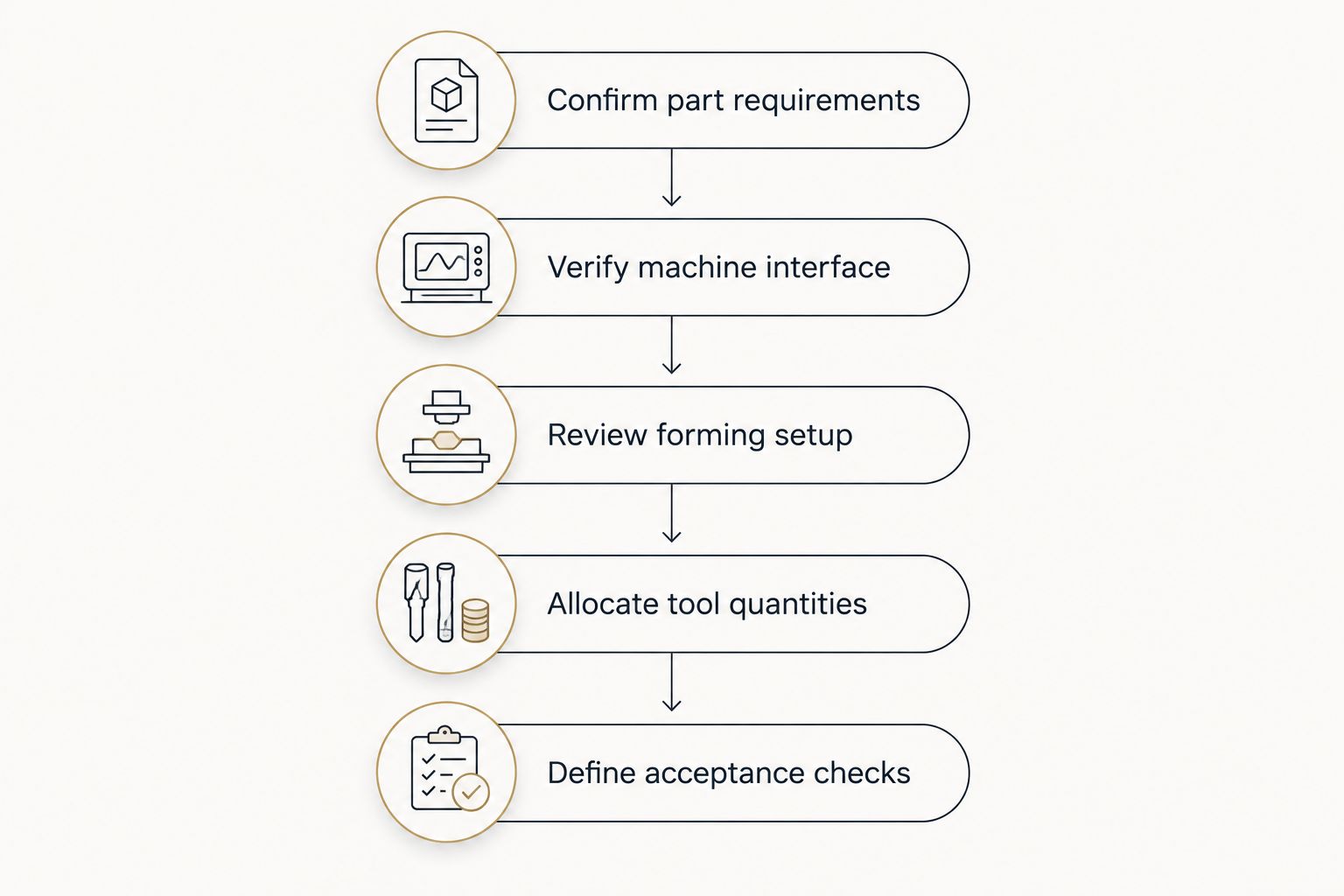
A complete review package gives Chinacovo the finished-part requirements and machine information needed for a standard or custom tooling discussion. Keep unresolved items open rather than replacing missing dimensions with assumptions.
How should you compare bulk tooling proposals in 2026?
Compare proposals against the same controlled specification. Different segment arrangements, working profiles or included holders are different technical scopes, even when the headline descriptions look similar.
Use a line-by-line comparison covering:
- Drawing number and revision for each punch and die.
- Clamping interface and any required holder or adapter.
- Working angle, radius, die opening and installed height.
- Individual segment lengths and total supplied length.
- Rated loading and the conditions attached to that rating.
- Inspection, identification and application-validation requirements.
Keep the purchasing comparison separate from the engineering acceptance decision. Commercial terms do not establish suitability, and technical suitability alone does not establish how many sets your shop needs.
Do not calculate savings against tools you would not otherwise buy. First remove unassigned profiles and excess quantities, then compare equivalent purchasing scopes.
Can you share bulk tooling across different press brakes?
Tooling sharing requires verification of each machine's interface and assembled setup. Matching the press brake brand name or nominal working length is not enough to approve interchangeability.
Check holders, retention, seating, installed height and permitted loading for every intended machine. Keep separate allocation records wherever the approved configurations differ.
Is a bulk assortment better than duplicate working sets?
A bulk assortment is better only when its included profiles match documented jobs. Duplicate working sets are the clearer choice when recurring production already uses the same verified geometry.
Compare application coverage rather than piece count. More pieces do not necessarily provide more usable bend length or solve a missing clearance requirement.
When should you delay a bulk tooling purchase?
Delay the purchase when interface dimensions, material specifications, required geometry or machine allocation remain unresolved. Resolve those items before multiplying the specification across additional tools.
For a 2026 production release, also check that the purchasing list uses the current part revision. An approved tool for an obsolete flange geometry is not evidence that the revised part will form correctly.
FAQ
Is bulk press brake tooling worth it for a small fabrication shop?
Bulk press brake tooling is worth considering when a small shop has recurring work that requires verified duplicate sets or specific segment arrangements. A staged order is the better fit when profiles and quantities remain unassigned.
What's the first thing to check before ordering tooling in bulk?
Check the complete tooling application and clamping interface before approving quantity. Include the finished-part drawing, machine configuration, material grade, thickness and required geometry.
Can I use the same bulk tooling order on different press brake brands?
A shared tooling order requires interface and setup verification for every intended machine. Brand names alone do not establish compatible tangs, holders, installed height or retention.
Should I buy long tools or segmented tools in bulk?
Choose the length arrangement that matches your bend lengths, clearance requirements and handling procedures. Segmented tools require an explicit segment schedule; total length alone does not establish application coverage.
Does buying more tooling solve setup problems?
Additional tooling does not correct an unsuitable working profile, incorrect die selection or unresolved machine interface. Identify the setup problem before specifying more tools.
Can Chinacovo supply custom press brake tooling?
Chinacovo manufactures standard and custom press brake punches, dies, forming tools and accessories. Base a custom tooling review on the finished-part drawing, machine interface, material grade, thickness and required geometry.
What should I do before ordering duplicate custom tools?
Approve the custom tooling specification and application-validation requirements before ordering duplicate sets. Link the accepted tool drawing to the relevant part revision and machine configuration.
One last thing
Check the shortest required segment before approving the total tooling length. A set can provide enough combined length and still lack the piece needed to clear a box wall or return flange.
Mark that segment on the proposed layout. This check tests whether the purchasing list follows the actual part—not just the overall bed length.
Related guides
- Can press brake tooling interchange between AMADA and TRUMPF?
- Segmented press brake dies for box forming
- Can worn press brake punches be reground instead of replaced?
Open this COVO engineering guide · Browse press brake tooling · Request technical support