COVO KNOWLEDGE
Round Bar Bending on a Press Brake: 60° Rod Bending V-Die, Two Bars per Stroke
Published:
Updated:
How to bend round bar on a press brake: a rod bending V-die with an R2.9 gooseneck punch and locating cradles bends two Ø8 bars to 60° in one stroke.
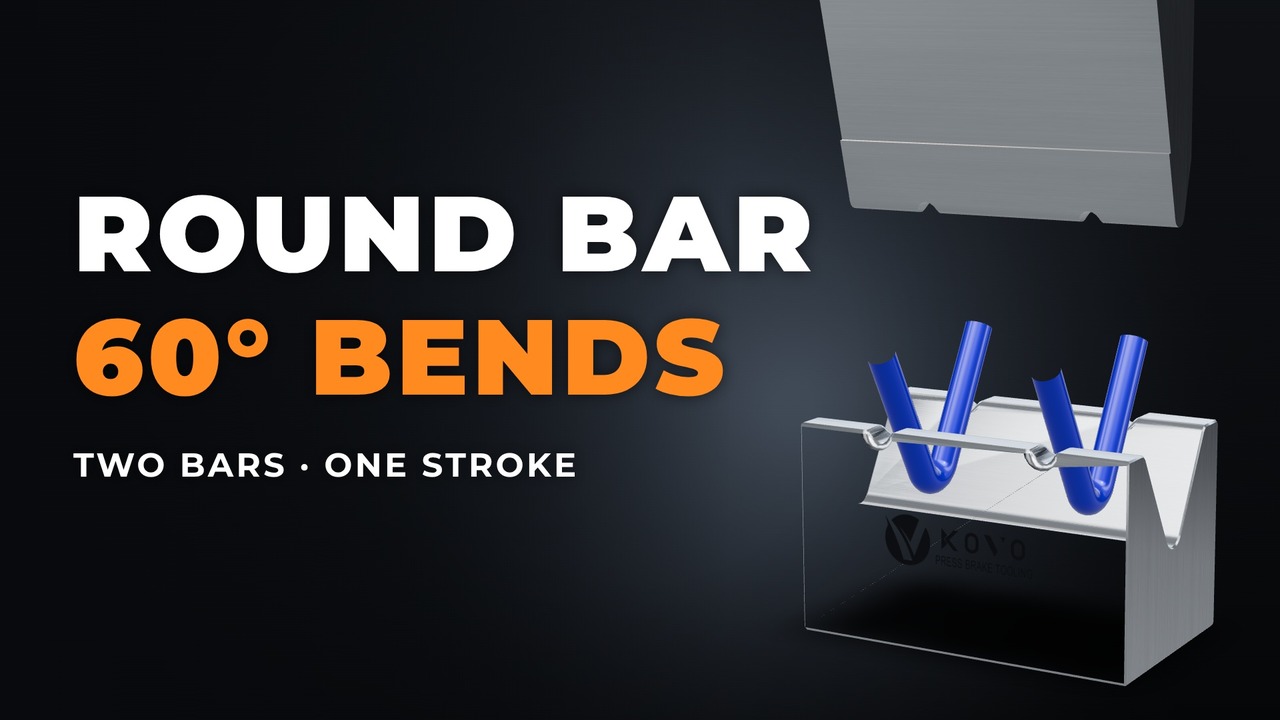
Direct answer: To bend round bar on a press brake, use a rod bending V-die rather than a sheet-metal V die. In COVO's design, a gooseneck punch with an R2.9 nose presses two Ø8 mm bars into a 60° V-groove in one stroke. Locating cradles hold each bar square to the V, the nose forms the inside radius, and the legs stop on the V faces at 60°. The die sets the angle, not the ram depth, so every stroke repeats it.
What the video shows, second by second
The middle column is the text on screen at that moment; the right-hand column explains what it means for the job.
| Time | On screen | What it means |
|---|---|---|
| 0:01 | One hit. Two 60° bends. | Both bars are formed in a single ram stroke. |
| 0:03 | Rod bending V-die: Ø8 round bar · 60° · two per stroke | The tool is made for one bar size and one angle. |
| 0:05 | Gooseneck punch: R2.9 nose = inside of the bend | The punch nose radius becomes the inside radius of the bar. |
| 0:08 | Design ready: section A–A, one stroke | The section drawing shows the gooseneck, the R2.9 nose, the Ø8 bar, the 60° V and a relief radius. |
| 0:10 | Hardened tool steel, precision-ground working faces | The nose and V faces carry the load on small contact areas. |
| 0:11 | 60° V-groove and relief radius | Locating cradles sit on top of the die; the relief radius sits at the bottom of the V. |
| 0:14 | One stroke: the nose presses both bars into the V | The on-screen counter takes the bar angle from 180° to 60°. |
| 0:18 | Legs on the V faces: they stop at exactly 60° | The die faces, not the stroke depth, set the final angle. |
| 0:20 | Every stroke: same 60°, bar after bar | Repeatability comes from the seated legs. |
| 0:25 | Two per stroke · located square · repeatable 60° | The three things the tool is designed to deliver. |
| 0:28 | Custom V angles & bar sizes on request | The same design can be made for other angles and diameters. |
The tool set: gooseneck punch, 60° V-groove die and locating cradles

A rod bending V-die is a matched punch and die for one bar diameter and one angle. Each feature in COVO's design solves a problem that round bar causes in a sheet-metal die.
| Feature | In the video | Why it is there |
|---|---|---|
| Punch | Gooseneck, R2.9 nose | The nose sets the inside radius. The slim, relieved body fits between the legs as they close to 60°. |
| Die groove | 60° V-groove | The legs finish flat against the faces, so the die sets the angle. |
| Bottom of the V | Relief radius | Gives the outside of the bend room, so the legs seat on the faces before the bend reaches the bottom. |
| Top of the die | Locating cradles, two stations | Holds each bar square to the V and in its own place, so it cannot roll or skew. |
| Material | Hardened tool steel, precision-ground working faces | A round bar touches the nose and faces on small contact patches, which concentrates the stress. |
| Output | Two Ø8 bars per stroke | Two bends per stroke: half the strokes for the same number of parts. |
The punch belongs to the same family as the goosenecks in COVO's press brake punch profiles guide, but the job is different. A gooseneck for boxes makes room for a return flange. Here, the narrow working end has to fit inside the bend. See the press brake tooling types guide for how punch profiles, dies and special tools relate.
A 60° included angle is a 120° bend
The video's 60° is the angle between the two legs after bending: the V-groove angle. The bar has been bent through 120°. Mixing up the two is a common source of wrong quotes and wrong blanks, so put both on the drawing.
| Included angle (between the legs) | Bend angle (bent through) | Die groove |
|---|---|---|
| 60° | 120° | 60° V |
| 90° | 90° | 90° V |
| 120° | 60° | 120° V |
For the blank, the 120° bend at the video's sizes uses about 14.5 mm of bar at the centerline (radius 2.9 + 4 = 6.9 mm). If the legs are dimensioned to the outside virtual sharp, the outside setback is (2.9 + 8) × tan(60°) = 18.9 mm per leg, so a starting bend deduction is about 23.3 mm. At a radius this tight the neutral axis moves toward the inside, so cut one test blank and measure. The method is the same as in bend allowance vs bend deduction, and the bend deduction calculator handles the arithmetic.
Why round bar needs its own die
- It rolls. A bar laid across a sheet-metal V touches it at two points. Nothing stops it rolling or sitting off center, and an off-center bar comes out with unequal legs.
- It skews. If the bar is not square to the V, the bend plane twists. Locating cradles fix the position before the punch arrives.
- The angle follows the stroke. In air bending, the angle depends on how deep the punch goes, and springback varies from bar to bar. Seating the legs on the V faces makes the die the reference.
- A standard punch cannot get inside the bend. An 85°–88° punch is wider than a 60° bend. The working end has to fit between the legs, as with acute bends in sheet.
- Contact is concentrated. The nose and faces touch the bar on small patches, so they need hardened, ground surfaces to keep their shape.
For short runs and prototypes, Steve Benson describes another route in How to bend bar on the press brake (The Fabricator): a shop-built punch and die with pulley wheels grooved to the rod diameter. A dedicated rod V-die suits repeat production, where the angle and position must hold for every part.
One stroke, two bars: how the bend forms
- Load. Each bar drops into its pair of cradles, square to the V. The two stations sit side by side along the die.
- Contact. The R2.9 nose meets both bars at the center of the V.
- Wrap. As the ram descends, each bar bends around the nose and both legs rise. The counter in the video runs the angle down from 180°.
- Seat. The legs land on the V faces at 60°. The relief radius keeps the outside of the bend clear of the bottom of the V.
- Release. The ram returns and both bars come out with the same 60° angle. Load the next pair.
Seated legs reduce springback but do not remove it. If high-strength bar opens up beyond the tolerance, the V can be cut slightly sharper than the target angle. Run a first-part check on your material before setting the production count.
Inside radius and bar diameter
The outside fiber of a bent round bar stretches by roughly (d/2) ÷ (r + d/2), where d is the bar diameter and r the inside radius. At the video's R2.9 on Ø8, that is about 58%. A tighter radius makes a more compact part, but ductility, not strength, sets how tight you can go. The outside of the bend is where cracks show first.
| Inside radius (punch nose) | Radius ÷ diameter | Centerline radius | Outer-fiber strain |
|---|---|---|---|
| R2.9 (video) | 0.36 | 6.9 mm | 58% |
| R4 | 0.50 | 8.0 mm | 50% |
| R8 | 1.00 | 12.0 mm | 33% |
| R16 | 2.00 | 20.0 mm | 20% |
Low-carbon bar usually takes the video's radius. With high-carbon, spring-temper or heat-treated bar, ask for a larger nose radius and check the outside of the first parts for cracks. Tight bends also flatten the bar slightly at the bend, so if a gauge or a mating part has to pass over the bend, say so on the drawing.
How much force does it take?
Round bar needs little force by press brake standards; the question is where the force goes. A solid round bar collapses in bending at a plastic moment of Mp = σ × d³ ÷ 6. In a V die, one bar needs about F = 4 × Mp ÷ span.
Take 450 MPa as the flow stress (a tensile strength typical of structural steel) and, as an example, a 30 mm span between the two support points. One Ø8 bar then needs about 5.1 kN to air bend, and two bars 10.2 kN. The video gives no die width, so use the span of your die. Seating the legs on the faces takes more. Steve Benson's rule of thumb in The Fabricator is about five times air bending for bottoming in sheet; at five times, it is about 51 kN (5.2 metric tons).
That is well inside a press brake's capacity, but it is concentrated on two short spots instead of being spread along a bend line. A tool rating in kN/m does not apply directly to two bar contacts. Check the tool's own rating for the job, and the press maker's concentrated-load limit, as in the short-part section of press brake tonnage, line load and headroom. For the difference between the two forming methods, see air bending vs bottoming.
Rod bending V-die versus other ways to bend round bar
| Method | How the angle is set | Locating the bar | Best fit |
|---|---|---|---|
| Sheet-metal V die, air bending | Ram depth; springback varies | None; the bar can roll | Occasional, non-critical bends |
| Rod bending V-die (this video) | The V faces; legs seat at the die angle | Cradles, square to the V; two stations | Repeat production of one bar size and angle on a press brake |
| Grooved wheel tooling | Ram depth around a grooved wheel | Groove matched to the rod; backstop and side gauge | Short runs and prototypes |
| Dedicated bar or wire bending machine | Machine rotation around a mandrel | Machine clamp | High volumes, multi-bend parts, separate machine |
What COVO's catalog has at 60°
COVO's standard catalog lists 40 dies with a 60° V (19 AMADA-style, 18 mark-free, 3 BYSTRONIC-style), with V-openings of 5.6–100 mm, and 65 punches with a tip narrower than 60°. These are sheet-metal tools: they have no cradles to hold a bar and no nose radius chosen for a bar diameter. Start from them for a 60° sheet bend (standard die selection). For round bar, order a rod bending V-die matched to the bar, as in the video. Browse the punch and die catalog, or see how COVO handles two-station tools and other special forming tools.
What to send for a rod bending V-die quote
- Bar. Diameter and tolerance, grade, and the tensile strength and elongation from the mill certificate.
- Bend. Included angle with tolerance, and the inside radius. Say whether the drawing angle is the included angle or the bend angle.
- Part. A drawing with leg lengths and how they are measured, and any surface or flattening limits at the bend.
- Output. Bars per stroke and the spacing between them, plus annual quantity.
- Machine. Press brake model, tonnage, and the upper and lower tooling system, for example AMADA-style.
- Approval. COVO returns a section drawing, like the video's "section A–A", for approval before machining. See custom press brake tooling design for the review steps.
FAQ
Can you bend round bar on a press brake?
Yes, with tooling made for it. Laid across a standard sheet-metal V die, a round bar touches it at only two points, so it can roll and the angle follows the ram depth. A rod bending V-die locates each bar square to the V, wraps it around a punch nose sized to the inside radius and stops the legs on the V faces. COVO's video bends two Ø8 mm bars to 60° in one stroke that way.
What tooling bends Ø8 round bar to 60°?
In COVO's design, a gooseneck punch with an R2.9 nose and a die with a 60° V-groove, a relief radius at the bottom of the V and locating cradles for two bars. The nose radius becomes the inside radius of the bend, and the V faces set the final angle. Both tools are hardened tool steel with precision-ground working faces.
Is a 60° bend the same as bending 60 degrees?
Not here. In the video, 60° is the included angle between the two legs, so the bar has been bent through 120°. A bar bent through 60° would have a 120° included angle. Write which one you mean on the drawing, because a die for one cannot make the other.
Why does a rod bending die use a gooseneck punch?
The punch has to fit between the legs at the end of the stroke. With a 60° included angle, the legs close in toward the punch, so its working end must be narrower than 60°, with a body slim enough to clear the rising legs. A standard straight punch with an 85°–88° tip would be wider than the bend it is meant to form.
How tight can you bend 8 mm round bar?
The video's R2.9 nose is 0.36 times the bar diameter. At that radius the outside fiber stretches about 58%, which ductile low-carbon bar usually takes, but harder or heat-treated bar may crack on the outside. Check the first parts there. A larger nose radius lowers the strain: about 33% at R8 (1 × d).
How do you stop round bar rolling in a V die?
Give each bar a fixed place to sit. COVO's die has locating cradles on top of the V so each bar sits square to the groove and in its own station before the punch touches it. Without them, a bar can sit off center or skewed, and the legs come out unequal or twisted.
How much force does it take to bend 8 mm round bar?
Not much by press brake standards. Using 450 MPa as the flow stress and an example support span of 30 mm, one Ø8 bar needs about 5.1 kN to air bend and two need 10.2 kN. Seating the legs on the V faces takes more; at five times, it is about 51 kN (5.2 t). The load is concentrated on two short spots, so check the tool and the press for concentrated load.
Can a rod bending V-die be made for other angles or bar sizes?
Yes. The video ends with "custom V angles & bar sizes on request." Send the bar diameter and grade, the included angle and inside radius, the leg lengths, how many bars you want per stroke, and your press brake and tooling system. COVO returns a section drawing for approval before the tool is made.
Next steps with COVO
COVO Precision Tooling is the tooling brand of Nanjing Kovo Intelligent Equipment Co., Ltd., based in Nanjing, China. It makes standard and custom press brake punches and dies, including special forming tools like the rod bending V-die in this video. Draft a punch profile in the online tool customizer, or send the bar size, angle, radius and machine details for a section drawing and quotation.
Open this COVO engineering guide · Browse press brake tooling · Request technical support