COVO KNOWLEDGE
Press Brake Tooling Types: Punches, Dies, Special Tools and Systems Explained
Published:
Updated:
Press brake tooling types explained: punch and die profiles, special forming tools and AMADA, TRUMPF, WILA, LVD and BYSTRONIC-style systems, with catalog data.
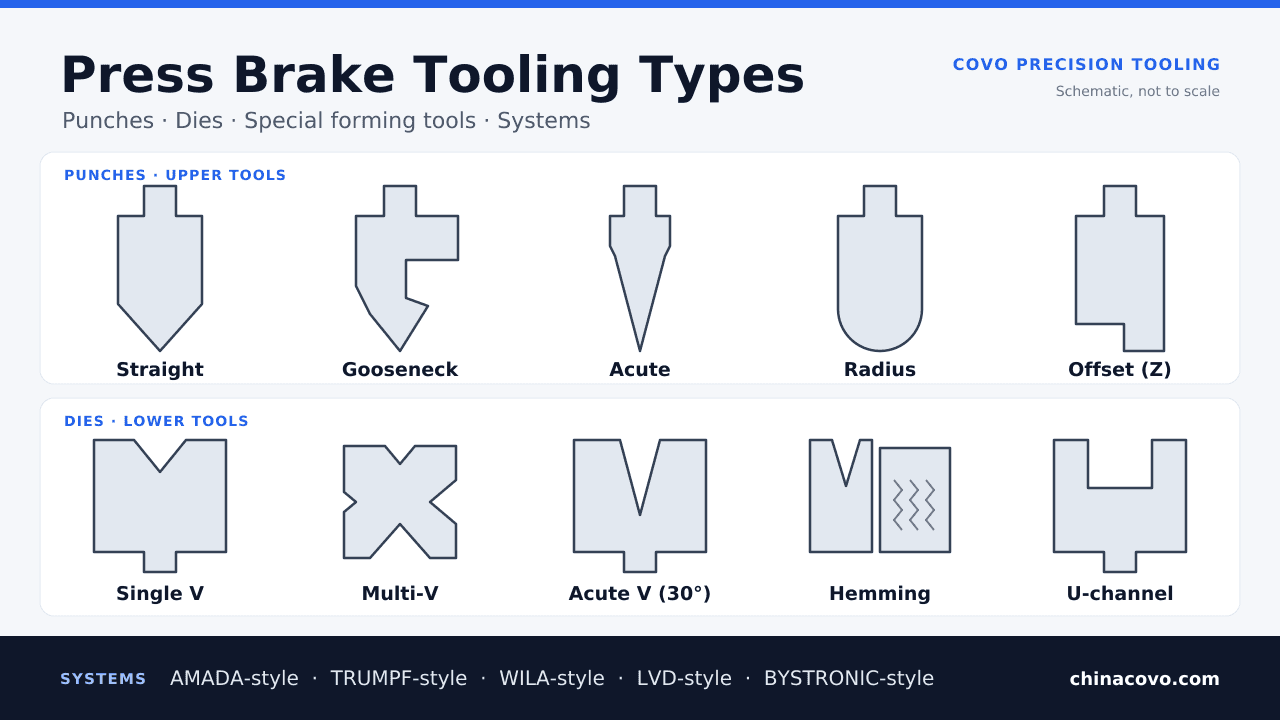
Direct answer: Press brake tooling falls into four groups: punches (upper tools), dies (lower tools), special forming tools that pair a punch and die for one profile, and the holders, clamps and adapters that mount them. Every tool has two separate specifications. The working profile (straight, gooseneck, acute, radius, single-V, multi-V and so on) shapes the bend. The system or style (AMADA-style, TRUMPF-style, WILA-style, LVD-style or BYSTRONIC-style) decides whether it fits the machine. In COVO's catalog snapshot of 517 load-rated tools, 203 are punches and 314 are dies.
This guide covers each type, what it is for and what to check, with figures from COVO's own catalog. Each section links to a detailed guide or the matching COVO product range.
Press brake tooling types at a glance
| Group | Type | What it does | Choose it for | COVO reference |
|---|---|---|---|---|
| Punch | Straight (standard) | General air bending with an 85°–90° tip | Open profiles without a tall return flange | Punch profiles |
| Punch | Gooseneck (swan neck) | Relief in the body clears a flange that is already formed | Boxes, trays and channels with return flanges | Punch profiles |
| Punch | Acute (sword) | Narrow 20°–35° tip for bends past 90° | Acute bends and the pre-bend before a hem | Acute V hook tool |
| Punch | Radius | Rounded nose that sets a larger inside radius | Large radii, crack-prone or visible parts | Radius tools |
| Punch | Offset (Z) | Stepped nose that forms two opposite bends | Joggles and offsets | Z-bending tools |
| Die | Single V | One V-opening on the die face | Most production bending | Die selection |
| Die | Multi-V | Two to four openings on one block | Frequent thickness changes on one machine | AMADA-style dies |
| Die | Acute V (30°) | Deep, narrow opening | Air bending through 90° toward acute angles | V-die opening |
| Die | 85°–88° V | Opening close to 90° | Bottoming a 90° bend | Air bending vs bottoming |
| Die | Hemming / flattening | Closes an edge that was pre-bent | Open and closed hems | Hemming tools |
| Die | U / channel | Forms a U section in one stroke | Repeat U channels | U-bending tools |
| Die | Adjustable | Variable V-opening | Thick plate and many thicknesses | Adjustable dies |
| Die | Mark-free / rotary | Protects the visible face | Stainless, aluminum and coated sheet | Mark-free dies |
| Special | Forming tools | Matched punch and die for one profile | Beads, louvers, hinges, multi-bend sections | Special tools |
| Holding | Holders, clamps, adapters | Mount and align the tools | Every setup | Clamping systems |
Two specifications for every tool: working profile and system
Most tooling mistakes come from mixing up two separate questions:
- Working profile: the tip angle, nose radius, body relief, V-opening and shoulder shape that touch the sheet. They decide the angle, radius, minimum flange, part clearance and bending force.
- System or style: the upper tang, seating shoulder, retention feature (safety groove, pin or click), lower base and installed height. They decide whether the tool fits the holder on your machine.
The same 85° straight profile can be made in several styles. Two tools that look identical at the tip can still refuse to seat in the same holder, so order the profile from the drawing and the system from the installed holder. The punch and die geometry guide covers the profile variables in detail.
Press brake punch types
In COVO's catalog snapshot, punch tip angles range from 20° to 86°. The most common, by number of punches, are 85° (36), 30° (24), 28° (20), 60° (17). Rated loads run from 120 to 1,600 kN/m, and a low rating is not limited to acute profiles: the 5 punches rated below 320 kN/m are 85°–86° AMADA-style and TRUMPF-style models. Check the rating of every punch against the job's line load (see the press brake tonnage guide).
Straight (standard) punch
The straight punch is the default upper tool for open profiles: a symmetrical body with a tip of about 85° to 90° and a small nose radius. It carries load well because the body is solid and centered over the tang. Choose it when no formed flange has to pass beside the punch.
Gooseneck (swan-neck) punch
A gooseneck punch has a recess cut into one side of the body, so a return flange formed in an earlier bend can sit inside it. It is the usual punch for boxes, trays and deep channels. The relief that makes room for the flange also removes material, so goosenecks are rated lower than a straight punch of the same height. Check the clearance against the bend sequence and the rated load before a heavy job.
Acute (sword) punch
An acute punch has a narrow tip, 20° to 35° in most of COVO's catalog, so it can drive the sheet past 90° into an acute angle. Paired with a 30° die, it also makes the pre-bend before a hem is flattened. Keep acute bends within the punch's rated load: a narrow tip concentrates the force.
Radius punch
A radius punch replaces the sharp tip with a rounded nose, so the inside radius follows the tool instead of the V-opening. Use it for large radii, for materials that crack at a tight radius, and for visible parts. COVO's catalog snapshot lists 34 load-rated radius punches; the radius tooling range lists the available radii.
Offset (Z) punch and matched offset tools
An offset punch has a stepped nose that forms two opposite bends, a joggle, in one stroke with a matched die. For repeat offsets, dedicated Z-bending tools or Z-bending holders with changeable inserts set the step height and repeat it without a second setup.
Sectional punches and horns
Punches and dies are sold in full lengths or in sections that combine into the required length, sometimes with horned end sections for box corners. Sectional tooling is easier to handle and lets one set cover many bend lengths. See sectional press brake tooling.
Press brake die types
Of the 314 dies in COVO's snapshot, 225 have a single V-opening and 13 have two to four. The most common die angles, by number of dies, are 30° (103), 60° (40), 85° (28), 78° (27).
Single V-die
A single V-die has one opening on its working face and suits most production bending. In air bending the opening sets the force, the inside radius and the shortest flange you can bend. A common starting point for mild steel is a V about 8 times the thickness; the V-opening calculator gives the planning range, and the die selection guide goes from thickness to tool.
Multi-V die
A multi-V die puts two to four openings on one block. The operator changes the opening by turning or repositioning the block instead of changing dies when the thickness changes. In COVO's snapshot all 13 multi-V dies are AMADA-style, with two to four openings each. Check that the opening in use is centered under the punch and that its rated load covers the job.
Acute 30° die and 85°–88° dies
The die angle limits how far the sheet can be bent. A 30° die lets an acute punch take the sheet through 90° toward acute angles, so one die covers a wide range of air-bent angles. It is the most common die angle in COVO's catalog: 103 of 314 dies. An 85°–88° die is used to bottom a 90° bend, pressing the sheet against both die faces for a repeatable angle at a higher force (see air bending vs bottoming). In both cases the punch angle must be the same as or smaller than the angle you form.
Hemming and flattening dies
A hem is made in two steps: an acute pre-bend, then flattening. Hemming dies combine a V for the pre-bend with a flat or spring-loaded pad for the flattening stroke, so both happen without changing tools. See press brake hemming tools, the spring-loaded hemming die and COVO's flattening tools.
Channel (U) dies
A channel die and its matched punch form a U section in one stroke instead of two or more bends. They pay off on repeat parts with a fixed width and depth. See U-bend tools and the six-bend hat channel die.
Adjustable dies
An adjustable die changes its V-opening by moving its shoulders. One die then covers thick plate across many thicknesses without heavy changeovers. COVO's 5 adjustable dies span V 25–400 mm, rated 1,250–6,000 kN/m (adjustable dies).
Mark-free and rotary dies
Visible stainless, aluminum and coated parts can be marked by the sheet sliding over steel die shoulders. Mark-free dies prevent this with protective contact surfaces or rotating supports. COVO's snapshot lists 29 load-rated mark-free dies with V 5.6–85 mm (mark-free range). See also oscillating dies and die selection for aluminum.
Special forming tools
When a part needs a shape that standard punches and dies cannot form reliably, a matched special tool forms it in one setup. COVO's special tool families:
| Tool family | What it forms |
|---|---|
| Flattening tools | Close a pre-bent edge into a hem |
| U-bending tools | Form a U channel in one stroke |
| U-bending with movable strips | U profiles whose width or release needs moving strips |
| Z-bending tools | Two opposite bends (an offset or joggle) in one stroke |
| Hinge tools | Curl a sheet edge into a round eye |
| Beading tools | Press stiffening beads |
| Long beading tools | Beads that run along the bend length |
| Louver tools | Lance and form louvers for ventilation |
| Trapezoidal bending tools | Trapezoidal sections |
| Radius embossing tools | Embossed radius features |
| Two-station tools | Two forming steps in one tool setup |
Special tools are designed from the finished section, the material and the machine interface, and reviewed as a 2D drawing or a 3D model before they are made. See special press brake tools and louver tools.
Tooling systems and styles
A tooling system or style is the mounting family: how the punch hangs in the upper clamp and how the die sits in the lower holder. COVO makes tooling in five styles. Each row below is based on the COVO catalog (load figures from the 2026-10-28 snapshot; system-page product counts on 2026-11-06):
| System style | Products on system page | Load-rated punches | Load-rated dies | Multi-V dies | Punch tip angles | Die V-openings (mm) | Rated load (kN/m) |
|---|---|---|---|---|---|---|---|
| AMADA-style | 195 | 70 | 108 | 13 | 24°–85° | 4–200 | 120–2,000 |
| TRUMPF-style | 100 | 33 | 65 | 0 | 20°–86° | 4–100 | 150–1,500 |
| WILA-style | 79 | 22 | 39 | 0 | 28°–86° | — | 400–1,600 |
| LVD-style | 95 | 15 | 54 | 0 | 26°–78° | 6–120 | 210–3,400 |
| BYSTRONIC-style | 45 | 20 | 14 | 0 | 30°–85° | 6–60 | 350–1,600 |
— = die openings not recorded in the load snapshot for that family.
Beyond these five styles, the snapshot also lists 9 multi-system punches. The radius, mark-free and adjustable ranges above are listed by function rather than by style. The full load data, grouped by V-opening, is in press brake die load ratings.
What a system name does and does not tell you
A style name is a purchasing shortcut, not a drawing. It does not define every dimension of the tang, seating shoulder, retention feature, lower base or installed height. Holder series within one machine brand can differ, and a retrofit clamp changes the interface completely. Before ordering, record:
- The installed holder: maker and model of the upper clamp and the lower holder, separately from the machine model.
- The upper interface: tang section, seating shoulder and retention feature, from a referenced drawing.
- The lower interface: die base, locating seat and support.
- The installed height: punch, die, holders and any adapter as one stack, checked against the machine's open height and stroke.
- The section lengths: the sections you will keep and the new ones you need.
Two naming habits cause most mix-ups. AMADA-style tooling is often called “European” or “Promecam” style, but the holder series still has to be identified (see AMADA-style interface checks). TRUMPF-style and WILA-style tools are often grouped together, but COVO lists them as separate families because holders, retention and heights differ (see connecting tooling to a WILA clamping system). American-style tooling, common in North America, is a separate family again and is not one of the five styles in this snapshot. Comparing tooling systems, clamping systems and adapters cover the interface side in more depth.
Standard vs precision-ground, materials and surface
- Precision-ground vs planed: grinding the working and locating faces makes sections interchangeable and repeatable, with less shimming and angle correction. Planed tooling costs less but varies more from section to section (is precision-ground tooling worth it?).
- Material and heat treatment: COVO product pages state the tool material, for example 42CrMo on the AMADA-style 11.831 and TRUMPF-style 15.38 punches. Hardness and allowable load belong on the approved drawing of the exact tool (material, heat treatment and inspection).
- Surface: where a face must stay unmarked, choose a mark-free die rather than polishing a standard one, and keep tools clean between jobs (tooling maintenance).
How to choose the right type
- Start from the part drawing. Note angle, inside radius, flange lengths, return flanges and visible faces.
- Pick the punch profile. Straight for open profiles, gooseneck for return flanges, acute for bends past 90° and hems, radius for large radii.
- Size the V-opening. Use the V-opening calculator, then check the result with the minimum flange length and air bending radius calculators.
- Check the load. Estimate force with the bending force calculator, divide by bend length and compare the line load with the punch, die and holder ratings.
- Match the system. Confirm the upper and lower interfaces and the installed height against the holder on your machine.
- Decide on length and surface. Choose sections or full length, horns, and mark-free contact where needed.
The tooling selection guide and the video guide to choosing punches and dies work through these steps with examples.
FAQ
What are the main types of press brake tooling?
There are four groups. Punches (upper tools) include straight, gooseneck, acute, radius and offset profiles. Dies (lower tools) include single-V, multi-V, acute 30°, 85°–88°, hemming, channel, adjustable and mark-free types. Special forming tools pair a punch and die for one profile. Holders, clamps and adapters mount them on the machine.
What is the difference between a press brake punch and a die?
The punch is the upper tool, clamped to the ram; its tip pushes the sheet into the die and sets the inside shape of the bend. The die is the lower tool on the bed; its V-opening supports the sheet on two shoulders and largely decides the bending force and the inside radius in air bending.
When do you need a gooseneck punch?
When a flange that is already bent would hit a straight punch on the next stroke. The gooseneck's relieved body gives the return flange room, which makes it the usual choice for boxes, trays and deep channels. The relief also makes it weaker, so check its rated load in kN/m before a heavy bend.
Which die angle should I choose, 30° or 85°?
For air bending, a 30° die lets the punch take the sheet through 90° toward acute angles, so one die covers many angles; it is the most common die angle in COVO's catalog (103 of 314 dies). An 85°–88° die is used to bottom a 90° bend. The punch angle must be the same or smaller than the angle you form.
What is a multi-V die?
A single die block with two to four V-openings, so the operator turns or repositions the block instead of changing dies when the thickness changes. In COVO's catalog snapshot, 13 dies carry two to four openings. Check that the opening you use is centered under the punch and rated for the load.
Are AMADA, TRUMPF and WILA press brake tools interchangeable?
Not by default. The same working profile can be made in several styles, but the tang, seating surface, retention feature, lower base and installed height differ between tooling families and even between holder series. Match the tool to the holder actually installed, not to the machine badge, and use a documented adapter only when the whole stack is approved.
What is the difference between standard and precision-ground press brake tooling?
Precision-ground tools have their working and locating faces ground to tight tolerances, so sections can be swapped and combined with less shimming and angle correction. Planed or standard tooling costs less but is less consistent from section to section. Ground, sectional tooling suits frequent changeovers and short runs.
When do you need special press brake tooling?
When a standard punch-and-die combination cannot give the required profile, clearance, part release, surface condition or number of operations, for example beads, louvers, hinges, one-stroke U or Z sections. A special tool is designed from the finished section, the material and the machine interface, and reviewed in 2D or 3D before it is made.
Next steps with COVO
COVO Precision Tooling is the tooling brand of Nanjing Kovo Intelligent Equipment Co., Ltd., based in Nanjing, China. It makes standard and custom press brake punches and dies in AMADA-style, TRUMPF-style, WILA-style, LVD-style and BYSTRONIC-style systems, plus radius, mark-free, adjustable and special forming tools. Browse the catalog by system, or send the part drawing, material, thickness, bend length and machine and holder details for a matched punch and die proposal.
Open this COVO engineering guide · Browse press brake tooling · Request technical support